Don’t let Melissa take your land!
The court’s role in resolving boundary disputes resulting from the storm
IF Hurricane Melissa destroyed or even shifted your fence or property boundary, there are a number of factors to consider before you do repairs. One of them is ensuring that you keep what’s yours.
Attorney-at-law Davion Vassell cautions that when reconstruction of boundary fences begins, some individuals may attempt to encroach on neighbouring lands in an effort to gain additional property.
“We have seen this in certain circumstances. Some people are honest enough to know that the boundary is at a particular place, and there are others who believe that the boundary is to be drawn at a different location, further up or further down, where they are the recipient of another piece of land,” Vassell stated.
He was speaking recently during the Ministry of Justice and Constitutional Affairs’ online forum for
Justices of the Peace.
Vassell explained that where disputes arise between two properties regarding the placement of a fence or boundary, the matter falls under Section 97 of the Judicature Parish Court Act.
“Section 97 speaks to the power of the parish court judge to settle disputes as it relates to properties. If you are the owner of a piece of land and, for whatever reason, you realise that there is an issue regarding where the boundary should properly be, you, as a plaintiff, can lodge a plaint [a formal statement of grievance or complaint] at the parish court. This plaint would speak to the regulation of the boundary,” he stated.
“Once this is filed, there is a requirement that this… plaint is served upon your neighbour. Once a neighbour is served to the satisfaction of the court, upon proof of service of the plaint, if the neighbour fails to attend the court, the court will hear your dispute in the absence of your neighbour — once the court is satisfied that your neighbour is properly served of notice of the plaint,” the attorney further explained.
Vassell noted that under such circumstances the court may order a commissioned land surveyor to survey the property in order to determine its true boundary.
“Instead of… resorting to violence it’s always best to seek the intervention of the court to have this matter rectified. If it’s a case where you’re not the owner but a beneficiary, once you can show the beneficial ownership, the court may actually grant you audience as well, depending on the circumstances. But usually it is something that the property owner can pursue,” he said.
Hurricane Melissa was a Category 5 system with 185-mile-per-hour winds, and a lot of fences — if they were not constructed by block and steel — were displaced by the sheer force and strength of the cyclone.
“When we are in a situation like this where natural disasters happen, the fence is gone… who reconstructs the fence? There is a requirement whereby, once it is that you own land with your neighbour the Dividing Fences Act comes into play — because once there’s no boundary or fence there’s a requirement under law that the parties share the cost to construct the fence,” Vassell explained.
“In constructing the fence the parties should ensure that the fence is strong enough, high enough, and suitable to prevent the crossing of animals for the purposes of certain lands. So the fence can be constructed from wood, zinc, whatever it is, as long as it is suitable enough for the purposes of properly delineating the boundary. This cost is shared by the owners of the property,” he added.
Vassell stated that if one property owner wishes to construct a fence and the neighbour refuses to contribute his or her share of the cost, the matter may require court intervention.
“You can make an application, bring the matter before the court, and your neighbour will have to compensate you for half the cost of constructing that fence. Now, what if a neighbour builds a fence that you consider the cost to do so was excessive? The court will do what is called an assessment of said fence,” he further indicated.
“If it’s a case where you may have some overly zealous neighbour who wants to build a fence at a certain height, use certain premium quality materials… that may be outside of your costs, outside of your budget… the court will do an assessment to see what an appropriate fence would be for the purpose of properly dividing the property, and will ask that you pay half of that once the assessment is done,” the attorney explained.
In rural areas, some properties may not have fences but are separated by trees. With the passage of the hurricane many of these boundaries could be lost, as trees were uprooted.
Vassell explained that the Dividing Fences Act would apply once a neighbour considers it necessary to construct a fence.
“If you and I are neighbours and we are satisfied with a tree or whatever is there to properly demarcate or delineate our boundaries, then there’s no issue. But once it is you believe that it is necessary for the property to be fenced, then that’s where the court intervention may become necessary,” he said.
“For example, I may have livestock, you may have produce on your land. You may be farming lettuce, and I have cows on my land. You realise that while it is that I may not want my land to be fenced, the fact that you have lettuce and the cows may come over to eat your lettuce, you may want a fence. But if we are both farming vegetables on our lands and there’s no animal to trespass to cause damage, then the tree may very well serve the purpose of properly delineating the boundary,” Vassell added.
Hurricane Melissa damaged 156,000 dwellings across the parishes of St Elizabeth, Westmoreland, Manchester, St James, Trelawny, and Hanover, with 24,000 recorded as total losses.
– JIS News
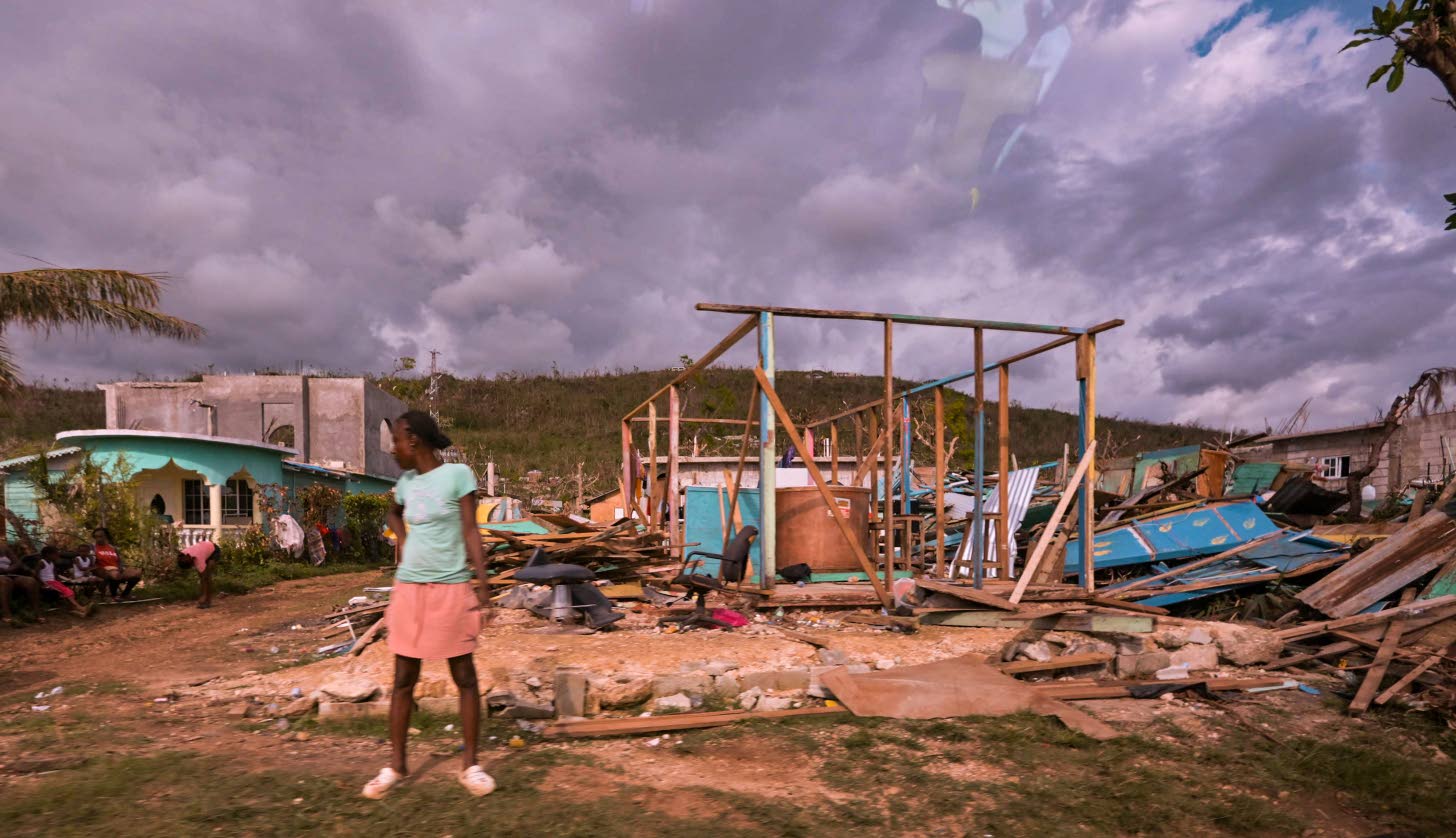
Property in Westmoreland destroyed by Category 5 Hurricane Melissa on October 28.Photo: YHOMO HUTCHINSON