



Tropical Sugar backs US$2.5-m mangrove rescue
TROPICAL Sugar Company Jamaica Limited executive Dr Horace Charoo says the entity — which on Tuesday broke ground for a US$50-million sugar processing plant in Monymusk, Clarendon — is prepared to throw its weight behind the US$2.5-million Mangrove Restoration Project now being led by scientists at The University of the West Indies (The UWI), Mona.
“We are prepared, as a new investor, to work with UWI-SODECO under Professor Terrence Forrester to do as best as we can because this restoration is in our mutual interest,” Charoo told the Jamaica Observer last Tuesday, following the ground-breaking.
“We are investors in the area and it’s a matter of protecting our investment so we are not just doing it for social or PR [public relation]; it’s for mutual interest and we are prepared to work with Professor Forrester to realise it. We want this area to be restored as far as possible,” Charoo said.
Mangroves are tropical trees that grow in mud, mostly on the coast, and which have roots that are above ground. They help protect populated areas by reducing erosion and absorbing storm surge impacts during extreme weather events such as hurricanes.
The SODECO (Solutions for Developing Countries) experts, led by Forrester since 2023, have been engaged in a US$2.5-million mangrove restoration project, in partnership with Sugar Company of Jamaica Holdings Limited and several other agencies.
On Tuesday, Charoo said the importance of that work was not lost on Tropical Sugar, especially given the disaster wreaked on the island’s south-western coasts by Hurricane Melissa, which touched down in New Hope, Westmoreland, on October 28, packing winds of 185 miles per hour.
“If the storm had gone north earlier [than it did], Rocky Point and Portland Cottage would suffer tremendous tidal movement and high waves up to 20 feet. We wouldn’t have a Rocky Point today. You see what happened at Parottee (Black River, St Elizabeth) and Whitehouse (Westmoreland), that would have happened here. We are lucky, by God’s grace, that that thing continued down west,” Charoo argued.
“We are not sitting down on our laurels, we are going to work with Professor Forrester. He has international support and we, as a newcomer, are gung-ho, it’s not lip service. We are prepared, as the chairman said, as soon as we start making a profit, to put 10 per cent of our earnings back into the community. And this is no bag a mouth talk,” he told the Observer.
In 2023 SODECO — in unveiling the Mangrove Restoration Project at a Jamaica Observer Press Club staged in collaboration with the Ministry of Economic Growth and Job Creation at Halse Hall Great House in Clarendon — said about 45 per cent of the mangroves between Milk River and Salt River in Clarendon had died because of a combination of factors, including extreme weather events, and human activity such as the construction of infrastructure including roads, as well as the cutting down of the trees for economic purposes. It said the solution was to reverse the damage by taking a strategic and systematic scientific approach to successfully regenerating the area.
“We, as a newcomer, support [the project]. We need to replant that mangrove as of yesterday. Time is not on our side, you see what is happening with climate change and the weather patterns nowadays? Whether you believe it or not, it will happen, so we want to be in the best position to deal with any severe weather eventualities. As a businessman we want to protect our investment,” an avid Charoo, who said his foreparents worked at different levels in the sugar industry while he has been involved in the industry for 62 years, told the Observer.
Charoo, who is one of the two local investors in the Tropical Sugar venture, was upbeat about the implications of the investment for the parish.
“We want to restore this area. In the 1960s Lionel Town had three commercial banks — Workers Bank, Scotia Bank and Barclays. Now, all we have is an ATM; that tells the story,” he said while disclosing that financial house Jamaica Money Market Brokers will be the first bank to return to Lionel Town, based on discussions now in train.
Meanwhile, Prime Minister Dr Andrew Holness in delivering the keynote address during the function on Tuesday, highlighted the work done by SODECO while emphasising that it will be necessary to use some of the unutilised lands in the area for climate resilience.
“Professor Terrence Forrester, very good job in the restoration of our coastal mangroves; that will be very important to us should another disaster strike in this area. That is our natural coastal protection,” the prime minister said.
In pointing out that much of the mangroves have been destroyed, partly due to ignorance about their purpose, Holness said, “It’s just a real tragedy, but I do take this opportunity to appeal to every citizen here and everyone who use our coastal assets that God put it there for a purpose, and the purpose is to protect our land and to prevent the saline intrusion which destroys our land, but more than that, prevents the sea from coming onto the land and taking away the land”.
“So I beg you, it is your duty to protect those mangroves and not destroy them, and they are also very good nurseries as well; so I make the appeal,” Holness said.
According to SODECO experts, healthy mangroves mean more fish and shellfish for local consumption as well as improved ecosystem services, flood regulation and mitigation, carbon sequestration, and increased coastal protection from hurricanes and storm surges. Mangroves are also nurseries for fish and protect them from predators.
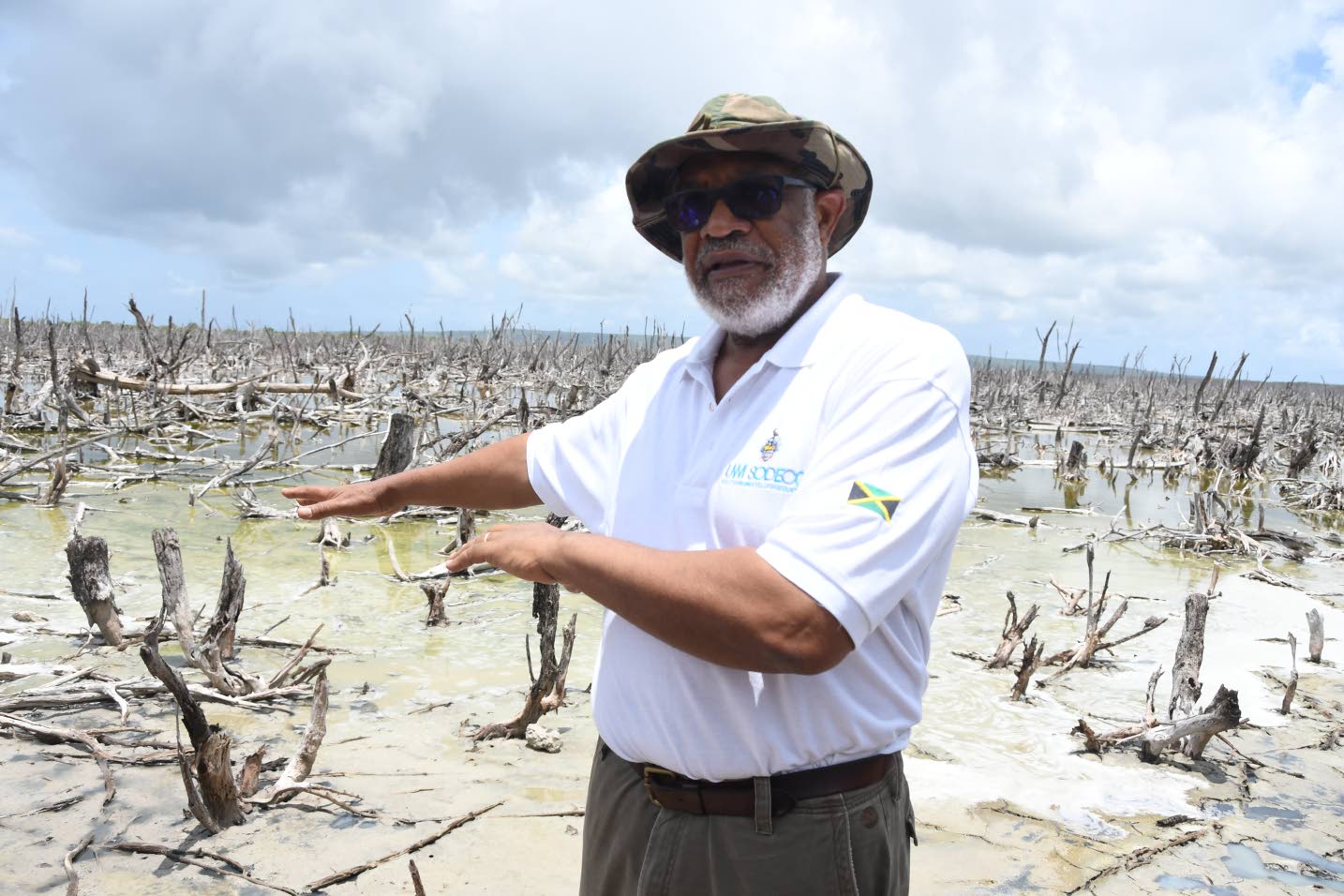
The University of the West Indies’ Solutions for Developing Countries chief scientist Professor Terrence Forrester points to damaged mangrove during a Jamaica Observer Press Club staged in 2023 in collaboration with the Ministry of Economic Growth and Job Creation at Halse Hall Great House in Clarendon during which the Mangrove Restoration Project was unveiled. (Photo: Garfield Robinson)


