



Funding fiction
School leaders question CAPRI’s conclusion that Jamaica spends enough on education
EDUCATION leaders have mounted a forceful challenge to findings in the Caribbean Policy Research Institute’s (CAPRI) recent Education Report Card, arguing that claims Jamaica spends adequately on education paint a misleading picture of the sector’s financing.
They contend that while the country meets international benchmarks as a share of gross domestic product (GDP), actual spending per student remains among the lowest in the Caribbean, leaving schools struggling with resource shortages, infrastructural gaps, and unequal learning conditions.
The criticism emerged during the Jamaica Teachers’ Association’s (JTA) Go Public! Fund Education national forum on Monday, at whichschool leaders argued that the country’s education funding debate has become overly focused on percentages and not enough on what is actually being spent to educate each child.
Among the most outspoken critics was principal of William Knibb Memorial High School and immediate past president of the Jamaica Association of Principals of Secondary Schools Linvern Wright.
He said policymakers and researchers were relying on a flawed metric when they point to education spending as a percentage of GDP.
“But just quickly to point out to you the fallacy of speaking to GDP per capita. If you look at what the insight says there, a country spending six per cent of GDP on education may still live off fewer dollars per child than a wealthier nation spending only four per cent,” Wright said.
“So our minister of finance says it, CAPRI says it, many, many people say it, and I’m very disappointed in CAPRI. You don’t understand how disappointed I am, because I think they have the comparative data to do this kind of work for us to understand that it is not percentage, but per capita, and it is how much we spend per child that’s the important thing,” he said.
The CAPRI report, released in September 2025, awarded Jamaica a B grade for financing and concluded that education spending meets international benchmarks, while raising concerns about inefficiencies in resource allocation and warning that existing funding formulae may reinforce inequalities between schools.
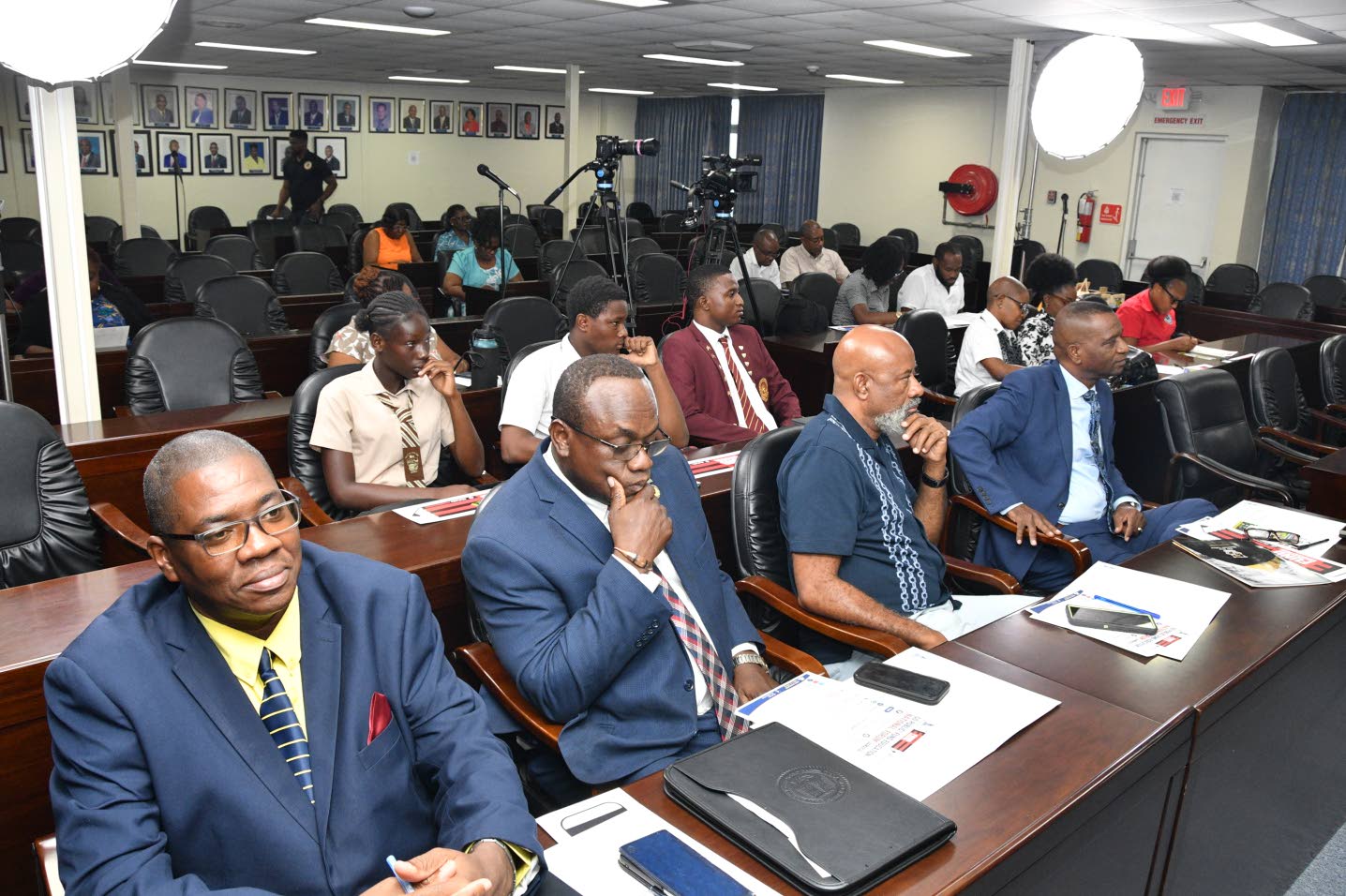
From left: Lieutenant Colonel Paul Scott, president of the Jamaica Association of Principals of Infant and Primary Schools; Dr Philmore McCarthy, principal of Excelsior Community College; Stewart Jacobs, president of the National Parent-Teacher Association of Jamaica; and Dr Asburn Pinnock, president of the Mico University College at the Jamaica Teachers’ Association’s Go Public! Fund Education national forum on Monday. (Photo: Joseph Wellington)
Wright, however, argued that the report’s conclusions fail to account for the realities facing Jamaican schools.
Drawing comparisons with other Caribbean countries, he said Jamaica spends significantly less per student than several regional neighbours despite allocating a similar share of GDP to education.
“So Jamaica spends 5.4 per cent of GDP. But it’s US$1,100 per child. Barbados spends 6.7 per cent, just about comparable, but it’s US$4,200 per child. Barbados’s literacy is about 99 per cent, Jamaica’s is about 89, and 89 per cent literacy is not something to write home about. In fact, of the countries that we have there, Dominican Republic, Trinidad, Barbados, we’re at the lowest in terms of per-student spending,” he said.
Wright also argued that education has not received the same level of long-term investment as other national priorities.
“If you look at how we have spent on security in Jamaica, look at what has happened for policing and security — most of our police stations have been redone, we have given the police more in terms of ammunition, we’ve given them more and we are celebrating a reduction crime. In the same period that we had that kind of spending for security, the capital spending for education was less and there was a feeling that education ought to have done better given what we got, but the capital spending is really a value-added spending, and if it is that you don’t add value in terms of investment, you’re going to have a problem,” he said.
The issue was echoed by JTA President Mark Malabver, who said discussions about education financing must begin with determining the actual cost of educating a child in Jamaica rather than relying on broad international comparisons.
“You have to interrogate it, because what they are doing is comparing percentage of GDP to that of the developed countries like Finland and Singapore, but here is the reality: When you break it down in terms of unit cost per education, it’s essentially comparing apples to oranges. Now, in Jamaica, the spend in terms of unit cost per education is somewhere around $300,000. The unit cost per education in Finland, for example, is in excess of $1.7 million, [and] that’s a sobering reality that we have,” Malabver expressed.


