


Seeds of second chances
Women farmers turn losses into learning, stronger livelihoods
IN Kitson Town, St Catherine, a quiet but powerful transformation is under way. For many farmers, youth, and community members, learning is no longer abstract — it is practical, hands-on, and rooted in daily survival.
Through the Improving Rural Livelihoods Through Resilient Agrifood Systems Project — a United Nations South–South Cooperation initiative implemented by the Food and Agriculture Organization of the United Nations (FAO) in collaboration with the Government of Jamaica and funded by the India–UN Development Partnership Fund — residents are gaining the skills, tools, and confidence to rebuild livelihoods in the face of climate uncertainty.
According to the FAO, more than 200 participants have completed training under the project, with nearly 60 per cent of them women. With the United Nations, led by FAO, declaring 2026 as the International Year of the Woman Farmer, the experiences emerging from Kitson Town reflect why this global observance matters. Women in Kitson Town are not only producing food, they are learning, leading, and reshaping local agrifood systems.
For pig farmer Nadia McKenzie, the training marked a turning point. Before joining the programme, she recalls struggling with losses and limited knowledge of proper animal care.
“I was in the pig area before, but I didn’t know how to care for them. I have lost a lot,” she shared. “Being in the pig programme has helped me to move forward, to know what to do when it comes to caring for pigs, how to prepare the sow for birth. I didn’t know I was supposed to use gloves, scissors, and other tools.”
Her experience is echoed by other women in the pig training cohort, who described learning essential practices around feeding, hygiene, water treatment, and animal welfare — details that make the difference between loss and productivity. As one participant noted, understanding that pigs do not sweat and must be cooled properly during the day was new knowledge that immediately improved animal health.
These changes speak directly to “better production”, one of FAO’s global Four Betters framework. In the St Catherine community, better production has meant adopting climate-resilient livestock practices, improved housing, structured feeding, and safer birthing procedures — all of which strengthen productivity while reducing losses.
But production is only one part of the story. The project has also advanced “better nutrition”, through training in food safety, hygiene, and the handling of livestock products, helping ensure that locally produced food is safer and more reliable for households and markets alike.
For Sharon Hamilton, also part of the pig training, learning about water treatment and animal cooling practices was eye-opening.
“You have running water to give them. You know how to treat your water to give them,” she explained, noting how these practices directly affect animal health and food quality.
Environmental resilience is another cornerstone of the project’s design, the FAO said. Through the promotion of climate-smart technologies, including improved animal housing, protected agriculture systems, solar energy basics, and water management, the programme reflects “better environment” in action. Participants are not only responding to climate shocks but actively reducing their vulnerability to them.
This approach proved critical in the aftermath of Hurricane Melissa, when resilient animal housing and recommended practices helped limit damage and safeguard livestock assets in the community.
Beyond individual farming practices, FAO said the project has invested heavily in training of trainers, ensuring that knowledge remains embedded within Kitson Town long after the project concludes.
Shahera Brown-Lawrence, a participant in the training of trainers programme, described her commitment to passing knowledge forward, particularly to young people.
“I’ve decided to use it wisely, educating youngsters, getting them involved in projects like this — food and agriculture —
so they won’t get left out or feel frustrated,” she said.
This multiplier effect is central to the project’s long-term vision. Teachers, extension personnel, and farmer leaders were trained alongside producers, creating a local network capable of sustaining progress, FAO said.
At its core, the project reflects FAO’s approach to sustainable rural development, it continued, which goes beyond infrastructure and inputs to place people at the centre of lasting change. And, ultimately, all these efforts contribute to a “better life”, stronger livelihoods, increased income opportunities, and a renewed sense of possibility for families and the wider Kitson Town community.
“When women farmers are equipped with skills, resources, and networks, local economies grow stronger, communities become more resilient, and development outcomes are more sustainable,” said Dr Ana Touza, FAO representative for Jamaica, The Bahamas, and Belize.
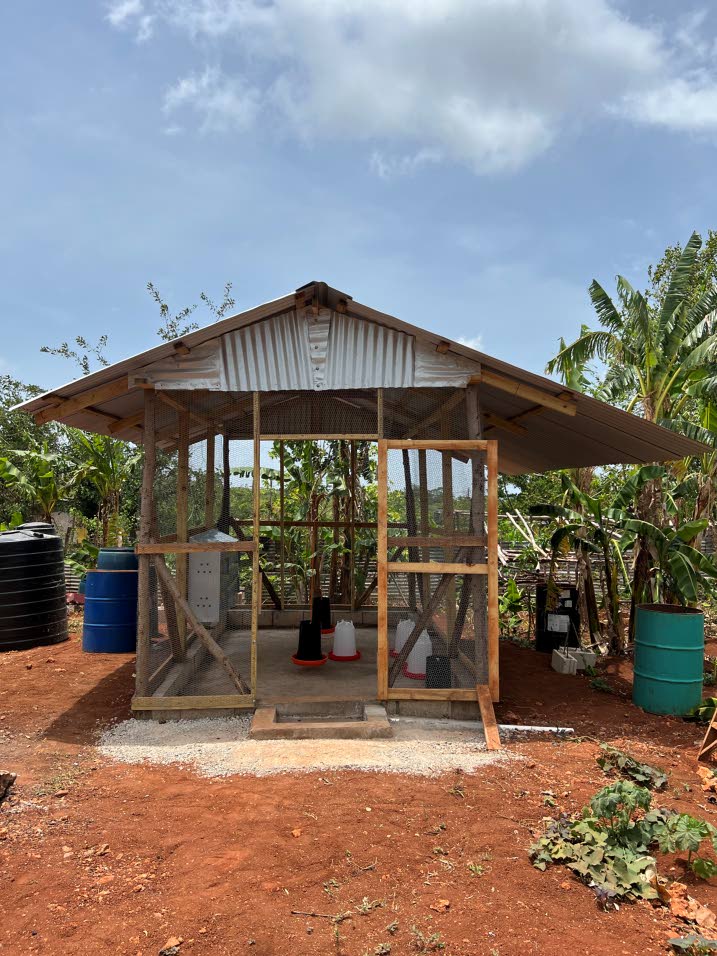
Poultry demo house constructed by participants in the training.Photo: FAO

