Jamaica’s coercion politics weakening, says researcher
DIRECTOR of research at the Caribbean Policy Research Institute (Capri) Dr Diana Thorburn is challenging the widely believed view that lower voter turnout in an election signals democratic weakness, arguing instead that Jamaica’s shrinking participation at the polls reflects an evolving and improving democracy.
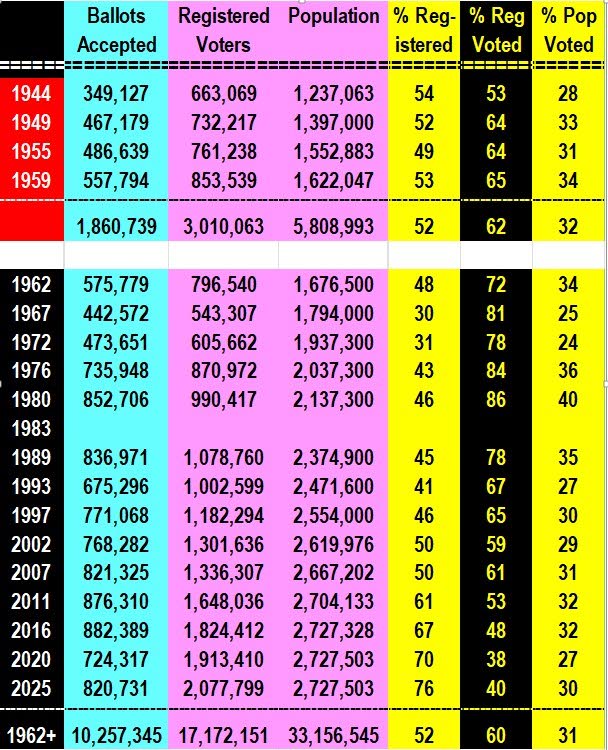
Pointing to the results of the 2025 General Election, which the Electoral Office of Jamaica (EOJ) said saw a voter turnout of 39.5 per cent, the Capri director noted that the outcome does not only highlight shifting political engagement but also calls for a fresh examination of the 2020 General Election, for which the voter turnout was widely regarded as an anomaly due to the COVID-19 pandemic.
The voter turnout in the 2025 General Election marks only a slight increase from the historic low of 37.9 per cent in 2020, but it remains far below the record high 78.4 per cent turnout in 1980.
“I think people who would have predicted a higher voter turnout [in the 2025 General Election], and that would have been people who would have concluded that the low turnout in 2020 was because of the pandemic — which this low turnout [in the 2025 General Election] has shown it wasn’t the pandemic — it would indicate…that our electoral system is changing, our political system is changing, and it’s changing for the better.
“…Lower voter turnout, in our case, right now at our moment in history, is a sign of a stronger democracy because people are not forced to vote; the politics of coercion and clientelism are weakening and so people who come out to vote are voting out of their own free will, and they’re voting based on what they want to vote on, not because they have to vote for survival,” said Thorburn.
She told the Jamaica Observer that clientelism is a style of politics in which politicians give people jobs, money, or favours in exchange for their votes or loyalty. She said the lower voter turnout indicates that Jamaicans’ codependency on politicians is dwindling, with voters looking more towards policies and demanding accountability instead of handouts.
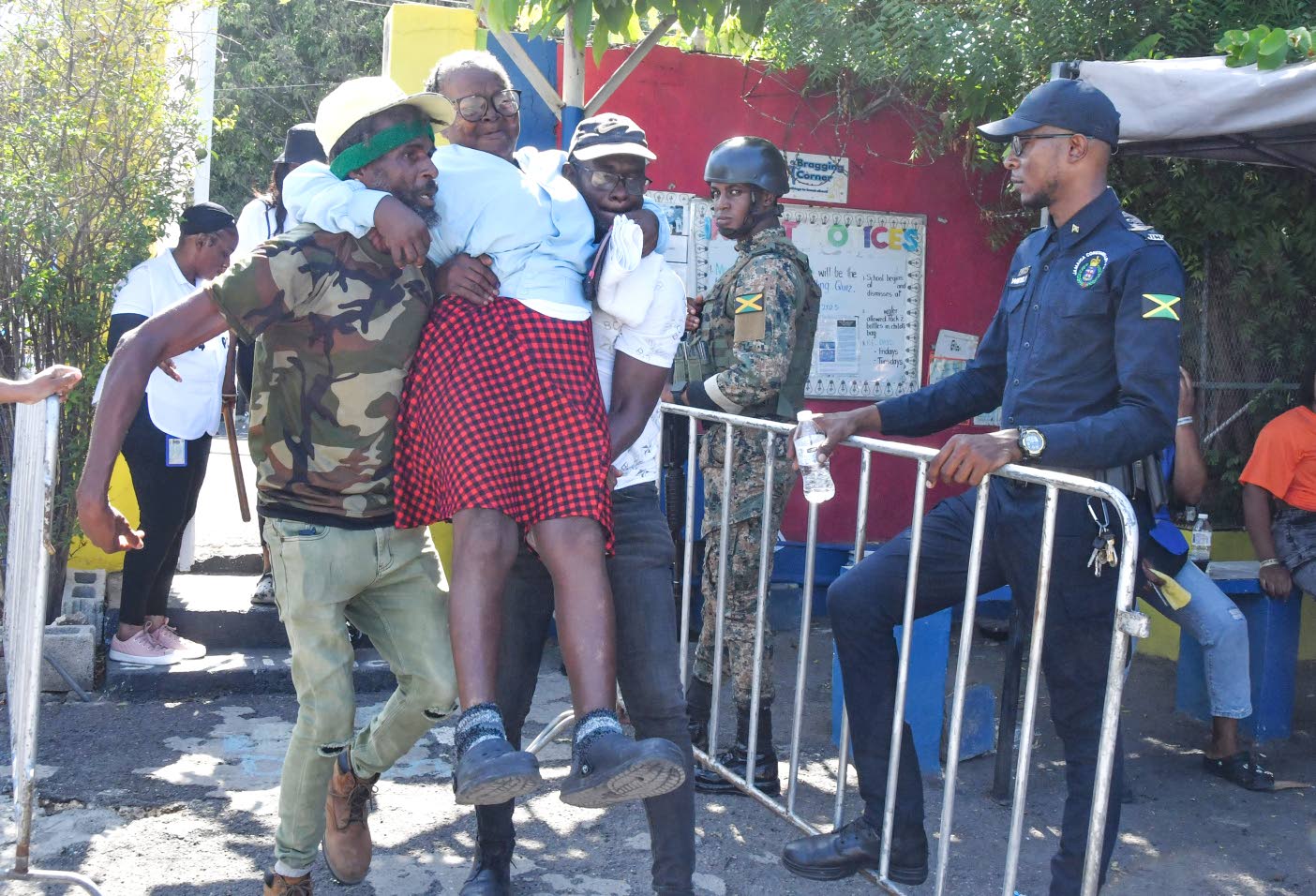
An elderly woman is assisted to a polling station at Seaward Primary & Junior High in St Andrew West Central on election day, Wednesday, September 3, 2025. (Photo: Naphtali Junior)
Thorburn shared that she has received pushback from those who believe that her hypothesis is incorrect, and they have argued that Jamaica’s flawed and bloated voters’ list must be considered when assessing turnout. However, she noted that the state of the voters’ list has no merit in her argument.
“No matter how you look at the voters’ list, or how you measure it, or how you measure turnout, turnout has been declining steadily over the years. I think the only year that it went up would have been 2007, in terms of turnout. The argument is that we are witnessing and experiencing lower voter turnout because the traditional push to vote, which, from the 70s has been coercion and compulsion of people in garrison or garrison-type communities, is weakening as time has gone on.
“If you look at the weakening of that style of politics and that system of politics, it is weakening in tandem with turnout, and that makes perfect sense because that system coerced people to vote. People had to vote. If you lived in a certain community, you had to vote. Your being able to live in that community depended on it; your access to services depended on it,” she told the Sunday Observer.
When asked about allegations of vote buying in recent elections, Thorburn said such practices, while troubling, actually support her thesis.
“It’s a very different thing for someone to buy your vote than to force you to vote, and, in fact, if there is an increase in vote buying, it would confirm the hypothesis that you can’t force people to vote anymore, so you have to pay them to vote or you have to buy their vote. In days gone by, you just put somebody outside somebody’s door. You didn’t even have to put somebody outside somebody’s door, they knew they had to come out to vote in certain communities; that was a fact of life,” she reasoned.
She further posited that while the 2020 General Election has widely been considered an anomaly, the slight increase in the voter turnout, in comparison to the large turnout expected, means that election requires a second look.
“I long suspected that the idea that 2020 is an anomaly, because of the pandemic, that it never really added up to me; because I was like, ‘But why is it such an anomaly? Why would the Jamaica Labour Party (JLP) have come out so strongly and the People’s National Party (PNP) not?’ Perhaps, and this is just speculating, because as I said, I think it’s something that we all have to look into more deeply now that we have this turnout to compare it to, it may be that because of the pandemic, the PNP had less patronage to disperse and so they were not able to get people to come out,” said Thorburn.
“Whereas, because of the nature of the pandemic, the Government was giving welfare and State support to people during the pandemic. We might not call that patronage, but maybe they were doing more that people felt they needed to pay back for…I think we really have to have a better understanding now we know that we need to not just write off 2020 as an anomaly. We need to have a better understanding of what really went down,” she told the Sunday Observer.
The 2020 General Election delivered a landslide victory for the JLP, which secured 49 of the 63 parliamentary seats, leaving the PNP with just 14. In contrast, the 2025 election produced a much narrower outcome, with the JLP’s majority reduced to 35 seats, while the PNP nearly doubled its tally to 28.
Thorburn said while the PNP was able to gain 14 seats, and the JLP lost 14 seats, it could be due to the PNP’s extending support to its traditional supporters.
However, she noted that a closer look at the polling divisions’ demography, constituencies, the stronghold for either party, and the areas of mixed support is needed to truly evaluate the claim of an anomaly.