



Advocate wants sports added to human trafficking laws
GREEN ISLAND, Hanover — A proposal for the addition of a sports layer to existing human trafficking laws received support from one of the island’s top track and field coaches who also advocated that the issue be added to the curriculum at GC Foster College of Physical Education and Sport.
Diahann Gordon Harrison, the national rapporteur on trafficking in persons and children’s advocate, raised the matter at a forum titled ‘Unmasking the Game: A Look at Human Trafficking in Sports’ held at Princess Grand Jamaica Resort in Hanover last Thursday.
“What we are seeing is that because Jamaica has so many sporting activities that we are involved in, so many athletes, so many children who are waiting to become discovered as the next big thing… we’re saying that we need to be aware that there is something called sports trafficking to ensure that our children and young people don’t fall prey to it, because the risk factors are there for us as a country,” Gordon Harrison argued.
The Trafficking in Persons (Prevention, Suppression and Punishment) Act of 2007 is designed to combat human trafficking by providing measures for prevention, suppression, and punishment of the crime.
While the framework allows for anyone in Jamaica to be prosecuted for human trafficking if the evidence points in that direction, and to be held accountable, Thursday’s discussion by stakeholders was focused on building the definition for trafficking to have sports specifically mentioned.
“We want that recognition more for the victims’ protection and to have different associations and stakeholders understand that because it’s now a legislatively recognised form of trafficking, we now have to be proactive in our systems and safeguarding rules that we come up with and so on. So we’re more looking at it from the victims’ perspective and the preventative perspective,” Gordon Harrison told the Jamaica Observer on the sidelines of the forum.
Chief technical director in the Ministry of National Security with responsibility for law enforcement, Michael Morgan, agreed with Gordon Harrison and suggested that the legislation be looked at to determine if there is a gap and have it addressed.
“In that regard, sometimes you have to make exceptions and you might want to penalise something specifically because of the significance of it. That’s a conversation that we need to have and that’s a conversation that we’re going to have coming out [of Thursday’s event]. But with the framework as it is now, the definition of human trafficking is so broad that even if someone was trafficked for sports, that person could still be penalised under our existing legislative framework,” Morgan told the Sunday Observer.
Jamaica Track and Field Coaches Association President David Riley said he wants trafficking in sports added to the GC Foster College curriculum.
Currently, track and field coaches have to undergo level 1-3 certification. The course has a module called safeguarding, which speaks about abuse and misuse of sports.
“From my understanding of the definition of trafficking, there is no mention [in the module] of trafficking, and I think that would be one of the appropriate places within the curriculum where it could be included. So expanding the safeguarding to include elements of trafficking and the awareness of trafficking would be one of the fixes for the gap that exists within the certification system,” argued Riley.
He said that “in addition to certification, coaches would have to licence the practice and that would then form the basis for their licence to be renewed and for us to conform to the international standards, and based on whatever treaties we’ve signed… and so on. So it’s definitely an opportunity for us to make those changes”.
Gordon Harrison agreed.
“I think that is an excellent idea,” she said, adding that one of the stakeholders who had been invited to join the conversation was among the leadership of GC Foster College, because a lot of the island’s coaching professionals and other sports administrators attend the institution.
“From the onset, when this conversation was thought about and conceptualised, I said to my team we have to have GC Foster here. So I am very disappointed that we didn’t have them,” Gordon Harrison said, adding that her office will be reaching out again for a continued conversation on the topic.
In March this year, a comprehensive global thematic report on sports trafficking was released by Loughborough University in partnership with Mission 89 and the Commonwealth Parliamentary Association.
Described as a rigorous academic and policy-oriented analysis of human trafficking in the global sports ecosystem, the report details a comprehensive literature review, interdisciplinary expert consultations, forensic analysis of documented trafficking incidents, comparative international policy assessment, and contributions from global experts.
Its working definition of trafficking in sports describes it as “the act of recruiting, transporting, transferring, harbouring, or receiving an individual — typically an athlete or aspiring athlete — within or across borders, through coercive, deceptive, or other abusive means for the purpose of exploitation in, through, or around sports. Exploitation may manifest as forced labour, sexual exploitation, slavery, servitude within sport-related activities or events. In the case of children, no means need to be present”.
The report references data showing that “15,000 young players are trafficked yearly from West Africa with hopes of becoming professional footballers”.
It also said that “in 2023, 47 young players, including 36 minors from Africa, Asia, and South America believed to be victims of human trafficking from a football academy in Portugal, were rescued by local authorities”.
Additionally, the report stated that “during the 2017 Super Bowl, a nationwide sweep by the US police authorities, who defined this top sporting event as a ‘magnet for illicit sex’, resulted in about 750 arrests related to human trafficking activities, highlighting the intersection of major sporting events and increased trafficking vulnerabilities”.
Experts say there are currently three categories of exploitation having to do with sports: Trafficking in sports — the act of luring somebody who has talent and making fake promises to them; trafficking through sports, where the fame of sports is used to exploit others; and trafficking around sports, under which people in communities may be sexually exploited with promises of living overseas by someone who visits an island for a mega sporting competition.
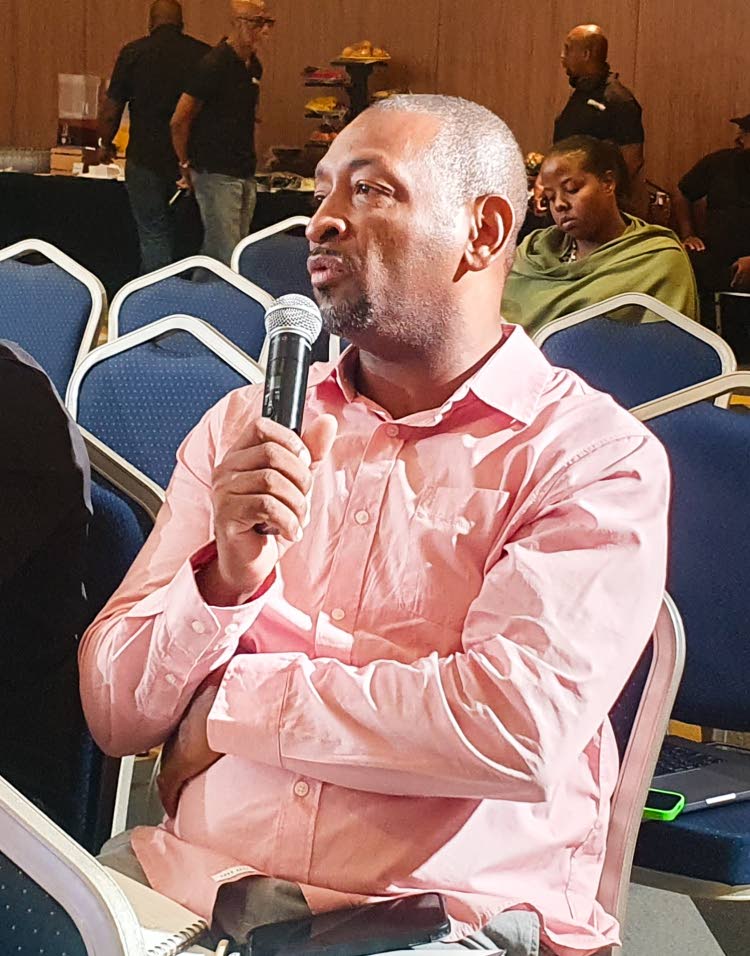
Jamaica Track and Field Coaches Association President David Riley making a point on trafficking in sports during last Thursday’s forum on the issue. (Photos: Anthony Lewis)
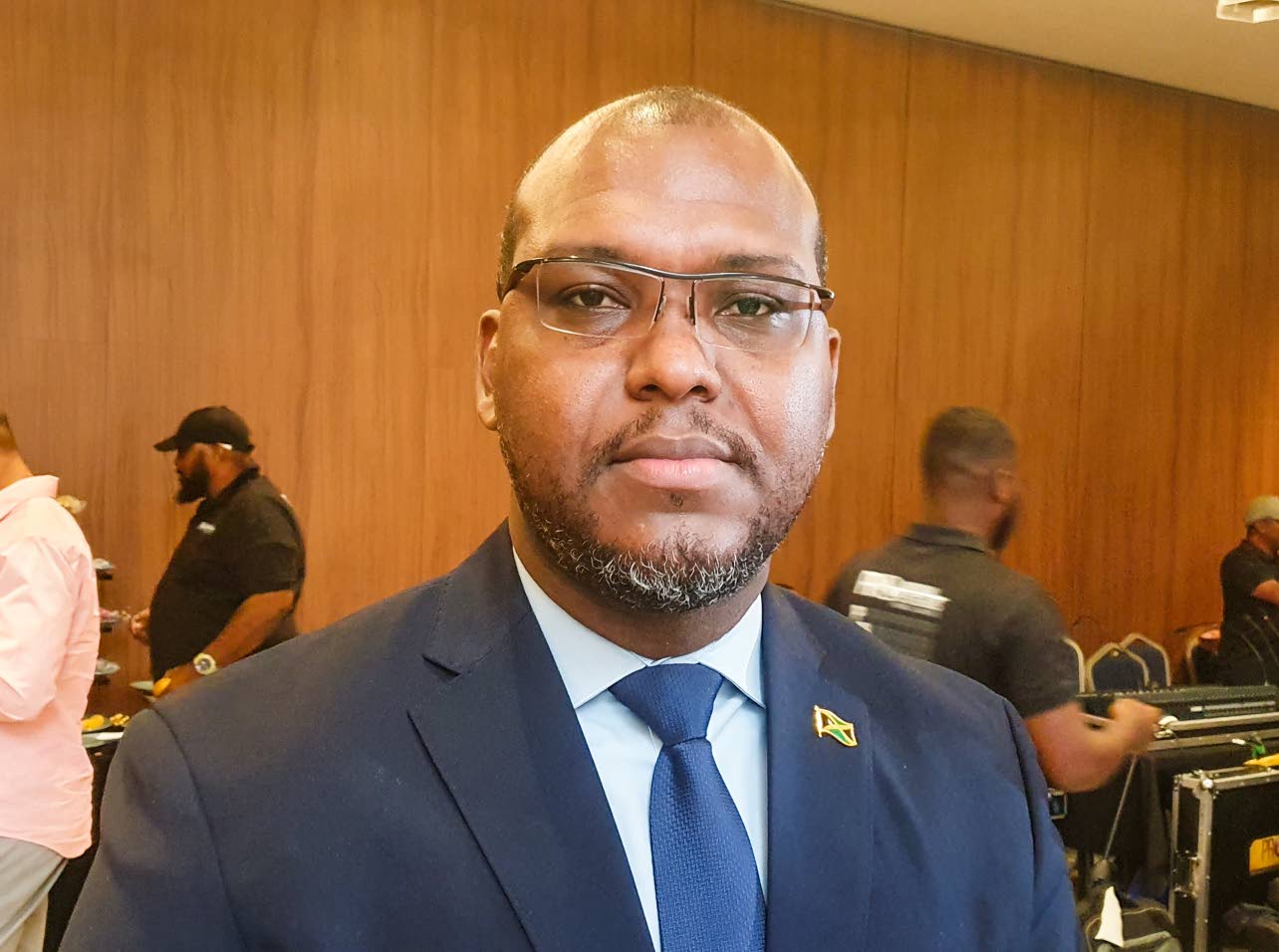
Chief technical director of the Ministry of National Security with responsibility for law enforcement Michael Morgan.


