



Banana Board embraces tissue culture to strengthen sector
DENBIGH, Clarendon — The Jamaica Banana Board (JBB) has been reaping results from tissue culture, a lab technique that reduces the potential for disease, and is now collaborating with partners from overseas to ensure local farmers have a better chance of rebounding from challenges.
“We have received several varieties from overseas and we keep them in the lab ready for multiplication. If there is a natural disaster, a farmer would reach out to us and we would take a good stock from our elite plants which would help the farmer to recover fast. In some cases, the farmer could replenish his field within a year. We not only have hurricanes but climate change is also a big thing and with that, there are always diseases coming up and so we are being proactive in preparing varieties that are highly tolerant to these,” said Sharae Clarke, JBB senior biotechnologist.
She was speaking during a demonstration of the tissue culture process at the JBB booth and display at the 71st staging of Denbigh Agricultural, Industrial and Food Show. For the past five years the JBB has been using the technique to replenish banana plants for both large and small farmers and to strengthen the crop for exponential growth. According to Clarke, the process involves in vitro micro propagation where plants are stripped and placed into containers in an environment that allows them to self-multiply under sterile conditions before being introduced to soil.
“We want to ensure we introduce clean plants into the lab. This process is to ensure we don’t introduce any microorganisms into the space. Initiation takes one month and then subculture goes up to about nine months. Then we prepare the plant for rooting,” Clarke explained.
According to her, tissue culture is also a “food security measure” as the varieties it produces are used to replenish those lost to disease.
“This process is focused mainly on the commercially viable ones like the Williams that most farmers request. We also have a germ plasm facility at the Bodles site and now we are doing germ plasm in vitro. We do it for all varieties, but farmers focus on the commercially viable varieties,” she said.
Tissue culture technique is recommended for large farmers who have lots of acreage as one plant can multiply into up to 1,000 within a span of approximately 10 months. In addition, plants derived from tissue culture may be purchased at Bodles.
Tissue culture plants are highly tolerant and will affect output in a positive way. The technique is expected to significantly improve long-term banana production, with the injection of much-needed resources. Clarke noted, however, that there is more work to be done.
“More persons are needed to bolster the current two-person biotech team. Imagine if we had a team of 10 who could do more and put in more work. Biotech is always advancing so in Jamaica we are currently at the preliminary stages of staffing. For now, we are focusing on public education so our farmers can get the information on what we are doing,” she said.
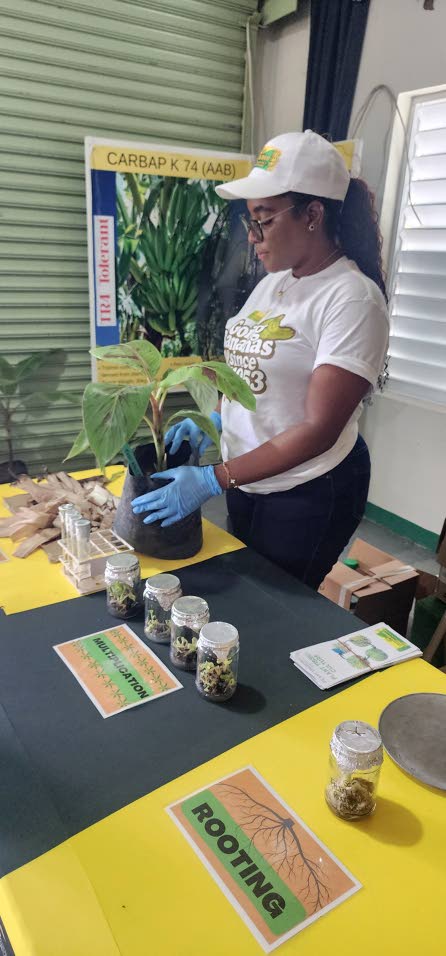
Sharae Clarke, senior biotechnologist at the Jamaica Banana Board, showing a sample of a banana plant multiplication process.


