



US$8-million investment
Jamaica Broilers’ new energy plant set to keep chicken prices steady
In a move expected to bring long-term price stability for one of Jamaica’s most essential food items — chicken — Jamaica Broilers Group on Tuesday officially commissioned a new LNG-powered co-generation plant at its Best Dressed Chicken facility in Spring Village, St Catherine.
The approximately US$8-million investment, aimed at cutting costs, reducing emissions, and strengthening the country’s food security, is powered by a 6.5-megawatt Hyundai engine designed to generate both electricity and steam which are key resources in chicken processing.
But beyond the technology, company officials and Government leaders say the real benefit will be felt by Jamaican consumers.
Jamaica Broilers Group President and CEO Christopher Levy said the system will help protect the company from unpredictable global energy prices, which have long influenced the cost of chicken.
“This is a very important investment for us. The challenges and what I call the imbalance of our economy in Jamaica, compared to some of the other economies worldwide, require investment like this that’s not mainstream and what it does, it allows us to be competitive in this environment… The purpose of it is what we like to call the food independence of Jamaica and in this world we need to recognise how important that has become,” Levy said at the launch.
He explained that the plant operates on a co-generation model, meaning it produces not only electricity but also reuses waste heat to generate steam and hot water used in processing operations.
This multi-purpose system, he said, allows the company to reduce fuel consumption and avoid relying on traditional heavy fuel oils, which are costlier and more damaging to the environment.
“I think it’s really important to also understand that the efficiencies of it are far-reaching. Yes, it produces energy or electricity, but it’s a cogent facility so the chicken plant uses a lot of steam, [and] that steam is collected from the exhaust heat of the energy and that exhaust heat goes through what’s called a heat-recovery boiler and produces steam. So we don’t burn any other energy at this plant. We burn energy once, and right now it’s gas and that produces all the steam that we need, hot water that we need, electricity that we need right there. So it’s a multi-tiered return on investment from a company point of view and a shareholder point of view,” Levy further explained.
Prime Minister Dr Andrew Holness, in his address, praised the investment, calling it “a significant improvement” for the company’s customers.
He said the effects will be noticeable for consumers as more stable production costs mean the price of chicken will be less likely to see sudden increases.
“I’m not here to tell you that the price of chicken meat overnight, tomorrow, is going to fall by 30 or 40 per cent. That’s not how it works. But what it means is that Jamaica Broilers has now secured… greater energy efficiency. It means that they are far more insulated from the volatility of international shocks in the energy market, which would be chiefly responsible for any unpredictable rise in the price of chicken and you would have seen that happen time and time again,” he explained.
Energy Minister Daryl Vaz also welcomed the development, describing it as a clear demonstration of what is possible when private sector leaders take bold steps towards sustainability.
“This plant will allow for more efficient use of fuel, producing both electricity and heat — an approach that brings tangible benefits. It is a bold statement of intent, a declaration that Jamaica is serious about building a cleaner, smarter, and more sustainable future,” Vaz said.
He noted that liquefied natural gas (LNG), which now accounts for roughly 60 per cent of Jamaica’s power generation, continues to play a vital role in reducing the country’s reliance on more polluting energy sources.
Minister of Agriculture, Fisheries and Mining Floyd Green called the project “one of the finest examples” of the modern era of agriculture in Jamaica, highlighting its importance to both food security and economic resilience.
“When we talk about poultry, we’re not talking about a side story in Jamaican agriculture, we’re talking about our largest domestic protein source. We’re talking about a sector that contributes significantly to rural employment, foreign exchange savings, and national food security and this plan is a living demonstration of how agribusiness in Jamaica is evolving, moving from high consumption models to low emission energy efficient systems that protect the environment while boosting output,” he said.
Green added that Jamaica is now fully self-sufficient in poultry production, with the industry remaining strong even after challenges such as Hurricane Beryl which affected sections of the island last year July.
He credited investments like Jamaica Broilers’ co-generation plant as key to that continued growth.
“When Jamaica Broilers invests like this, the reality is it’s felt all over Jamaica, because the network of contract farmers in rural Jamaica that depend on the Jamaica Broilers structure is tremendous… This is not an investment in manufacturing, this is an investment in agriculture, and I can tell you agriculture is leading the way, especially in local investment, and poultry has been leading that charge,” Green said.
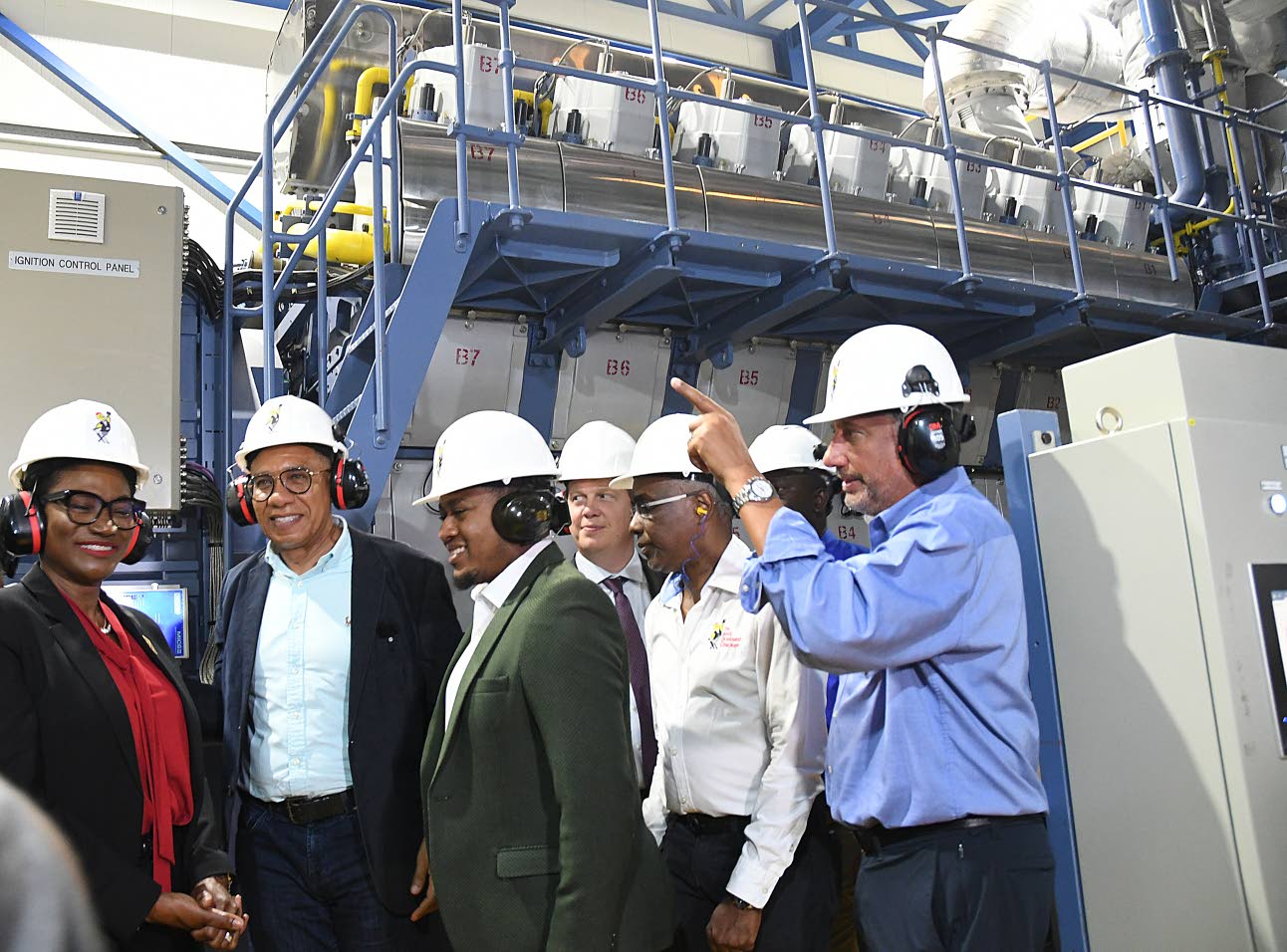
Jamaica Broilers Group President and CEO Christopher Levy (right) points out features of the company’s new LNG-powered co-generation plant at Spring Village, St Catherine, to Prime Minister Dr Andrew Holness (second left); Scotia Group President and CEO Audrey Tugwell (left); and Agriculture Minister Floyd Green (third left). At second right is Best Dressed Chicken Division Vice-President Dave Fairman. Occasion was the official opening of the US$8-million plant on Tuesday. (Photos: Karl Mclarty)


