



Dairy dilemma Several factors keeping farmers away from lucrative sector
Jamaica Dairy Development Board (JDDB) Project Coordinator Trevor Reynolds has renewed a call for new farmers to enter the rapidly declining dairy sector.
According to Reynolds, local production supplies just about 10-12 per cent of the fresh milk needed in Jamaica and this must be addressed.
“We are trying to get new farmers to come into the business. Over the last four years, the annual milk production has declined with some farmers going out of business due to debt, or no successors to continue the business,” Reynolds told the Jamaica Observer at the just-ended Denbigh Agricultural, Industrial and Food Show in Clarendon.
He pointed out that the majority of milk products now on the market are from reconstituted milk.
“Any amount of milk that is being produced in Jamaica there is a market for it. Right now, the market is so competitive that the processors are going around and offering farmers premium prices to buy their milk. Some processors supply the farmers with animals on a loan basis and over the years they collect back the money through the sale of milk.
“It’s very lucrative but it’s a lot of hard work because you have to milk 365 days of the year, you don’t get Saturday and Sunday [off],” added Reynolds.
He argued that employing people to assist in carrying out the daily functions will ease the burden on small dairy farmers.
Reynolds told the Observer that the major challenge facing the dairy industry is that small farms are still highly labour intensive, which sets back production.
“We not getting the productivity we would want to get because of the archaic technology that we keep using. Here at the dairy board, we try a number of initiatives to assist the small farmers. One of the latest is the technological equipment centre where there is equipment that both small and large farmers can lease. These include a forage harvester, hay baler, and others that can be leased for a month and used to improve on their productivity and efficiency on the farms.
“We also have cooling equipment which are modern. Most of the dairy farmers now, the cooling system they use is from in the 1950s so it uses a lot of energy and so often times they have to discard the product because the milk is not cooling properly. As a result, we have been introducing modern cooling systems to assist the farmers to efficiently cool the milk,” said Reynolds.
“From anecdotal evidence, farmers who use the equipment can attest that they have seen a reduction in their utility bills because these machines are far more efficient than the older ones they are accustomed to using. We have some small farmers in St Thomas who still milk by hand so the dairy board has been working to get them to milk by machine.
“We have received some mobile equipment so they can cut their time down from 10 minutes to milk a cow. With the machine they can finish milking within five minutes. Not only that, but their hands are not in contact with the udder of the animal, so the sanitation of the milk improves and by virtue of that they will eventually start to sell A-grade milk because the bacterial load will be reduced,” said Reynolds as he took the Observer on a tour of the JDDB booth.
He acknowledged that because the current system is so capital intensive, the young farmers are reluctant to venture into the market as they don’t have the money.
“For those who grow up on the farm and see the struggles their parents went through, a lot of them are not willing to continue that tradition. However, we at the dairy board are working on informing them that dairy can be very lucrative. That is why we are equipping them with different types of equipment so they can improve productivity and efficiency to encourage them to come into production,” he said.
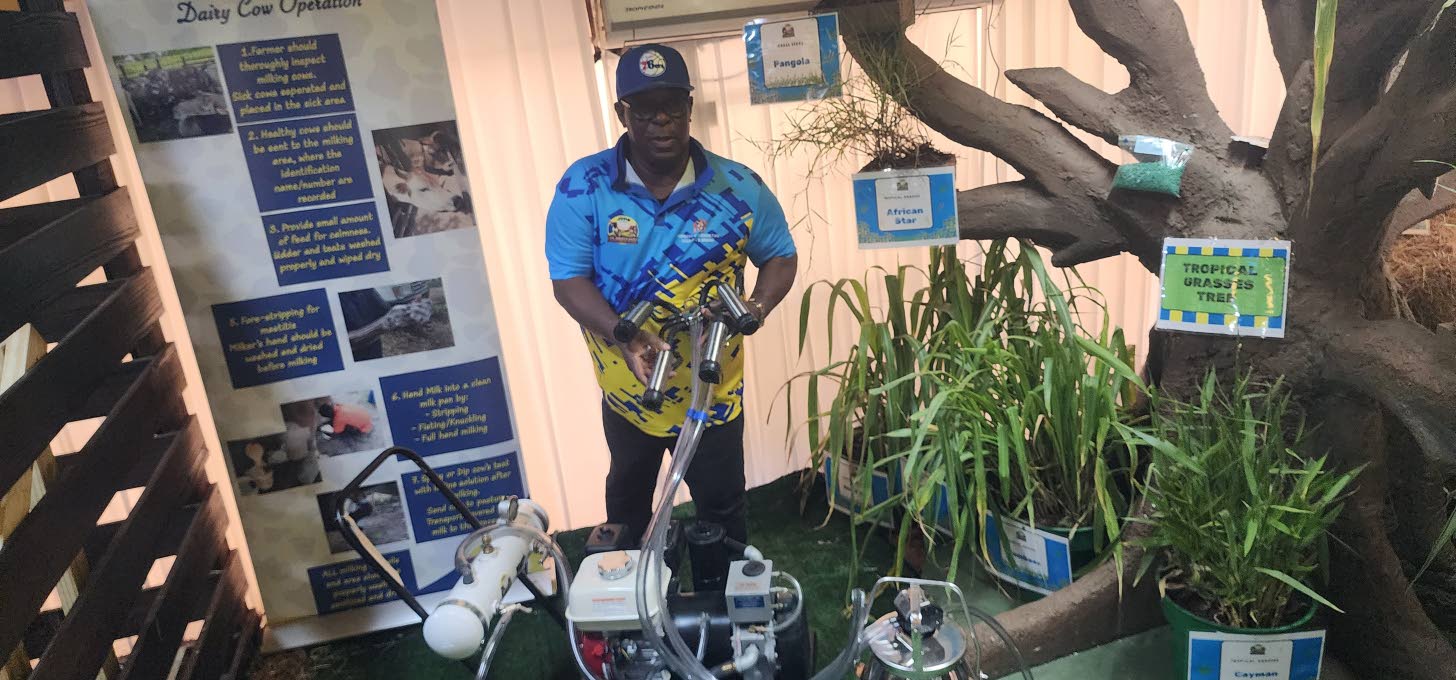
Project coordinator at the Jamaica Dairy Development Board, Trevor Reynolds, showing the milking machine used to extract milk from cows.


