



The path to Jamaica House
Speculation is rife as to when Prime Minister Dr Andrew Holness will “fly the gate”. Your readers will recall that on August 11, 2020, Prime Minister Holness announced in Parliament that elections would be held on September 3, 2020, with nomination day scheduled for August 18, 2020.
September 3, 2007 holds political significance to the Jamaica Labour Party (JLP). It represents Bruce Golding’s and the JLP’s return to Government after 18 years in Opposition. On September 3, 2020, Holness and the JLP were re-elected to Government in a landslide victory.
Historically, election dates are announced at mass rallies. Half-Way-Tree holds the distinction of five general election announcements. Three were made by former Prime Minister PJ Patterson in 1993, 1997, and 2002, and two were made by former Prime Minister Portia Simpson Miller in 2007 and 2016. Prior to 2020, the last time an election date was announced in Parliament was on July 28, 1959 by Chief Premier Norman Manley, three years before Jamaica gained Independence.
ARE JAMAICANS BETTER OFF?
For most Jamaicans, bread-and-butter issues and their safety will be at the forefront of their minds as the election approaches. They will have to ask themselves: Am I better off today under a JLP Government than I was under the last People’s National Party (PNP) Government?
The 2025 General Election will be the most consequential in the island’s history. For the first time in modern Jamaican history, a Government will be able to campaign on an actual record of achievements. The JLP will need to remind voters of its management of the economy during COVID-19 and how it had to ignore the PNP’s call to “run wid it” and recklessly squander the economic gains that spanned multiple administrations. The unemployment rate of 3.3 per cent is at the lowest ever in the island’s history. This means more Jamaicans are gainfully employed than at any other time in our history. While significant economic growth has eluded us, all the macroeconomic indicators are heading in the right direction.
The steady and sustained reduction in murders and increased public confidence in the Jamaica Constabulary Force (JCF) is a direct result of the Government’s crime plan, and the JCF deserves every commendation. Overall, major crimes in the first quarter of 2025 are at their lowest in 25 years. If the trend continues, Jamaica could record fewer than 600 murders in 2025, representing a 36 per cent decline compared to 2024.
Statistically speaking, the Jamaican people are safer today than they have ever been, and the Government continues its aggressive investment in the security apparatus, moving the JCF from the big black book era into a modern intelligence and technology-driven, fit-for-purpose force.
On those two bases alone, coupled with the two years stolen by COVID-19, Holness and the JLP have earned a third term in office.
WHAT IS THE PNP’s POLICY POSITION?
The Opposition PNP is hoping to capitalise on the general discontentment of those Jamaicans who the economic benefits have not reached and the pain points of the perennial water crisis as well as poor road and infrastructure management, which have been exacerbated by chronic underinvestment and climate change.
It is also hoping that the perception of corruption created by the Integrity Commission has so damaged the prime minister and the Government that it can wrestle Jamaica House from the JLP as it did after the Manatt-Dudus scandal of 2011.
The JLP knows all too well it cannot underestimate the PNP, despite the party having a leader who is not as popular as the prime minister and in the absence of any policy to capture the imagination of Jamaicans. Political history has taught us that Jamaicans have a history of giving Government to the PNP after the JLP Government has stabilised the country. They did so in 1989 and 2012.
In the same way we have to judge the JLP on its record, we must judge the PNP based on its history in Government and its current policy positions. The party’s criticism of the rural school bus deployment is giving me deja vu. It reminds me of the political criticism of the prime minister’s private residence leading up to the 2020 General Election. Comments from the hierarchy of the PNP have left a bad taste in the mouths of Jamaicans, and to add insult to injury, the children of the two most vocal critics, Opposition Leader Mark Golding and his number two, Peter Bunting, would never travel on public transportation in Jamaica. Even my PNP friends have said it is the height of political hypocrisy and reeks of ‘bad mind’.
Yes, Golding is hoping to secure his place in history by returning the party to Government, a feat his predecessors, Portia Simpson Miller and Dr Peter Phillips, failed to do in 2012 and 2020, respectively. If he loses, even with an increased majority, his leadership of the party would be untenable.
Dr Holness is looking to defy political history. If re-elected, he would have secured an unprecedented third term for the JLP, and by the end of his five-year term in 2030, he would replace PJ Patterson as Jamaica’s longest-serving prime minister.
The path to Jamaica House for either of the two parties will not be easy. This election will be won and lost based on which party has a message that resonates with voters, can mobilise its base on election day, and importantly, convince undecided and younger voters. That is the party that will secure its place in history and pave a clear path to Jamaica House.
Andrew King is a public affairs commentator with an interest in public policy. Send comments to the Jamaica Observer or abking020@ gmail.com.
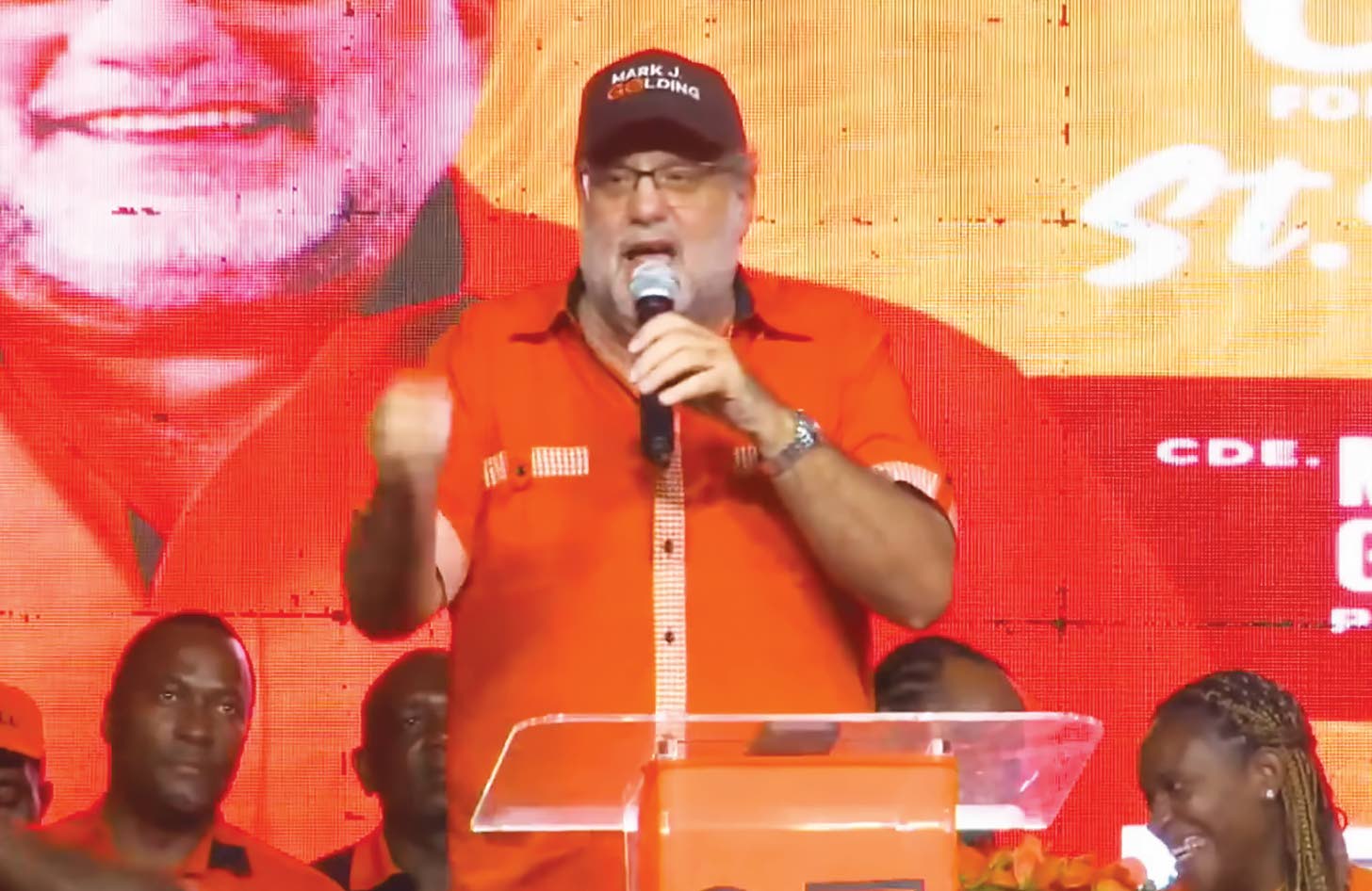
Mark Golding
The date of the 2025 General Election is yet to be announced.


