Danger to democracy
Concern as large number of police and soldiers shun electoral process
AS Jamaicans prepare to go to the polls for the country’s 19th general election, there is concern that the persistent low turnout at the polls by members of the security forces could weaken the island’s democracy.
The worry is that the lack of interest in voting by members of the Jamaica Constabulary Force (JCF) and the Jamaica Defence Force (JDF) raises questions about the viability of the country’s democracy, and the message their disengagement sends to the public.
Despite being given the opportunity to cast ballots ahead of the general population, police and soldiers have long recorded low participation in elections.
According to the Electoral Commission of Jamaica, in 2016, 53 per cent (5,322) of the 10,041 members of the JCF on the voters’ list took the opportunity to vote. However, only 930 (36 per cent) of the 2,569 soldiers registered to vote cast a ballot.
In the 2020 General Election, conducted during the COVID-19 pandemic, the numbers fell even more with only 4,849 of 11,512 (42 per cent) of the police registered to vote casting their ballots, and just 982 of the 4,181 (23 per cent) soldiers on the voters’ list exercising their franchise.
According to social scientist Ricardo Smith, the low voter turnout by members of the security forces cannot be ignored.
“It sends a very negative message when the people who are trained and appointed to protect our interests, to serve and protect us, to enforce laws relating to criminal justice, have a hands-off approach as it relates to who serves the country,” said Smith.
“That is not good because you would think that persons who are part of the security forces would be so inclined to cast their votes because they want to ensure that a robust system of government is there, and is established for us to continue into the future,” added Smith.
His concerns were echoed by political commentator Dr Nadeen Spence, who underscored that voter disengagement among any specific group of people is a negative indicator for society.
“Apathy in the population and in any specific group is problematic. So yes, it is concerning that voter behaviour among special groups is so low, which says that there is a lot more to do, to find out why people feel disengaged, and to see how we re-engage people from different groups.
“Find out what it is that is turning them off and then see how we can get them back to being interested in participating in the voting process,” said Spence.
But Smith is convinced that there are many factors that have contributed to the high level of disengagement by members of the security forces. He argued that geographical location is a prime factor that hinders their participation in the voting process.
“I think one of the drawbacks is that a lot of people might find it challenging to get to the polling stations from where they are stationed or where they are placed, because as we know, many of our security personnel don’t necessarily work in the locations from which they are from.
“Whenever they are finished training, basic training, and they are placed in the different locations, they may not get the chance to go back home to conduct that particular voting process,” reasoned Smith.
He added that years of unsatisfactory wage and salary negotiations and unmet promises could have left members of the security forces feeling politically disillusioned.
“Most public sector agencies have had their challenges in terms of getting the remuneration that they so desire. You might find that that will play a factor in how they view the current political system in Jamaica, whether they see it as just empty promises or their concerns are actually being met.
“Individuals are no longer just casting their vote because of parties and politics, but they are voting according to the strategies and the plans for implementation that is outlined by the political parties,” said Smith.
Spence agreed that many people, not just in Jamaica, have decided against being involved in the political process because of great disappointment in the leadership they have experienced.
She argued that their staying away from polling booths was not just a measure of taking their right to vote for granted, but used as protest due to frustration.
“We went through the golden age of the popularisation of the democratic process, countries like ours coming off the second wave of democracy, post-colonial states entered into this whole business of independence, expecting a lot and expectations were not met,” she said.
“And I think, people wondered if it made sense to stay connected to this with their engagement that wasn’t yielding the kinds of rewards that they wanted. They were not seeing themselves advancing the way they would have anticipated, and so I think people had legitimate reasons for staying away.“
In the meantime, Smith told the Jamaica Observer that getting members of the security forces re-engaged in the electoral process could set a precedent for the 70 per cent of non-voting Jamaicans.
“I think that it is important that we get these individuals to vote more because voter apathy doesn’t send the right message. You cannot have a population of 100 and you only have 25 per cent voting.
“If we can get the individuals who we look up to, those who serve and protect us, to vote, then the normal citizens, they will also see the importance of voting in a general election,” argued Smith.
Both Smith and Spence suggested that the approach needs to be hands-on and deliberate to engage the island’s police and soldiers.
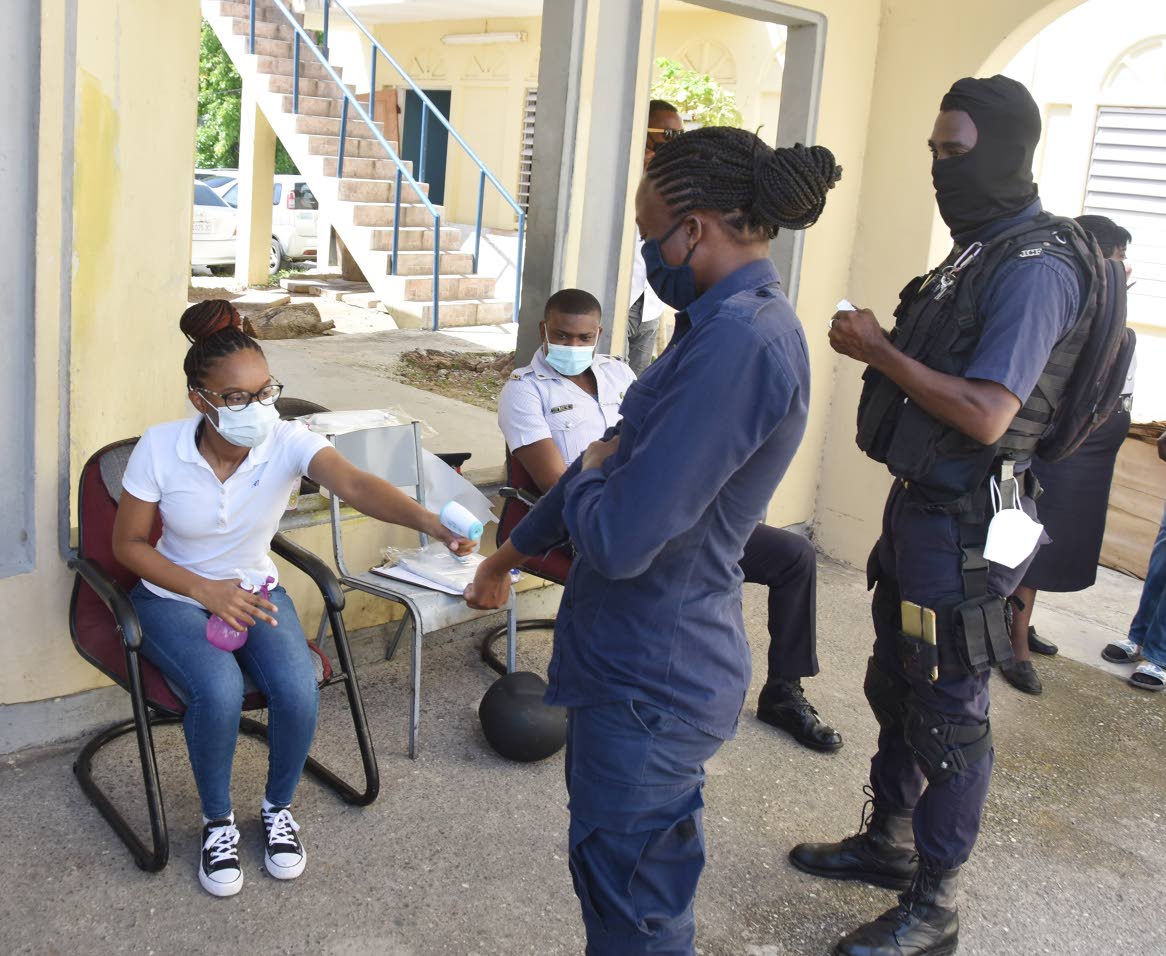
A member of the security forces has her temperature checked before voting at the Greater Portmore Police Station in St Catherine Southern in August 2020, at the height of the COVID-19 pandemic, while her colleagues look on. (Photo: Karl Mclarty)
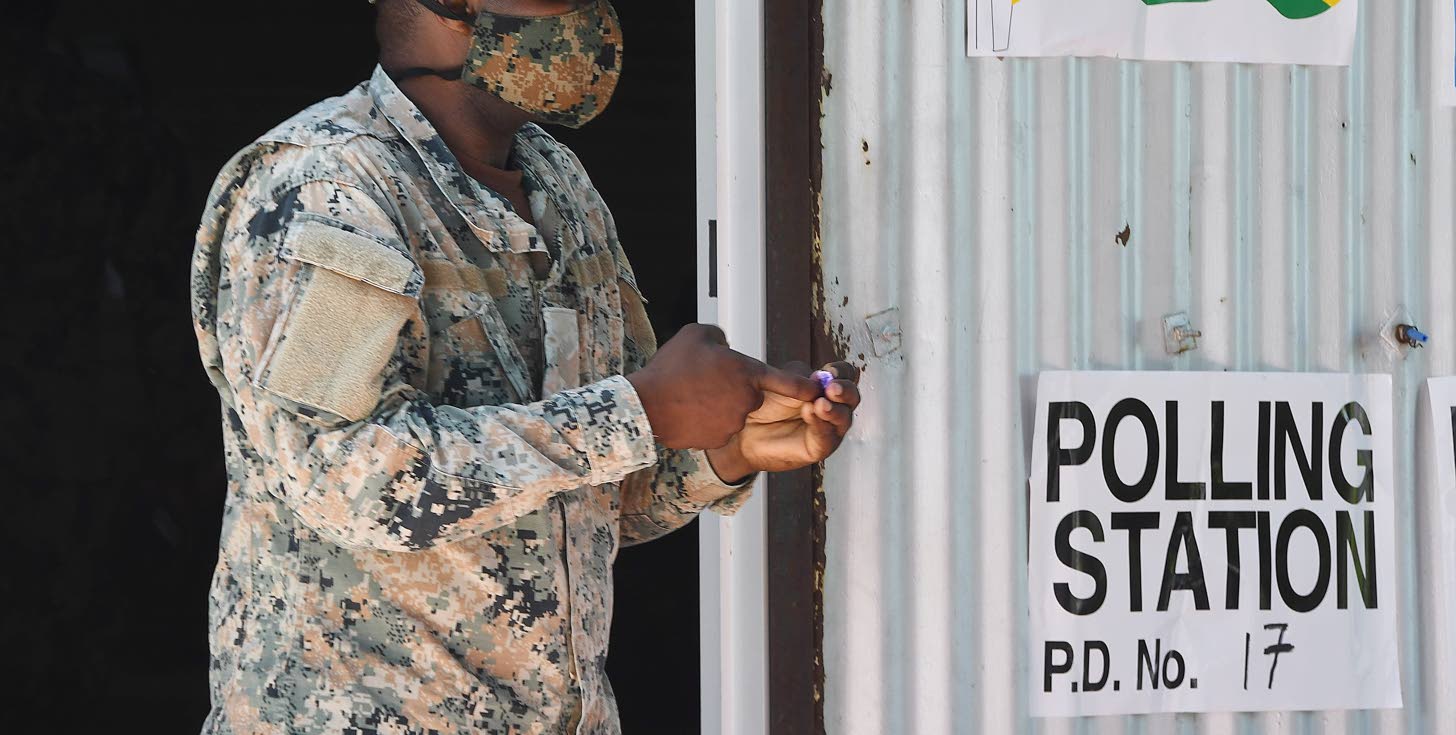
A member if the JDF leaves the polling station at Up Park Camp after participating in voting for election day workers and members of the police and military forces in 2020.