



Education gains
Steady improvements recorded in core subjects for CSEC, CAPE
After years of learning loss caused by challenges related to the COVID-19 pandemic, Jamaican students who sat this year’s Caribbean Secondary Education Certificate (CSEC) exams have bounced back, posting improved pass rates in core subjects and outperforming the Caribbean average in both English and mathematics.
Education Minister Dr Dana Morris Dixon, announcing this year’s performance report at a press conference at the ministry on Friday, said the achievements were particularly significant, given the disruption that fifth form students faced at the start of their secondary education.
“Remember, these students, especially the ones for CSEC, they would have spent first form online, and when you listen to their stories and you hear the valedictorians speak, they all spoke about the challenges of COVID. It is actually very real, and the data around the world show us that the learning losses from COVID are formidable,” she said.
In English A, the national public school pass rate climbed to 85 per cent — up from 76 per cent last year, and is above the regional average pass rate of 80 per cent.
Morris Dixon also acknowledged the significance of this improvement, noting that the 85 per cent pass rate has surpassed the country’s pre-pandemic pass rate which was 82.8 per cent in 2019.
Furthermore, mathematics, which is traditionally a weaker area for Jamaican students, also saw progress.
The public school pass rate rose to 44 per cent, up from 39 per cent last year and is ahead of this year’s Caribbean average of 39 per cent.
However, while the minister acknowledged this improvement, she did note that the pass rate was still far from where it needs to be, acknowledging that it is still behind the pre-pandemic pass rate of 54 per cent in 2019.
“We obviously want that to be higher, but last year it was 39 per cent, and the regional average is 39 per cent of students passing mathematics. We are above the regional average again in mathematics [and] as the CXC (Caribbean Examinations Council) meeting yesterday (Thursday) noted, across the entire region there are concerns around mathematics. It is something as a region we’re going to have to tackle, but we in Jamaica, we’ve already started it, and it is very encouraging to see that we are above region, and we’re going to continue on that thrust,” she said.
Morris Dixon also highlighted particularly strong performances in several other CSEC subjects. Food, nutrition, and health achieved a 93 per cent pass rate; theatre arts, 92 per cent; and agricultural science, 86 per cent. information technology recorded an 88 per cent pass rate, while Visual Arts and Biology reached 83 per cent and 84 per cent, respectively.
However, she acknowledged that there are subject areas needing urgent attention.
Pass rates in physics and chemistry declined compared to last year. Chemistry fell from 64.1 per cent pass rate in 2024 to 58 per cent in 2025, while physics fell from 69.6 per cent in 2024 to 63 per cent in 2025.
She linked some of the difficulties in science to inadequate laboratory resources, noting that the Government has begun procuring new equipment following an audit of all school science labs.
“We know that a part of that problem has to do with the labs, and that is why we have the lab programme, so we did an audit of all science labs, and we have started a procurement [process] to get equipment for the labs in our science areas, and so we think with that, when we equip the labs and we do some more targeted interventions there, we can work to get those numbers up. We also know that this 2025 CSEC exam was the first year that there was a change in the testing and the syllabus for the social studies area, so we have to continue working on that area,” Morris Dixon stated.
Performance at the Caribbean Advanced Proficiency Examination (CAPE) level was also encouraging. Unit one recorded a 91.2 per cent pass rate, while unit two achieved 92.3 per cent, with improvements in 25 unit one subjects and 17 unit two subjects.
However, Morris Dixon expressed concerns that fewer students are doing CAPE, an issue that she said the ministry will look at over time.
The country also saw a minor improvement in the number of students who attained five or more CSEC subjects, including mathematics and English.
According to Morris Dixon, in 2024, a total of 6,024 students (18 per cent) had five CSEC subjects including maths and English A. This year, the number rose to 6,200 (19.2 per cent).
She said that with interventions by the ministry “we expect that this number will continue to go up in terms of our students getting five or more subjects, including maths and English”.
Morris Dixon was also pleased to announced improvements in the 56 schools under the National School Learning and Intervention Plan (NSLIP) that have been receiving targeted support.
She explained that 47 of the 56 schools under the programme saw an increase in the number of students passing mathematics with schools such as Cross Keys High rising from 7.7 per cent to 40 per cent and Kemps Hill from 2.8 per cent to 29.4 per cent.
This is also complemented by all 56 schools improving in English A with schools such as Charlie Smith High improving from 30.1 per cent last year to 75 per cent, and Fair Prospect High climbing from 9.5 per cent to 73.7 per cent.
“Our teachers are working hard, our principals are working hard. They’re working with us [and] we can’t let the ministry just say, ‘Oh, we’re going to do these interventions’, and they just happen. The school has to be receptive, the school has to do a lot of work to create the environment for the interventions to work, and they did, and that’s why we can today celebrate with all of these schools. This is remarkable, absolutely remarkable for our country,” she said.
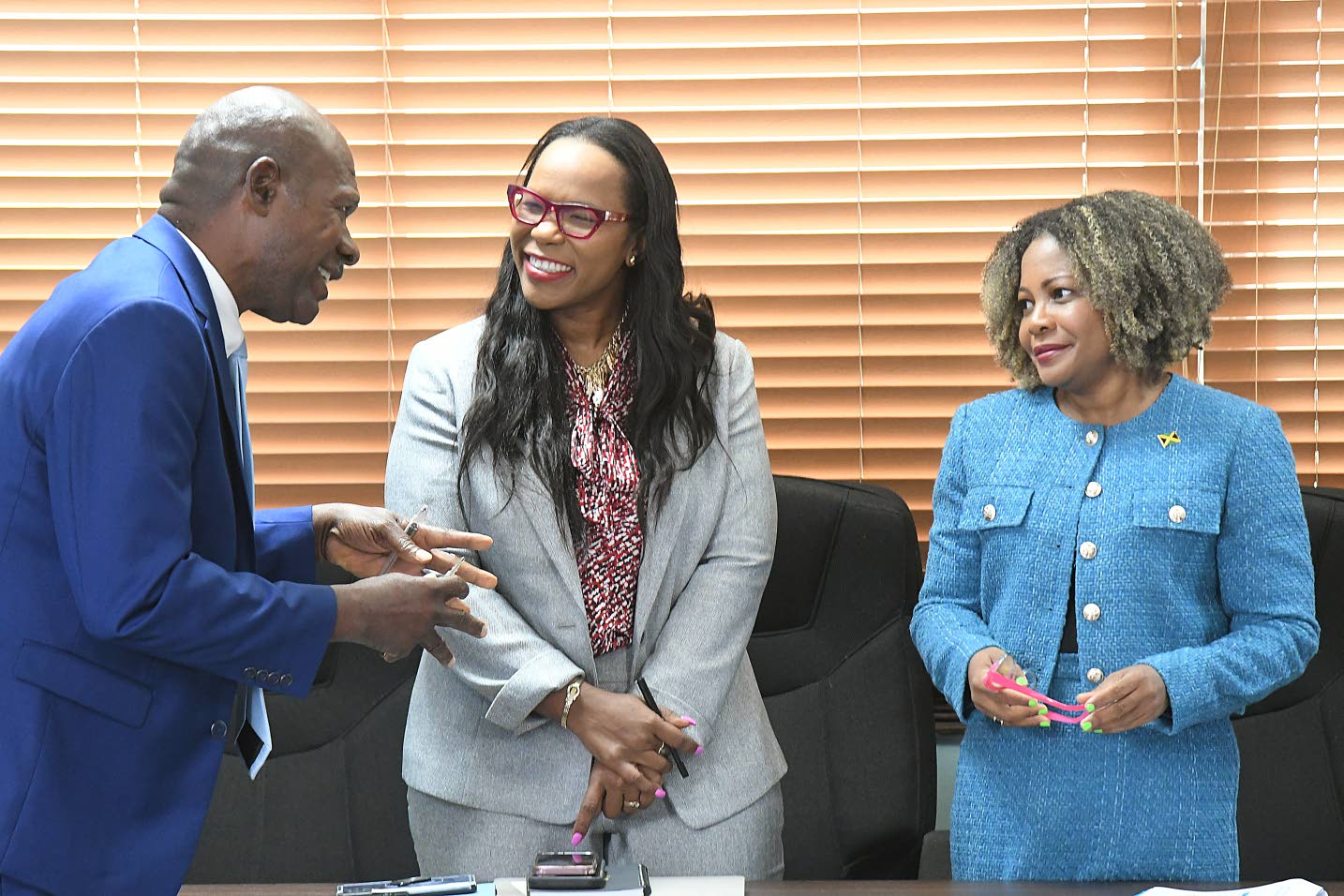
Education Minister Dana Morris Dixon (right) speaks with Hector Stephenson, CXC local registrar, and permanent secretary in the Ministry of Education Dr Kasan during a press conference on Friday at the ministry to give the report for this year’s CXC performances. (Photos: Karl Mclarty)


