



No hurdles to voting
Long-standing special provisions guarantee police, soldiers can cast ballots
THE Electoral Office of Jamaica (EOJ) has sought to assure Jamaicans that neither duty nor distance stand in the way of members of the security forces casting their ballots on election day.
Director of Elections Glasspole Brown on Friday pointed out that long-standing special provisions guarantee the seamless participation of members of the Jamaica Constabulary Force (JCF) and the Jamaica Defence Force (JDF) in the voting process.
Official data from the Electoral Commission of Jamaica (ECJ) show that in 2016, 53 per cent (5,322) of the 10,041 members of the JCF on the voters’ list took the opportunity to vote. However, only 930 (36 per cent) of the 2,569 soldiers registered to cast a ballot.
In the 2020 General Election, conducted during the COVID-19 pandemic, the numbers fell even more with only 4,849 of 11,512 (42 per cent) of the police registered to vote casting their ballots and just 982 of the 4,181 (23 per cent) soldiers on the voters’ list exercising their franchise.
In trying to explain the worrying absence from the political process by police and soldiers, social scientist Ricardo Smith, in an interview with the
Jamaica Observer on Wednesday, argued that geographical location is a prime factor that hindered the participation of members of the security forces in the voting process.
“I think one of the drawbacks is that a lot of persons might find it challenging to get to the polling stations from where they are stationed or where they are placed because, as we know, many of our security personnel don’t necessarily work in the locations from which they are from.
“Whenever they are finished training, basic training, and they are placed in the different locations they may not get the chance to go back home to conduct that particular voting process,” reasoned Smith.
But on Friday Brown told the Observer that logistical arrangements have long been in place to accommodate members of the security forces who may be stationed far from their home constituencies on election day.
Brown explained that the EOJ receives lists from the JCF and JDF with the names of the police and soldiers on the voters’ list, and where they are stationed.
This allows the police and soldiers to cast their ballots at a polling station close to them and allows them to avoid travelling to where they were enumerated.
“There are a number of voting locations that are set up for the members of the JDF and the Jamaica Constabulary Force across the island. So what normally happens is that the [JCF] high command and the JDF would send us a list of persons who are close to a particular location, not necessarily where they were registered,” said Brown.
He pointed out that polling stations for members of the security forces are usually located close to their bases and save them the hassle of travelling.
“In fact, most of the polling stations for the members of the JDF are within their compounds and therefore, they would attend upon those polling stations based on the listing that we get, which normally is close to where they are currently serving,” added Brown.
The director of elections underscored that under the Representation of the People Act, members of the JDF and JCF, along with election day workers, are afforded the benefit of casting their ballots three days before the official date of the voting process, which ensures that their right to exercise their franchise is not hindered by having to perform their civic duties.
With the general election scheduled for September 3, Brown said the process for election day workers and members of the security forces to cast their vote will remain smooth for those who choose to dip their finger in the ink.
“So again, we rely upon the information that we get from the high command in terms of where we should send their ballots and so therefore, that option is available. The facilities will [be], and always have been, available,” stated Brown.
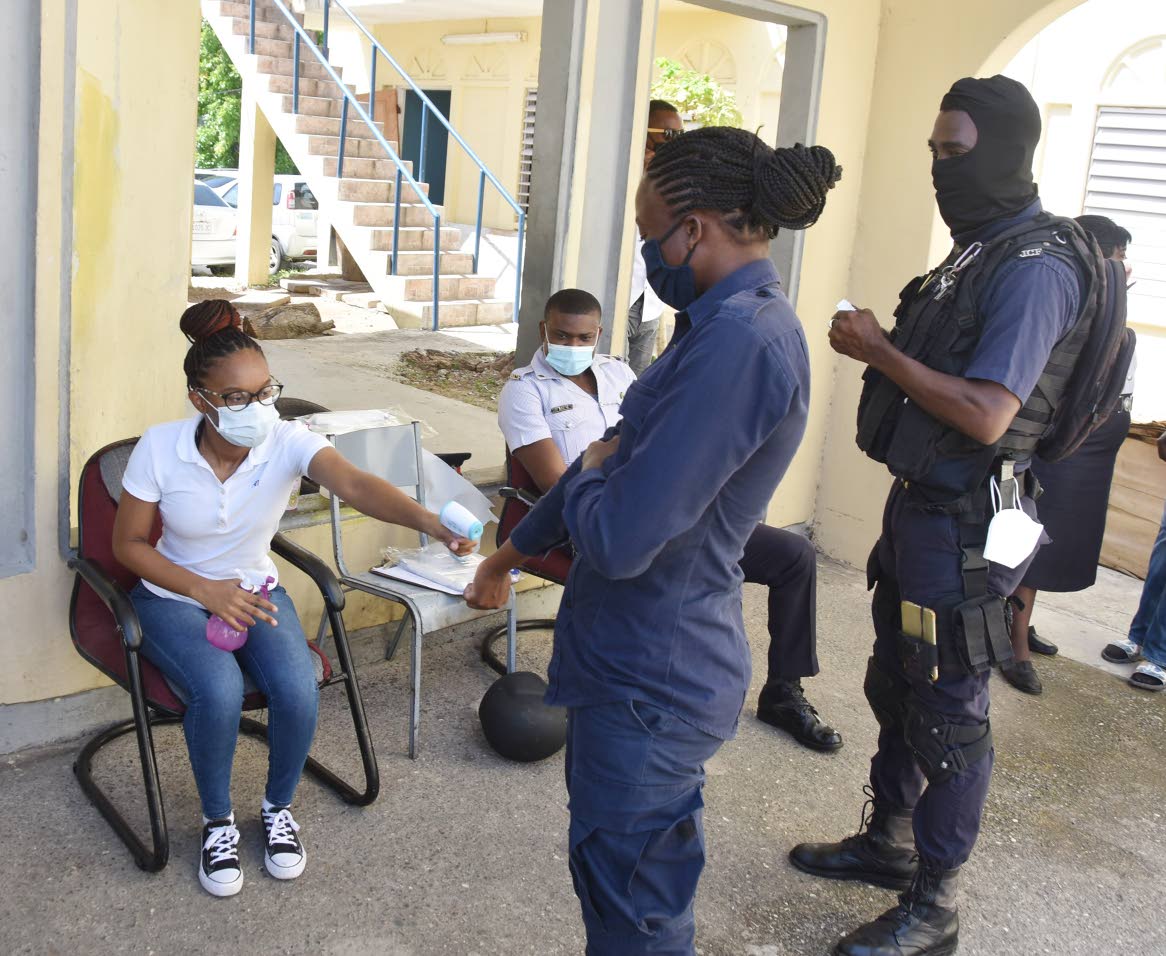
A member of the security forces has her temperature checked before voting at the Greater Portmore Police Station in St Catherine Southern in August 2020, during the height of the COVID-19 pandemic, while her colleagues look on.


