



Jamaicans hell-bent on being doctors battle blackouts in Cuba
SOME Jamaicans hell-bent on becoming top-notch, high-quality doctors are making the most of the opportunity to study medicine in Cuba, but that comes with its own set of challenges.
In the Spanish-speaking country these Jamaicans are able to capitalise on a very affordable option to study in the medical field, especially when comparable costs in other countries around the world are considered.
One such student, Kelsey Clarke, is gearing up to enter her second year of medical school in Girón later this month. She told the Jamaica Observer that her experience in Cuba has so far been fun, but challenging.
“My experience as a medical student in Cuba is filled with a plethora of challenges but it is something worth the experience — whether short term or long term. It is definitely a lot of hardship, and you have to make adjustments, but it is worth it,” said Clarke.
According to the Jamaican, approximately CAD$90,800 can cover the entire six to seven-year duration of her medical studies in Cuba, while in other countries the price tag could be more than CAD$400,000.
Clarke shared that being in a foreign country, with no family support, and where the official language is Spanish and not her native English, has been a struggle. She also disclosed that there is a constant battle due to frequent and prolonged power outages in the Caribbean country.
“I lost my father last year, and being away from my family for 10 months and then coming back to face that challenge [before] coming back to Cuba to try and do school, it is a lot to balance. But, everybody is making sacrifices so you have to make yours.
“Another challenge [in Cuba] would be the light outages. We have scheduled [power] outages for like eight hours in the 24-hour day. It is a lot, but you have to do what you have to do. It impacts studying because for me, personally, I like to be comfortable when I study — I need the light and the fan,” she explained. “Here, the heat and the mosquitoes make the conditions quite the opposite of comfortability when trying to pass an exam that is important for the progression of your career.”
But she keeps pushing.
“What motivated me to want to become a doctor is just knowing that I could help people make a change or become better from what they experience. I had personal family members who were ill and I wanted to know more about what was the cause of the disease they were suffering from. I wanted to become a doctor and I wanted to find one of the most economical ways to achieve that goal, which was [studying in] Cuba. I knew that they are very good at producing doctors, whether it be in the country or regionally.
“Cuba is different, but fun and safe; it is definitely not like Jamaica with crime. The culture is different, the food is different, the experiences outside are different,” Clarke said. “I am pretty good at Spanish, because I had to go to the University of Havana for one year of medical sciences and then I had to go to Girón my first year as a medical student.”
The Jamaican shared that she would consider living in the Spanish-speaking country if the United States embargo against Cuba — which is essentially an economic, commercial and financial blockade — were to be lifted and conditions in the country were different.
“Cubans are always dancing and partying. The Cubans I have been around are always together, they are very family-oriented and always willing to help. The food may not be the best but I buy my food and cook for myself. As Jamaicans, when we visit home during holidays we get the opportunity to take up mackerel and corned beef in our suitcases.
“I love Cuban culture, but not more than my own. It is fun for the most part [but] it’s just really different, and I am still getting used to some things. I still haven’t gone to some of the places in Cuba that I want to go to,” the former student of St Andrew High School for Girls said.
Dominique Whitely, a sixth-year medical student at the University of Havana and a 2019 recipient of the Cuba/Jamaica Bilateral Scholarship, told the Sunday Observer it is widely believed that once people can survive the conditions in Cuba, they’ll be able to survive anywhere else in the world.
“It is hard to study medicine but we always say it is 10 times harder to study medicine in Cuba. Another thing that we say is that once you pass through Cuba, you are prepared for life. There are so many things you have to deal with — the blackout is one…we have water shortages as well. On campus, especially during the summertime, sometimes we have to bring in water trucks, we have buckets, and we have to catch water and store it. We have been through so much,” she recalled.
Whitely said, too, that having to cope with the conditions in Cuba, is humbling.
“Some things, people take it for granted. When we just got to Cuba there was a shortage of simple essentials like tissue and toothpaste; even if you had the money, the fact was that the item was just not there,” she explained. “You learn to improvise; some of the times you don’t have the resources you need. It is good life building skills.
“You learn how to think quickly on your feet, which is good in the medical career because those are habits you will have to develop. Once you pass through Cuba, you can go anywhere and survive,” Whitely told the Sunday Observer.
Turning to the blackouts, which she said are referred to as apagones in Cuba, Whitely said while they are largely scheduled, they also occur outside the designated hours.
“When you know the blackout is going to come, you can prepare for it. If it is sudden, there is really nothing you can do. It is frustrating, especially as a medical student, because when there are blackouts the Internet is inaccessible. If you want to research something, you are unable to do so. You probably may want to charge your laptop and your phone, and all of that is affected. One of the things I encourage myself to do is to have good people around, because it gets discouraging sometimes.
“You have to keep in mind the end goal, and have good people around to motivate you. Among medical students in Cuba are people from over 110 countries. We try to build a community where we have WhatsApp groups, and we link up sometimes just to have social gatherings to keep you going.
“This is your home away from your home; there is no family with you in Cuba. If something happens to you it is nice to have someone looking out for you while you are here,” she said.
She did, however, highlight a major advantage of studying medicine in Cuba, which is the hands-on experience of working with patients.
“That is different from a lot of other medical schools around the world. From the first year, we get to do health checks, blood pressure checks, sugar checks…from the start you feel like you are a doctor. That was motivating for me, as I transitioned from the theoretical years to the practical years. You are in the hospital doing ward rounds, having duties and so, overall, it has been a great experience.
“The doctors are very willing to teach any procedure you want to learn — that is something I appreciate as well. You might be a third- or fourth-year student but they don’t hesitate to teach you. Even if it is just to observe until you are confident enough to do a procedure, Cuba allows you to do that. People say Cuban doctors are the best, not only because health care is free but there is an overall passion for health care in Cuba,” the medical student said.
Whitely emphasised that Cuban health-care providers are proponents of prevention over cure.
“They go into the houses to see the living conditions [so as] to tell you how to improve your conditions to allow for a better lifestyle; that is something we were immersed into as well. I am waiting to see just how I can improve on my time management because in the sixth year you have what is called on-call duties, which usually last for 24 hours. I am waiting to see how well I can manage that as I transition into this internship year; it will be like that going forward into the medical career where we have long duties,” she explained.
Another Jamaican studying medicine in Cuba, who requested anonymity, said going to Cuba was one of the best educational decisions.
The young woman, who hails from Westmoreland, is heading into year six of her medical studies.
“I feel like it is honestly one of the best routes to take in terms of studying medicine. The conditions are not the most ideal, given the situation with the electricity crisis…but they have a strong educational programme here. I still manage to pass all my courses.
“I have a light-saving bulb in my kitchen, and I would study under that until it goes out and until the computer shuts down. That would be when my study time ends,” she explained to the Sunday Observer.
“People who are not fully equipped to come to Cuba to study medicine, I would not recommend it. It is a rigorous course and it is not easy; we study completely in Spanish. I did not do Spanish at the Caribbean Secondary Education Certificate or the Caribbean Advanced Proficiency Examination levels — I came here with a third-form level of Spanish.
“I say, if you are not passionate about medicine and in love with your career and caring for people, I do not recommend it. You are going to be faced with multiple obstacles, and oftentimes than not you are going to feel like you want to quit, but you cannot,” she said.
Unlike the feedback from other Jamaicans, she said she loves Cuban food.
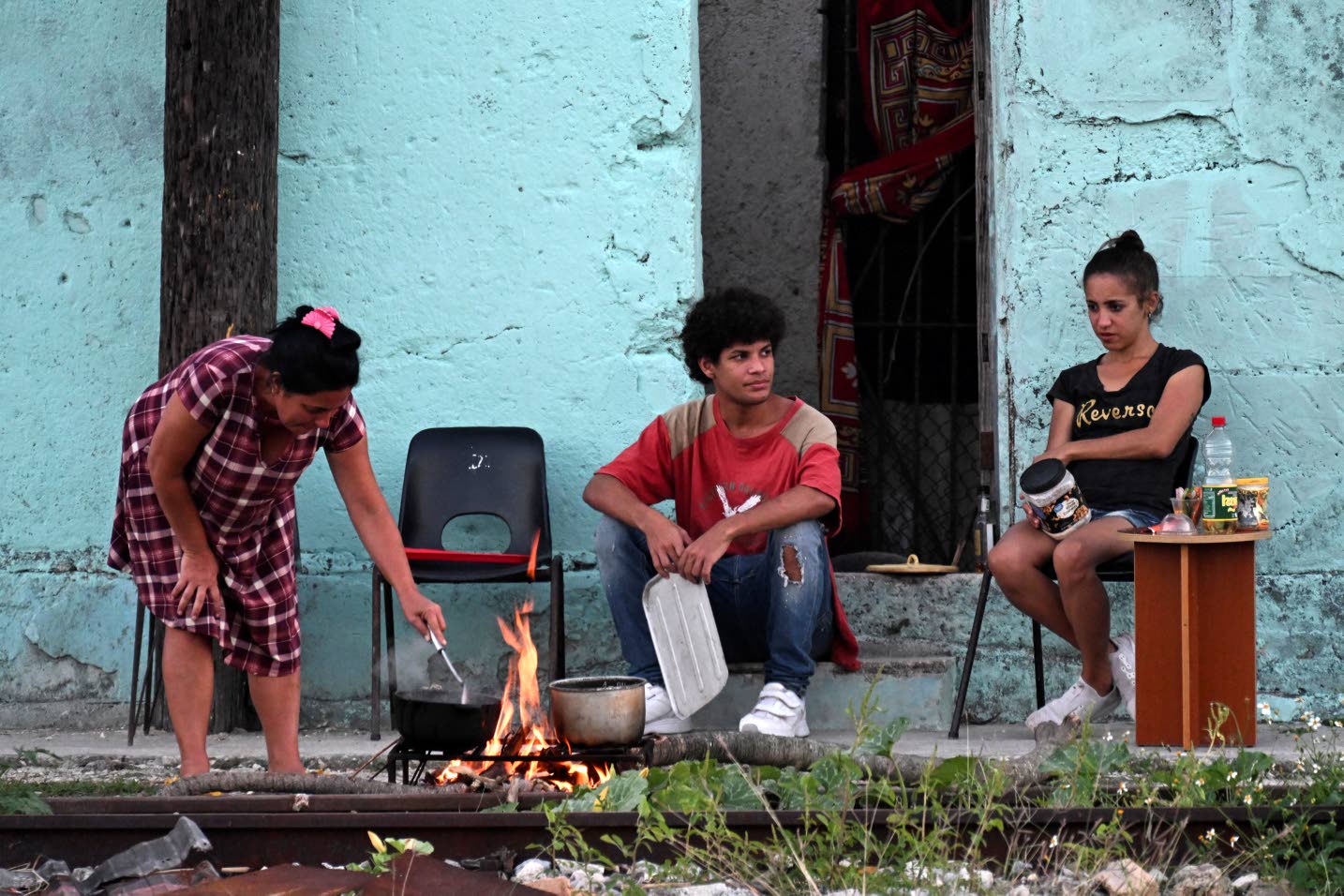
Cubans cook outside their house during a nationwide blackout caused by a power grid failure in Havana on March 15. (Photo: AFP)


