



‘The farm doctor’
Science and passion fuelling record pepper yields at BGB Farms in Florida
WITH just 20 acres in production, BGB Farms Inc might seem modest in comparison to other farms in Quincy, Florida.
However, the farm is one of the largest producers of Scotch bonnet peppers in the United States (US), yielding over 700,000 pounds annually for the domestic market.
At the heart of this success is Dr Bravo Brown, a Jamaican-born farmer from Duanvale, Trelawny, whose unique approach blends science, innovation, and his deep-rooted passion for agriculture.
His secret is that he doesn’t just grow the peppers — he nurtures them.
“I work like the doctors do. You know how you go to the doctor nowadays and you have a pain, they don’t just give you Panadol? They say, ‘Okay, we want to see a blood test to see what’s happening.’ That’s what I do,” explained Dr Brown.
“I do a leaf analysis like probably every three, four weeks which basically gives me an up-close and personal look at what’s going on in the plant,” added Dr Brown.
This diagnostic method allows him to detect nutrient deficiencies or other issues early, before they affect yield. By treating the plants based on real-time data, Dr Brown ensures precise application of fertilisers, fungicides, and insecticides in a targeted, timely, and effective manner.
It is a strategy that has proven successful, turning a 20-acre operation into a powerhouse of productivity and positioning BGB Farms Inc at the forefront of the US Scotch bonnet pepper market.
Dr Brown left Jamaica in 2001 to pursue his studies in plant science. After earning bachelor’s and master’s degrees in the field, and later a PhD in environmental science, he launched BGB Farms Inc, testing his academic knowledge against real-world farming.
From plastic mulch used for pest and weed control, to precision drip irrigation systems that deliver nutrients directly to plant roots, every decision on his farm is influenced by careful observation and years of hands-on experience.
“We have two different types of plastic [mulch]. We have the black plastic and the silver plastic, and it’s there for a reason. The silver plastic, I use it basically for insect control because we have certain types of insects that affect the peppers,” Dr Brown shared.
“We have our drip irrigation. We do most of our herbicide, fungicide, and insecticide applications by mechanical means. But I think the advantage that I have is in my fertilisation technique. But my fertilisation programme is my birthright, I won’t give it away,” he continued.
With mechanical equipment used for most applications, customisation is key, the 54-year-old plant scientist noted. He shared that as the peppers grow and thicken, spray nozzles must be adjusted to ensure chemicals reach even the innermost leaves.
“Whatever equipment you are using has to be spraying with enough pressure to force the chemicals in between these areas because you see there’s peppers right in there, so you have to force the chemicals.”
His tender loving care (TLC) approach sees him regularly inspecting his plants, identifying signs of disease or pest damage to immediately treat and remedy them.
“Once you identify it, then you start to do the treatment. You might put some insecticide, whether in the drip system or when you’re applying your foliar, your fungicide, or whatever,” said Dr Brown as he added that both his, and the experience of his business partner Carol Hopkins, help in confirming any diseases, pests, or nutrient deficiency.
Dr Brown, who also farms habaneros and pumpkin and produces crushed pepper, explained that Scotch bonnet peppers are fragile and prone to diseases and pests.
“Scotch bonnet is not that resistant to a lot of diseases. And over the years, there’s not much improvement in terms of the variety of Scotch bonnet, so it is easily affected by everything. What I normally say is Scotch bonnet is like a premature baby, so you always have to find ways to incubate,” he said.
Because Scotch bonnet peppers aren’t widely grown in the US, there are few pest control products labelled specifically for them. Hence, Dr Brown relies on trial and error, building a customised system that cannot easily be replicated.
“There is no chemical that you will find that says use on Scotch bonnet. They will say habaneros, and then the habanero, although it’s a pepper, it still has different characteristics and different things. So you basically have to do trial and error a lot of the time. So that’s why I’m not giving away my birthright, because a lot of the stuff that I use has been the challenges that I’ve gone through.”
He recalled a major challenge in 2017 when a pepper weevil infestation devastated his crop.
“I did not know nothing about it. And when it came, by the end of August, I had nothing left. But based on that experience, I can now manage that effectively. So pepper weevil still exists. It’s one of the major pests of peppers, but I know to control it, I know to deal with it,” he said.
BGB Farms Inc also benefits from strong partnerships with universities, which offer guidance and support, while also using the farm for pilot studies on new chemicals and techniques.
“If, for example, we have a problem that we cannot identify on the farm. We can always take up the phone and say, ‘We see something that we are not familiar with,’ and I can guarantee you if I call now…by the end of the day, somebody’s gonna come, they’re gonna take a sample, and they’re gonna take it back to their lab to let their people deal with it, and they’re gonna come back and tell you what it is, how to treat it and all.
“And also, what happens sometimes is the university will sometimes come in and say, ‘can we do a pilot project on your stuff?’ So they sometimes try out some of the best chemicals they have available or new chemicals that are available so that gives you an edge compared to other persons, and when they do this, they compensate you for what they do,” he explained.
But Dr Brown stressed that his yield success begins with quality seeds. In that regard, he partners with a company that handles germination so that by the time seedlings arrive at the farm, they are ready for planting.
“What makes BGB stand out is our quality. I mean, the quality that we have supersedes any other pepper on the market. And it’s not just talk. You can see whenever our peppers hit the market in Miami or New York, it basically shows up anything else and they become second best. So our trademark is just quality, and we start with quality from the seeds that we produce and straight up until it reaches the supermarket or reaches a table, we maintain that quality,” declared Dr Brown
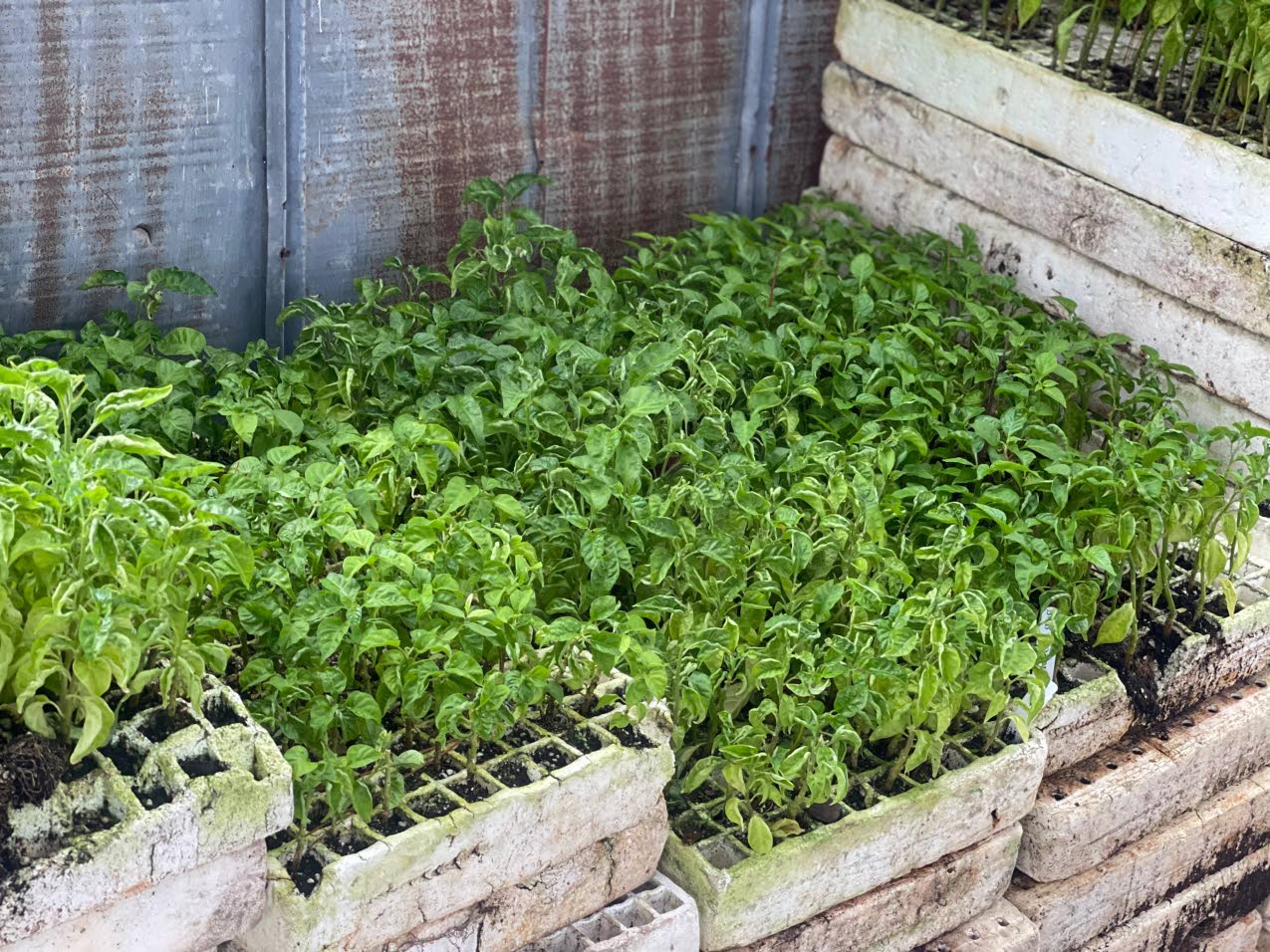
Young pepper trees ready to be planted


