



Kartel case lesson
Chief jurist points to internal inefficiencies’ effect on dispensing justice
HEAD of Jamaica’s judiciary Chief Justice Bryan Sykes on Monday highlighted dancehall artiste Adidja “Vybz Kartel” Palmer’s murder case as the poster child for “how internal inefficiencies can affect justice” and stressed that time standards established for the courts are of prime importance in dispensing justice.
Addressing the sixth Judiciary Strategic Management Retreat, Sykes argued that “judicial officers have ultimately the greatest impact on the performance of courts”.
He pointed out that there is an increasing recognition that the efficiency of courts is not so much tied to the amount of resources in the system, as it is to the performance and the behaviour of judicial officers. As such, the chief justice urged participants to utilise the strategic planning session to “think more deeply about these things and how we are going to improve our efficiency, not for the sake of numbers, but also for service delivery, so that persons can predict with reasonable accuracy how long the matters will take and consequently how much money they will have to expend”.
In highlighting the Palmer case as his “now best example of how internal inefficiencies can affect justice” Sykes said, “So here we have a case in which no court has said that the evidence could not sustain the conviction. No court has said that. But the case went down because of internal inefficiency, that’s what happened, you know”.
“So what we have is a gentleman, the deceased — I don’t know how many of you have read the case, but he was literally beaten to death by his attackers and the family did what they were supposed to do. The police did what they were supposed to do. The forensic services did what they were supposed to do. Matter came to court. Judicial error occurred. But had our internal processes been what it ought to be, in all probability, there would have been a retrial,” the chief justice said.
“So what we have is that Mr Palmer and his co-defendants are happy as they ought to be, because it took a very long time. But what about the family of the deceased? They can’t say that the justice system worked for them. And it can’t be that a litigant, a witness, the police, the forensic services, they do the prosecution, they do their jobs and because of our internal inefficiency a man who should really be sitting down behind bars is now free as a bird entertaining countless millions of persons and the family of the deceased don’t even have the satisfaction of saying, well, at least someone was convicted for the murder of their son, their father, their uncle, or whatever other role he may have had in that particular family structure. And that is why time standards matter,” Sykes said.
“So the Adidja Palmer case is an extreme case, but nonetheless it has actually happened,” the chief justice added.
He said the case is, in itself, an important example to trial courts.
“For those of us in the trial courts, one of the important lessons, if you look at the decisions coming out of the Court of Appeal — particularly on the criminal side — you see increasingly the complaint, and which the Court of Appeal is responding to that because of the delay [saying] ‘these distressing things are happening to me’. And so the Court of Appeal has responded now by reducing the sentence, and so on and so forth. But again, and that’s fine, I have no problem with that, but you have to think now about those who turned up and gave evidence sometimes at serious risk to life and limb,” Sykes noted.
“And then now when they read about this in the newspaper, they say, ‘But is what kind of system this? Imagine me go to court now, I hide from all sorts of persons and the man only get this’. So those are the things that undermine public trust and confidence. So you can, in fact, follow the law, but people don’t have confidence in it because it takes too long,” Sykes argued.
“So when we come here and we plan, it is really not a week of relaxation, it’s a week where we give serious thought to how we do what we do, and when we return we should return with a commitment to improve service delivery to our citizens, keeping adjournments to a minimum, only necessary adjournment should be granted,” he said.
In July last year Palmer and his co-accused were set free after the Court of Appeal ruled against retrying them for the murder of Clive “Lizard” Williams.
Palmer, Shawn “Shawn Storm” Campbell, Kahira Jones, and Andre St John were convicted of the September 2011 murder of Williams in 2014. During the murder trial, one juror was accused of offering bribes to other jurors, and after the court became aware of that allegation, the judge chose to continue the trial instead of dismissing the jury and moving to empanel a new jury. Subsequently, Palmer was sentenced to life in prison with eligibility of parole after serving 35 years. His co-accused — Campbell, Jones, and St John — were also handed life sentences. Campbell and Jones would have been eligible for parole after serving 25 years, while St John was to be eligible for parole after serving 15 years. However, following an appeal, the men’s parole times were reduced by two-and-a-half years each.
Lawyers representing the quartet took the case to the local Court of Appeal in 2020, but their convictions were upheld. The appeal was then taken to the United Kingdom Privy Council, and on March 14, 2024, their murder convictions were overturned on the grounds of juror misconduct. The Privy Council then remitted the case back to the Jamaica Court of Appeal to decide whether there should be a retrial.
The prosecution’s case was that the correspondence and communication media, taken as a whole with the evidence of the sole eyewitness, proved the fact of the killing, the reason for the killing, the method of disposal of the body, and the identity of at least one of the killers. However, during a five-day hearing in June, the Appeal Court panel reiterated concern that for at least two of the men there was danger that they could be prejudiced, given the length of time already spent behind bars. In ordering the release of the men, Appeal Court judges said they considered 12 factors in arriving at the decision not to retry them. The factors included the absence of evidence, the absence of defence witnesses, the absence of prosecution witnesses, the physical, psychological and emotional health of Palmer, and the possibility that Campbell and Jones would get more time if a new trial was ordered. The Court of Appeal also noted that the estimation was that it would take 15 years before the matter would go for a retrial.
Jones was the only one not released from prison on the day, as he was serving an 18-year sentence for wounding with intent stemming from an incident in which he shot a man in Waterford in Portmore, St Catherine, in 2009.
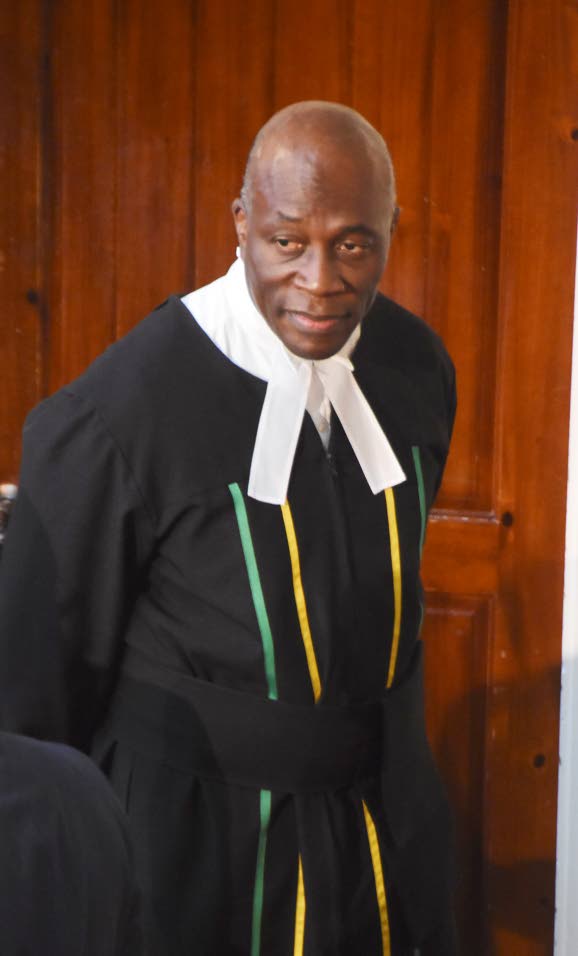
SYKES… judicial officers have ultimately the greatest impact on the performance of courts.


