



Cancer centre needed
Survivors, doctors celebrate support for Pink Run but point to recurring screening shortfalls
CITING the sheer cost of cancer medication and therapies, as well as the time treatment takes, a local surgeon says it may be time for a cancer centre to be established in the country.
“We have to consider whether we need to have a cancer centre. We started by having clinics directed towards cancer but we’re [up on] a time that we may need to have an actual cancer centre. And I have no dog in this fight; I have friends on both sides of the pool. I don’t have on no orange, I don’t have on no green, and I tell them the same thing. So whichever party gets into power and their platform is going to be health, that is something that needs to be entertained,” Dr Hugh Anthony Roberts, consultant general at Kingston Public Hospital, said Tuesday at the launch of the 25th Jamaica Reach to Recovery (JR2R) Pink Run at S Hotel in New Kingston.
JR2R President Sandra Samuels, a breast cancer survivor, detailed the purpose of the Pink Run.
“While October sees a surge of pink and increased screening, life tends to return to normal after… However, breast cancer is a 24-7 concern and the need for support is immense,” she said.
One cancer survivor and JR2R member in the room was Nadine Blackwood, who first received a diagnosis in 1998.
She fought the disease until 2002, when she was declared cancer-free. However, Blackwood was shocked in March this year when her second diagnosis came, 27 years after the first.
“I fought the battle and I overcame, and then to my surprise, this year March it came back, but it was detected early so here I am. I am not through this process yet, and I am a proud ‘thriver’,” she said.
The Ministry of Health and Wellness indicates that breast cancer is the most common cancer among Jamaican women. It’s women like Blackwood the Pink Run, under the theme ‘Reaching hearts, restoring hope’, works to assist.
Currently, JR2R not only funds therapy for cancer patients but also donates to their care, with the maximum donation recently increased to $150,000. It also provides prosthetics and specialised bras for women who have had mastectomies.
“Too many women still resort to stuffing their bras with cotton, cut-up cloth, [or] socks because they can’t afford a prosthesis and a specialised bra,” Samuels said.
The run, formerly known as the ICWI Pink Run, is the primary fund-raiser for JR2R, enabling the non-profit to carry out its mandate. Since January 2025 JR2R has assisted 150 Jamaicans with cancer treatment at a cost of $7.5 million, and provided prostheses worth $500,000
For Blackwood, screening herself led to an early diagnosis, and as every speaker at the event emphasised, early detection saves lives.
“I see many younger women coming into our meetings and too many, too many persons coming in with late-stage breast cancer, which is not only harder but more expensive to treat,” Samuels explained, her voice filled with emotion.
Jamaica Cancer Society (JCS) Executive Director Roshane Reid-Koomson pointed again to the lack of routine cancer screening among women and men at risk, an issue that has plagued Jamaica for some time.
“What we see most often are women who have already detected a lump, and they are coming now to confirm. What we want to do is to embark on a national programme where public education is increased to the point where we see an increase in screening,” she said.
The JCS president said while one barrier to screening is education, another is accessibility.
“National estimates suggest that [only] 20 per cent of women who should be screened annually are actually getting screened, but this issue of screening is also tied to inaccessibility,” she said.
Reid-Koomson’s assessment was supported by Dr Roberts who explained that of the two mammogram machines in use in the public health sector, neither is used for screening purposes.
“They’re used for diagnostic purposes, meaning they may be used for persons who [already] have a disease and you’re investigating them, or you’re using that to pick up something else in a person who may have already been diagnosed with breast cancer or some other disease that may increase their risk of having breast cancer later on in their life,” Dr Roberts said.
He explained that this means women who want to keep up with screening, which is recommended to be done yearly for those over 40, must pay to do so at a private health facility.
At the same time he explained that even in the private sector, only eight parishes offer mammogram services.
Roberts went on to share that almost half of Jamaica’s patients with a cancer diagnosis present with late-stage cancer.
“The problem is, in Jamaica we actually have persons presenting with breast cancer at stage three… almost 50 per cent of the patients,” Roberts said.
Additionally, he indicated that the median age of presentation in Jamaica is around 54, compared to North America where it is between 60 and 62.
“In that cohort of persons who present, you actually find about 33 or 36 per cent, depending on what studies you quote, are actually under the age of 50, and a further 16.6 per cent are under the age of 40,” he explained.
He emphasised, though, that to battle these numbers, a lower screening age than the current 40, and improved mammogram technology, could help.
While acknowledging that the stage of cancer is not the only deciding factor in treatment cost, Roberts maintained that early detection in breast cancer can not only reduce the money spent but also give patients a higher chance of survival.
Citing the significant distances that patients often travel to have mammograms done at the Jamaica Cancer Society, Reid-Koomson reiterated the need for a national mammography programme — which the JCS has called for before — and maintained that improving coverage for screening and doing self-checks are paramount.
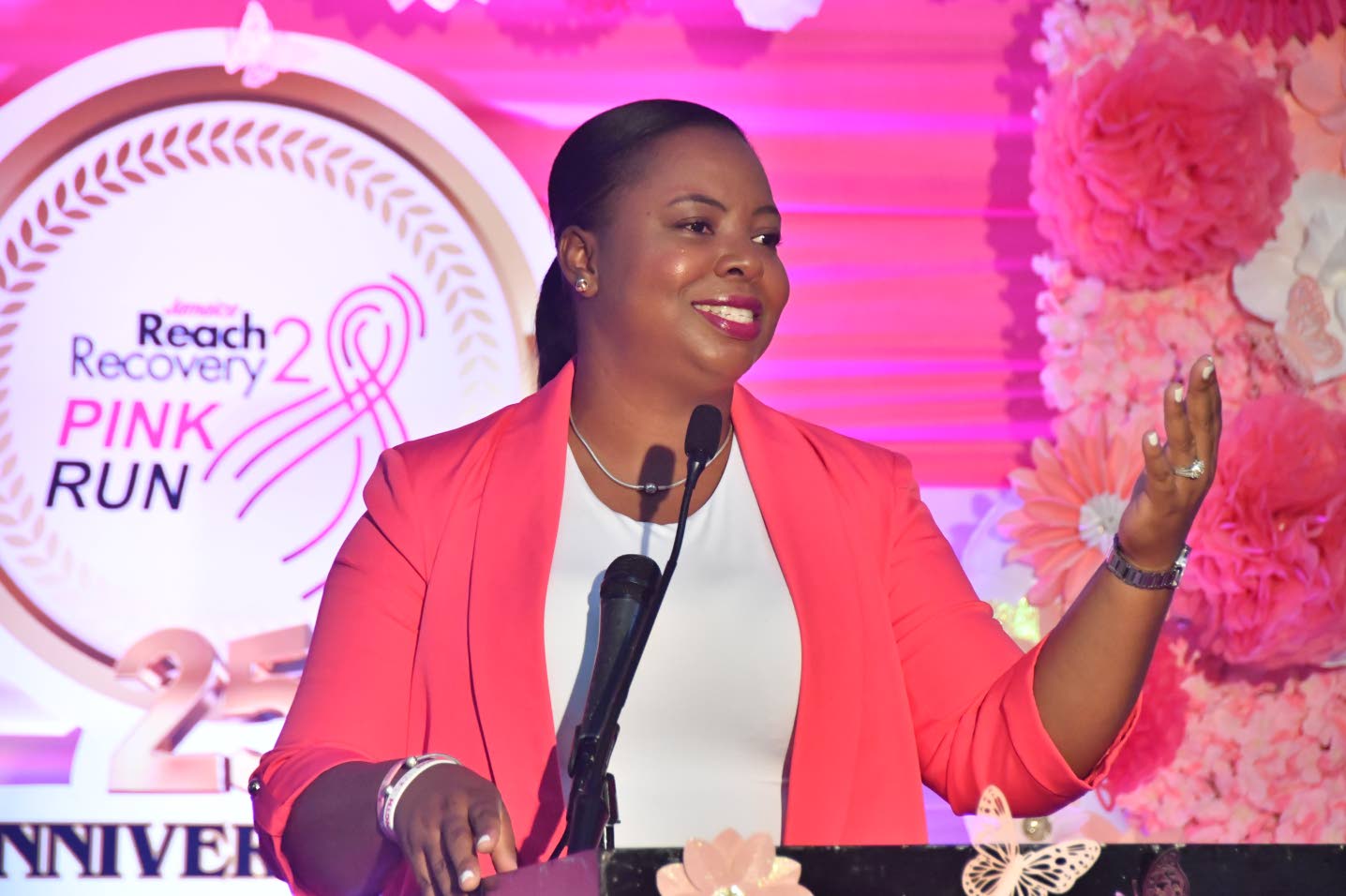
Jamaica Cancer Society Executive Director Roshane Reid-Koomson emphasising the importance of screening at the launch of Jamaica Reach to Recovrey Pink Run on Tuesday, August 26.


