JLP’s minimum wage plan ‘morally correct, economically necessary’, says Holness
After casting his vote at Mona High School in the St Andrew Eastern constituency Wednesday morning, Jamaica Labour Party (JLP) leader Prime Minister Dr Andrew Holness reiterated that his party’s minimum wage promise is more than just a campaign tactic, describing it as a continuation of his Government’s commitment to building a stronger working class.
Speaking to journalists after exiting the polling station, Holness said: “You build the middle class out of the working class, meaning you support the working class. You give them the tools to climb the economic ladder, such as consistently increasing their minimum wage so that they can get access to better income, better amenities, and better education and that is the core of building the middle class.”
He dismissed criticism that the JLP’s minimum wage policy was unsustainable, insisting that the increase was both “morally correct” and economically necessary to keep the labour force growing. He argued that fears of middle-class decline were misplaced, recalling that the minimum wage was $6,000 in 2016 compared to $16,000 today, during which period unemployment fell from 13 per cent to 3.3 per cent.
Holness also criticised the tax relief proposal made by the People’s National Party (PNP), suggesting that it would benefit high-income earners at the expense of low-wage workers.
“To me, this policy that the PNP put in place was not just fiscally irresponsible, but immoral. Some economists have said, though, that it’s not sustainable, and it will affect the middle class adversely,” he declared.
Holness also defended his Administration’s record, stressing that the JLP had outperformed past governments across several areas.
“There has never been a Government to have cut crime in half, cut the national debt in half, cut poverty in half, presented 10 budgets with no net new taxes, who have actually given back taxes to the people, to have cut taxes and to have taken on some of the previously thought to be intractable or impossible problems and addressed them in substantial ways. In other words, our Government has transformed the fundamentals of Jamaica,” he said.
Pointing to challenges during his tenure, including the COVID-19 pandemic and natural disasters, Holness insisted that his Government had demonstrated resilience while maintaining fiscal discipline.
“We dealt with the pandemic, coming out of it very rapidly, without increasing our debt, without cutting one job in the public sector or cutting any pay in the public sector and immediately after, increasing public sector wages by the largest increase ever in the history of Jamaica,” he stated.
On the campaign itself, Holness described the JLP’s approach as strategic and achievement-focused, noting that the party had presented both a record of accomplishments and a manifesto outlining its future agenda.
Acknowledging that corruption remained a concern for some voters, Holness stressed that the JLP was focused on making government systems more orderly.
“Efficient systems can’t be corrupted. If you’re trying to deal with corruption you have to make systems efficient. You want quick delivery of results, systems that are integrated, transparency, and a fair process of adjudication,” he argued.
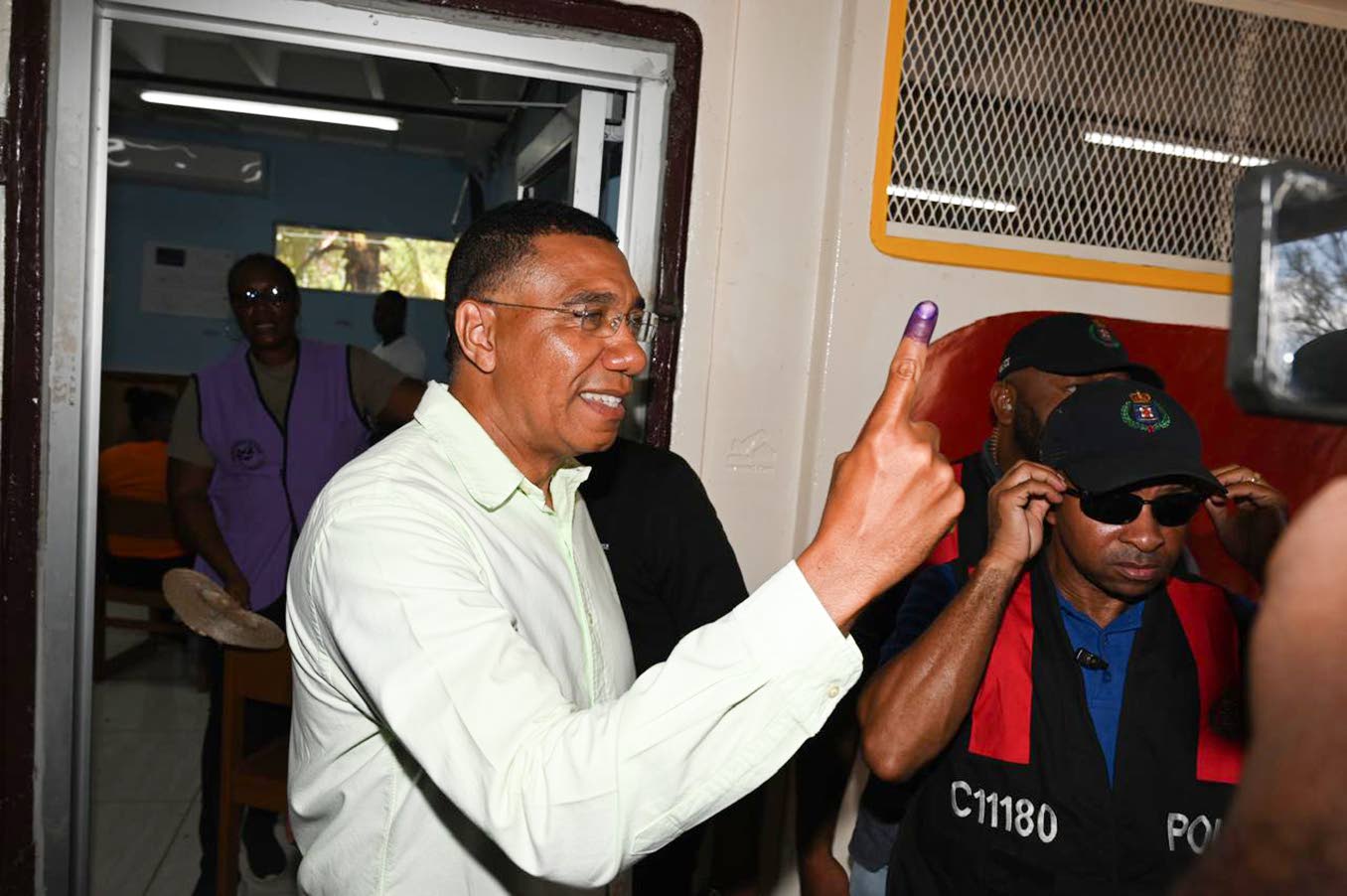
Jamaica Labour Party leader Prime Minister Dr Andrew Holness shows his inked finger indicating that he cast his vote on Wednesday.