



Plea for the disabled at polling stations
A People’s National Party (PNP) councillor in Portmore, St Catherine, on Wednesday spotlighted what he believes are weaknesses in the electoral process that threaten to alienate disabled voters.
Speaking with the Jamaica Observer from the Missionary Church Hall in Waterford, St Catherine East Central, Councillor Fenley Douglas (Waterford Division) said the melee which ensued at one polling station in the constituency over the procedure to be used for a voter said to be suffering from dementia was a call for legislative action.
“There are a lot of things I would like to see changed because persons who are incapacitated — persons who need assistance, the physically challenged, they are having it real rough, because the police are not in a position, under the law, for you to let these people go in front of the able-bodied,” Douglas said.
“I believe the law needs to be looked at. I saw where this morning a lady who had dementia, her sister came with her to assist her and the presiding officer told her the lady has to be in a position to indicate to her how she wanted to vote and she was saying how the law is now, is either she has no hands and needs assistance to make the X or the person is blind. So a lot of things need to be looked at, it’s now 2025, we have passed the years of universal adult suffrage long ago and we shouldn’t be having these problems; voting needs to be friendlier,” he told the Observer.
In the situation referenced by Douglas, which was witnessed first-hand by this reporter, the woman, said by relatives to suffer from dementia, was brought to the polling station at Grace Communion Jamaica/Worldwide Church of God to cast her vote, but was delayed as electoral workers tried to determine how to proceed. That delay sparked concerns amongst several orange-clad voters who expressed displeasure. One man, who went as far as to issue death threats at the officials, was chased by a cop on site back to the tent where outdoor workers for the PNP sat.
Alva Smith Drummond, returning officer for St Catherine East Central, explained the approach of the workers at the polling station to the Observer via telephone.
“I can only report what they told me, because I wasn’t on the spot. So what I was informed is that she came to the station to vote and as is the protocol we asked the person accompanying her to wait outside while we questioned her to determine who she wanted to assist her because we needed to give her the option. She was able to answer questions and she said she would mark her ballot herself. That was the report I got. So she went to mark her ballot, but on finishing she was unable to fold the ballot properly,” Smith Drummond said.
“They didn’t say this, but I am assuming that the ballot was exposed, so they had to spoil that one and issue a second. When they were issuing the second one I was told that her daughter was called in to assist her because by then they realised that she was able to answer the questions, but her coordination was not in order, so she wasn’t able to fold the ballot properly, so the daughter was called in and the vote was cast and everything was rectified after that,” she said.
The Representation of the People (Amendment) Act 2020 (ROPA), which is the primary legislation governing elections, makes provisions for persons with disabilities, particularly the blind, to cast their ballots. An individual who is blind, for example, can allow the presiding officer to make their mark on their behalf (in public) or can opt to bring a friend or relative to assist him or her.
For Douglas, however, this is not enough, given the realities seen on Wednesday across constituencies where the sick and the lame — some with both arms or legs missing, others wheelchair-bound or hobbling on walkers and walking sticks, while, still yet, others suffering from some form of dementia — showed up to exercise their franchise.
“Basically, I believe that how the system presently stands it is a deterrent for some people when they come to vote, because the system takes like a tax office effect where you have to spend the entire day to get the chance to cast a ballot,” he said.
One of the very first voters the Observer met in St Catherine East Central on Wednesday was an elderly woman with a walker who was being assisted by a friend from the polling station. Somewhat hard of hearing, when asked her age by this reporter she responded, ‘Mi nuh know, ask dem when them come,’ referring to relatives who were on their way to pick her up. She was, however, able to give her name as “Joyce”.
On Wednesday, 93-year-old Maud Brady who, according to family members, also suffers from dementia, was assisted by family to cast her vote at Cumberland High School in St Catherine South Eastern, where the Jamaica Labour Party incumbent Robert Miller went up against the PNP’s Dr Alfred Dawes.
Brady, while sharing that her process was uneventful, told the Observer she has exercised her franchise “since voting began in Jamaica”. However, a family member told the newspaper that she had, in fact, left the island as a young adult and had resided overseas for a number of years before moving to Jamaica after retirement.
Elroyton McPherson, a visually impaired man, was assisted by his friend Carl Smith to cast his vote at Cumberland High School.
“Mi teck the poll and I am satisfied,” McPherson, who was being led from the polling station, told the Observer. Asked whether he had told his friend what his voting preference was, he declared confidently, “He knows, all a wi work together fi years…mi friend lead mi to the station and mi talk to the people dem in charge and mi step to the poll,” he said.
A runner for the PNP stationed at Passage Fort in Gregory Park, St Catherine South Eastern, said the number of elderly voters was remarkable.
“Voting going excellent, all of the PNP them come out, the old people them come out more than the young people, lots of the old people came out for the PNP, from six o’clock this morning mi go fi di old people them,” she said happily.
The picture across those two constituencies mirrored each other, with election day workers and police personnel alike reporting slow but steady voting minus any difficulties other than the odd voter showing up without identification for which the legal provisions were utilised.
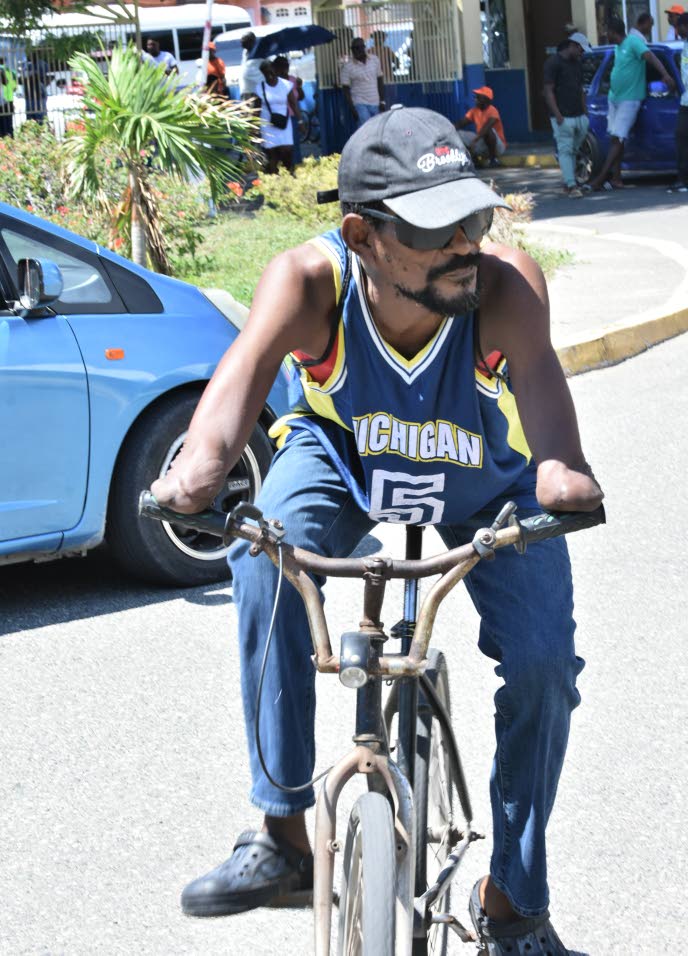
This man, without fingers, seen at Cumberland High School in St Catherine South Eastern, on election day riding his bicycle. It was not clear if he was there to vote.
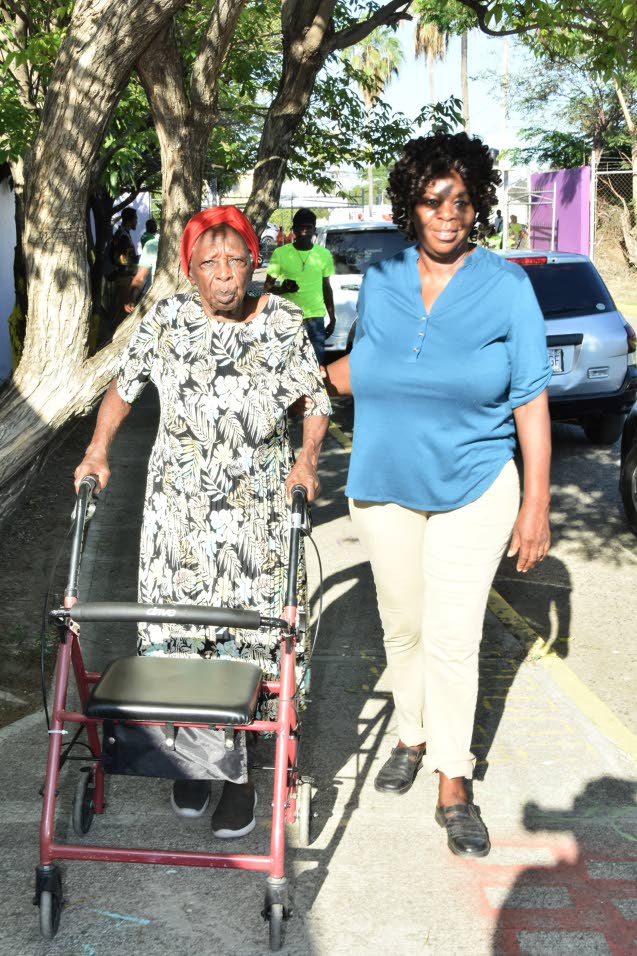
This elderly woman heads home, with the help of a family member, after casting her vote at Christian Gardens Infant School in Gregory Park, St Catherine East Central on Wednesday in the general elections.
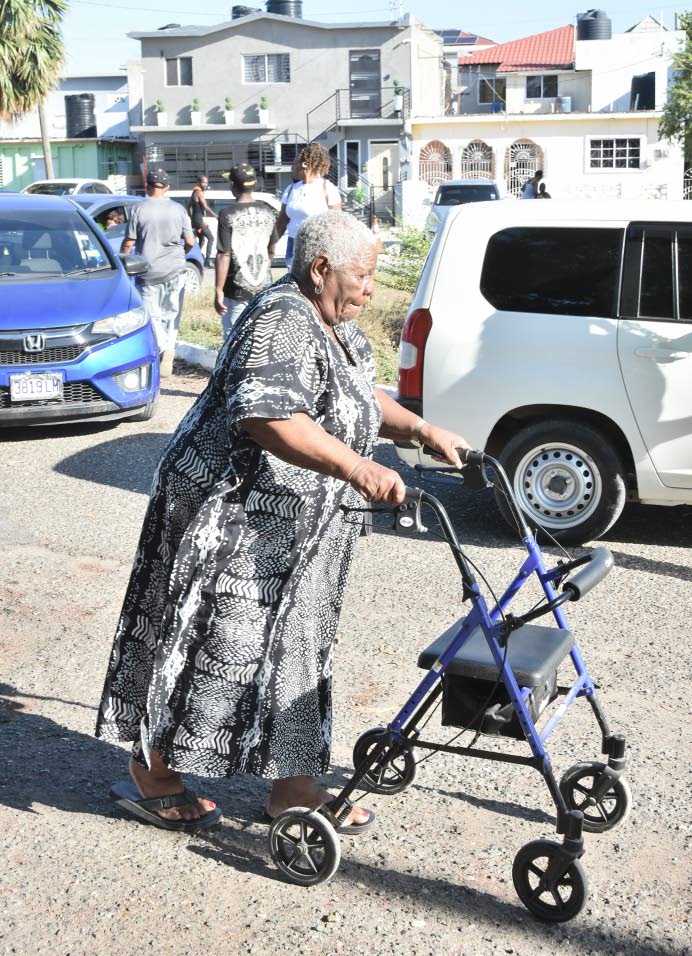
This senior citizen on her way to vote in Greggory Park, St Catherine.


