



Mayberry bets on Keo’s deal to power growth amid market setbacks
Mayberry Group Limited continues to face pressure from a weakened stock market, with its Mayberry Jamaican Equities portfolio driving a $700-million net loss in 2024, but the company is banking on diversification, including potential upside from fintech affiliate Keo World’s takeover of American Express’s international credit card business.
“Keo World has partnered with a hedge fund and has identified a shell company that was previously traded on the Nasdaq Europe exchange called Maha Capital [Partners], and they have concluded an arrangement where Keo will get a certain number of shares from this new entity where the funding will be used to take over that credit card business of American Express,” revealed Mayberry Chief Executive Officer Gary Peart during the company’s recent annual general meeting on Wednesday.
The digital fintech company, focused on micro lending, has secured the opportunity to take over American Express’s credit card business outside of North America as Amex retreats from that market. It will benefit by deploying its proprietary software to earn ongoing fees as the business grows, while also receiving a one-time distribution of shares for its role in the transaction.
“We have a decision to be made, whether those shares will be liquidated for cash or those shares will be distributed to the shareholders as shares,” Peart shared.
While the company is still considering how the distribution of shares will be handled, management noted that there are varying valuations attached to the holdings. At present, the calculated value of the investment is equal to its original outlay. Based on the latest briefing, the transaction is expected to be finalised before the end of December, with more details to be shared after the September 30 quarter. In the meantime, Mayberry sees positive results ahead through its investment of a Chalmers Avenue property. The company has completed its second building on the 33-acre property, though it has not yet been rented.
“I believe once we do so, it puts us in a position to start earning significant income,” said Peart.
The first building, a four-storey structure with about 100,000 square feet of space, has already been rented and sold, generating profits that funded the construction of the second 100,000-square-foot building. Together, both developments occupy about five to six acres, leaving roughly 20 acres for further build-out.
“We have entered into an agreement to sell approximately nine acres of it that we’re finalising now, which again, we should be able to book some profits once that sale is completed,” he revealed.
The broader intention is to gradually develop the property into a large-scale commercial enterprise. This, management noted, will support diversification of the portfolio as the company seeks new income streams following a 56 per cent decline in net profits. For the first six months of the year, performance was hampered by a weak second quarter, as softness in the stock market weighed on its stock, Mayberry Jamaican Equities (MJE). The decline was led by Supreme Ventures Limited (SVL), the company’s largest holding in MJE, along with Jamaica Broilers and National Commercial Bank (NCB) Financial Group.
“We are pretty confident in the outlook for SVL and most of the other shares in our portfolio,” Peart said. “We manage volatility, and just because a company might have a very bad quarter or even a bad year does not mean that you should sell the stock, and SVL is a very good example of that.”
According to Peart, profits have begun to return for Supreme Ventures, with dividends also resuming. He expressed similar optimism about NCB Financial Group, noting that the stock price has moved from $28 to $41.64 as of September 4, 2025. Mayberry values the stock at closer to $120 and expects both MJE and the wider group to benefit from future gains. As for Jamaica Broilers, the second-largest stock in MJE’s portfolio, a third-quarter loss was reported, and audited results are pending to determine the extent of impairment. Peart acknowledged there may be further impairment but said once the results are available, the company will have a clearer view of the stock’s position and outlook. He explained that any loss in the MJE portfolio ultimately flows through to the Mayberry Group, which owns 53 per cent of MJE. Despite this, Mayberry maintains confidence in the long-term value of its holdings, pointing to MJE’s net book value of $12.59 per share against a market price of $7.75, representing a 40 per cent discount to its net asset value.

Mayberry Group Limited financial performance 2024, as presented at its annual general meeting.
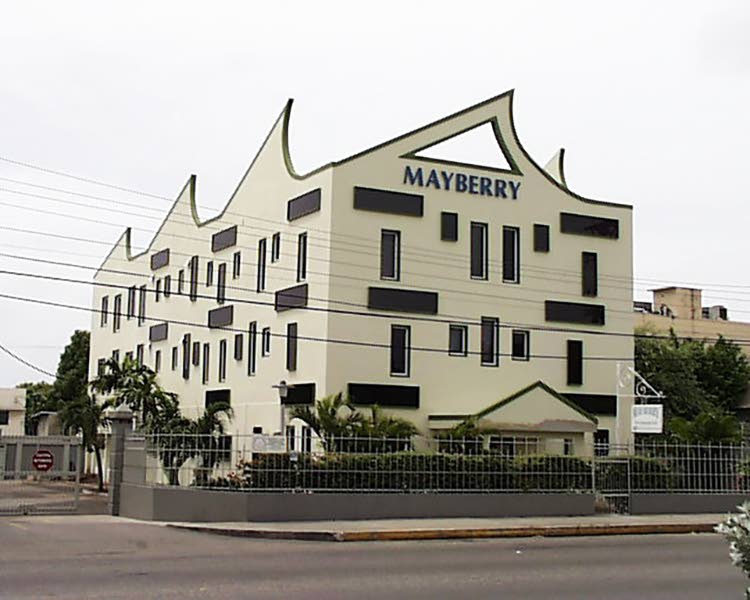
Mayberry Group Limited’s corporate headquarters in St Andrew.


