UWI, Mona gifted Dr Nigel Clarke’s policy memoir
FORMER Minister of Finance Dr Nigel Clarke has presented copies of his new book,
Footprints in the Sand, to The University of the West Indies, (The UWI) Mona campus, urging future leaders, scholars, and policymakers to continue the unfinished work of building an economically independent Jamaica.
The book, a curated collection of reflections and policy essays authored during Clarke’s time as minister of finance in Jamaica, outlines the country’s journey from economic instability to hard-won resilience.
“This is a call to continue,” said Clarke. “Economic stability is a means — not an end. The real goal is independence. And for that, we need a generation of citizens who understand the history of reform and the principles that made it possible,” added Clarke.
He emphasised the three conditions necessary for policy transformation — commitment to purpose, continuity in sound decisions, and the courage to act.
Clarke, who now serves as a deputy managing director of the International Monetary Fund (IMF), credited former managing director of the global entity Christine Lagarde for naming these as key elements behind Jamaica’s recovery.
“These are not abstract ideas. These are decisions that had to be made in real time, under pressure, with long-term consequences for real people. What I hope this book does is contextualise those decisions so that students, administrators, and policymakers can learn from them,” said Clarke.
The former finance minister also cautioned against complacency, likening economic progress to a cricket match: “Don’t celebrate at lunch on day one. The game isn’t over. The work continues.”
Clarke later shifted the focus from macroeconomic policy to a deeper, more urgent priority — access to tertiary education.
He described it as a “non-negotiable pillar” of national development, warning that without matching economic gains with investment in human capital, progress risks leaving the very people who built it behind.
“It doesn’t matter how strong the economy looks on paper if our people aren’t equipped to access its rewards. If we don’t expand access to high-quality tertiary education, the benefits of growth will end up elsewhere — not with the communities that helped make it possible. That’s why this isn’t optional — it’s urgent,” added Clarke.
He praised The UWI for its “historic role” in producing the human capital that undergirds Jamaica’s institutions and industries, describing the campus as “fundamental to the transformation of not just Jamaican society, but the region”.
The book was officially handed over to representatives of the Mona Library, the Department of Economics, and the UWI administration, with principal of The UWI, Mona campus Professor Densil Williams and other senior leaders in attendance.
“This gift to the university is far more than a symbolic gesture — it’s a scholarly resource that deepens our understanding of Jamaica’s economic evolution,” said Williams,
“Our students and researchers must engage with local policy reflections like Footprints in the Sand so they are learning about global theories and also interrogating and applying the lived realities of Jamaican governance and reform,” added Williams.
The book, which compiles and expands upon Clarke’s published thought pieces between 2016 and 2023, is framed as both a historical document and a living roadmap. He described it as being written with the curious student in mind — someone seeking to understand the “why” behind the “what” of economic reform.
“Jamaica’s project of development is still in motion. This book is a contribution to the conversation, so we can go further, faster, together,” added Clarke.
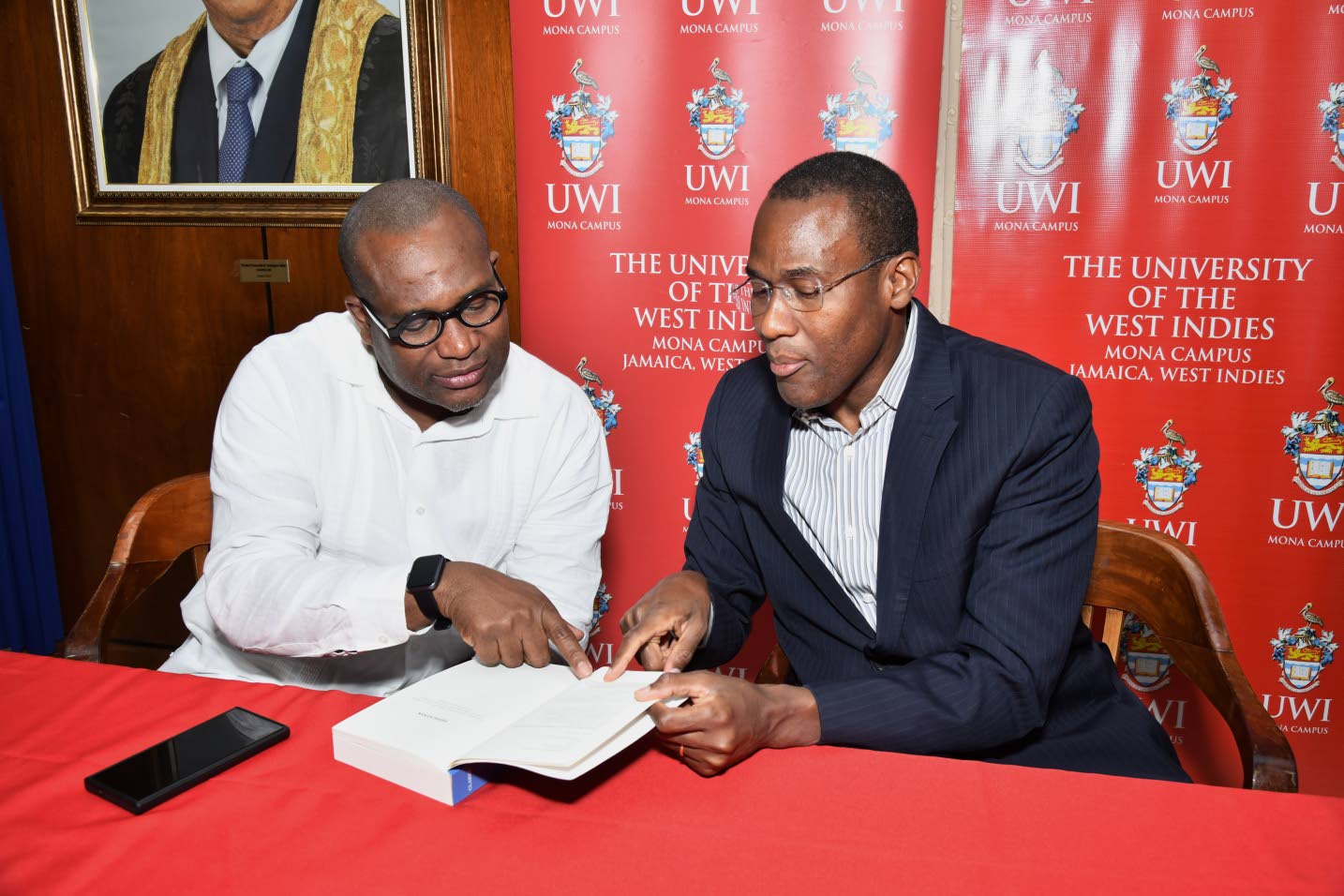
Dr Nigel Clarke (right) and Professor Densil A Williams examine a section of Clarke’s book Footprints in the Sand following the official presentation.