



Our elections: Then, now, future
The 2025 General Election was the best in Jamaica’s history. It was the election we have all fantasised about since the bloody 1980 civil war election when Comrades and Labourites had running gun battles across the country, and not even children were safe from tribalists’ bullets.
That bloodshed inspired the wonderful Festival song by the great Stanley Beckford, Come Sing With Me, in 1977: “I’m dreaming of a new Jamaica… A land of peace and love…”
Stanley’s dream finally came true 45 years later, as orange- and green-clad supporters hugged and danced in unprecedented camaraderie to the best set of campaign songs this music-drenched country has ever produced. Huge crowds of all persuasions attended political rallies across the island with no reported violence. The hilarious icing on the cake was the Jamaica Labour Party (JLP) appropriating the People’s National Party’s (PNP) March We a March anthem — perhaps the catchiest political song since the lyrics “My faada born yah” — as their victory theme, without even bothering to change “We don’t care what the Labourites say” text. When a song good, it just good! (https://x.com/swankycamille/status/1964733069858115621?t=hvuFxd1Aan-xJfvzBkF4RQ&s=08) Take a bow, my Jamaican people.
The great lessening of political tensions began in 2011, as the 2007 election was still violence-plagued. Recall these headlines: ‘Police investigating political violence’, ‘Motorcade supporters blockaded and beaten’, ‘Candidate and supporters come under heavy gunfire’, ‘3 workers shot in drive-by incidents’, ‘3 shot and killed’, ‘Two female campaign workers shot and injured’, and ‘Party claims attacks on supporters a deliberate strategy to use violence and terror to intimidate’.
But newspaper headlines about the 2011 nomination day read: ‘Nomination day violence free’, ‘Like a family fun day’, ‘Carnival-like atmosphere’, and ‘History in the making: Political rivals mingle in West Central St Andrew’.’
I wrote then: “[E]ven if he fails to get a mandate on December 29, Andrew Holness will still have left an indelible stamp… in his inauguration speech, he expounded a new vision:
“ ‘Jamaica is yearning for a new politics to emerge. How can we be fully free when some of us are not even free to express our conscience? Zones of political exclusion are incompatible with freedom… It is time to end garrison politics.’ ”
“Holness, since becoming prime minister, has refrained from personal attacks and, even under hostile questioning, has never lost his temper or got testy with interviewers… people describe him as ‘calm’
“[T]hings have been improving… But there is no question that this prime minister who keeps condemning election violence, and is generally smiling, and never gets into verbal tussles… and never seems to get angry in public, has rubbed off on our politics.’ (http://www.kevinobrienchang.com/articles/celebrating-democracy—jamaican-style.html)
I’ve been wrong about many things in my time, so it’s nice to be able to pat myself on the back about my 2011 predictions: ‘You finally got one right, my friend!’
Andrew Holness did fail to get a mandate in 2011. Yet, prime minister now from 2016 to 2025, his mild-mannered, usually smiling, non-confrontational persona has unquestionably dampened political tensions.
Most world leaders are cordoned from the public by armed bodyguards. In this election, “Brogad” has been amazingly accessible, especially to children. Youngsters generally see politicians as distant and scary, but they seem to view “1PM” almost as a big teddy bear, approaching him fearlessly and gleefully hugging “Anju” without permission.
The 2025 election boiled down to Jamaicans’ reluctance to give third terms versus the Andrew Holness Administration making Jamaicans feel safer than they have in 30 years. Common sense always suggested that a Government with such quantifiably real accomplishments was unlikely to be booted. Elections usually boil down to: Improved my quality of life? Another term. My standard of living has got worse? Goodbye!
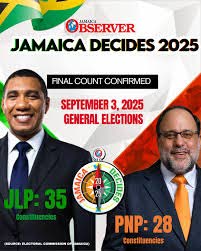
I am a single-issue voter — crime! Who seems more likely to keep me and my family safe always gets my vote. The final JLP 35, PNP 28 scorecard means a stronger Opposition, and that Police Commissioner Kevin Blake and his men will continue to get the backing and resources that have helped cut murders by almost 50 per cent.
Holness became only our second three-term PM other than P J Patterson. Horace Chang was already numerically the best Security Minister on record, and is now the only General Secretary to win three-straight general elections.
Kudos to Mark Golding for doubling number of PNP MPs under his watch. Is it not incredible that a full white British descended Jew — albeit Jamaican-born — running to be the elected leader of a 90 per cent black country, was not even a topic of discussion? Not one of the hundreds I talked to brought up the skin colour of “Markie G”, who is certainly a wonderful ‘out of many’ example. It’s amazing how often Jamaicans take for granted things unthinkable in many countries.
In every Jamaican election since 1944, about 31 per cent of the Jamaican population has voted. The high point was 40 per cent in 1980, and it sunk as low as 24 per cent in 1972. The percentage registered to vote has increased significantly, but vox pops suggest this has more to do with registered voter cards being a convenient national IDs than with any surge in voting interest.
A plausible explanation for Jamaican voter apathy is the lack of compelling divides. There is no racial element as in the US and Trinidad, no class politics as in Britain, no geographical or language rifts as in Canada, no religious antagonism as in India, and no real ideological splits as in Brazil. JLP and PNP demographics are almost identical. From an outside big-picture view, quality of leadership apart, the two main parties are really “no better barrel, no better herring”. Party supporter passion often seems more akin to Manchester United vs Manchester City-style football team fervour than any real belief in the superior ability of their party to govern.
Many moan about low voter turnout. Yet the most enthusiastic ballot casting came during the bloodiest election, and who would want to go back to 1980’s murderous mentality? Maybe in terms of peaceful politics, a touch of voter indifference is not necessarily a bad thing.
A simple change that could conceivably increase voter turnout would be to make general election day a public holiday. It is only one day every five years, and many people already stay home. So loss of productivity claims would be minimal. Furthermore, reliable sources say many corporate entities did not give workers their allowed three hours, not including lunchtime to vote. Some, not all, call centres were said to be among the major culprits. A public holiday election day would ensure all Jamaicans have an opportunity to cast their ballot, as is their constitutional right.
It might also step up the election vibes, with all-day election dances held in every town, and the added fervour might push more of the indifferent to the ballot box. Data show that countries with election day as a public holiday generally have a higher voter turnout, including Australia, Belgium, South Korea, and Costa Rica. So what’s there to lose?
Kevin O’Brien Chang is an entrepreneur and public commentator. Send comments to the Jamaica Observer or kob.chang@fontanapharmacy.com.
Kevin O’Brien Chang


