



Jamaica’s reputation for an efficient electoral system must be jealously protected
From my recollection this is the first time in the last 35 years that allegations have been made of significant irregularities in a general election. The 2016 General Election that was won by a majority of merely one seat and a plurality of only 3,237 votes resulted in a change of Government and a seamless transfer of power without any claim of irregularities.
Jamaica has earned plaudits for the management of its electoral system and the conduct of elections. Having led several electoral observer missions for the Commonwealth and the Organization of American States in Africa, Asia, the Pacific and the Caribbean, I have been proud of the admiration we enjoy in many countries for the quality of our election apparatus that many have sought to copy. This is a reputation that we must jealously protect.
Against this backdrop, the recent claim by the People’s National Party (PNP) of irregularities in the September 3 General Election and its call for an independent enquiry must not be taken lightly. The party has two representatives on the Electoral Commission of Jamaica and perhaps that is where the investigation should begin before elevating it to an “independent inquiry”.
That investigation must be informed by specific evidence: the particular polling stations at which persons in line at 5:00 pm were not allowed to vote, specific instances of vote-buying, all of which should be supported by written statements.
I recall that in the Buck/King election petition following the 1976 General Election I spent two weeks in Eastern Hanover collecting statements with a justice of the peace as witness to substantiate the claim of irregularities. They proved to be persuasive and the election result was overturned.
It should be noted that instances of vote-buying are outside the scope of authority of the Electoral Office. It is a criminal offence which, under section 94 of the Representation of the People Act, is punishable by a fine of up to $80,000 or imprisonment for not less than three years. A charge for such an offence is police work, not the job of the Electoral Office.
Vote-buying is a pernicious practice that has perhaps been ever present in our elections. Prominent figures in the PNP have acknowledged this. Former PNP General Secretary Paul Burke was reported in the media as questioning the moral authority of his party colleagues who spoke out against vote-buying in the 2019 by-election in Portland Eastern, saying that money and benefits have been a growing feature and campaign strategy in the PNP’s own internal elections.
Vote-buying is hard to trap. An envelope quietly put in the hand of a voter in the privacy of his home can hardly be detected unless the voter is prepared to attest. More overt displays in the precincts of a polling station are more easily captured by phone cameras and could be submitted as evidence.
The PNP also complained about the use of State resources to influence voters in the period leading up to the elections. I cannot recall any election in which this accusation was not levelled against the party in power — JLP (Jamaica Labour Party) or PNP. We face a dilemma. The functions of a Government and the services it provides can hardly be shut down during an election period which can extend for over a year. But I believe our voters are smart. They know when a benefit is linked to an upcoming election, even the fixing of roads. They will accept it because they need it but I doubt that its influence on how they vote in the secrecy of the polling booth is that significant. I know of some candidates who bemoaned the amount of money they gave away in an election but still lost.
Another complaint by the PNP is the inadequacy of the three-hour window provided for employees to be away from work in order to cast their ballots. This needs to be addressed. We need to consider making election day a public holiday as is done in a number of countries, including Guyana, where I recently observed its elections. Some may use the day to go to the beach but those are persons who would be unlikely to vote anyway.
Concerns have been raised that the voters’ list is inflated, containing a large number of persons who have died or migrated. Under the continuous registration provisions that exist, persons can attend at the offices of the returning officer to apply for registration. An enumerator along with scrutineers is then dispatched to the address given to confirm that the applicant is resident there. There is also provision to require the registrar general to submit to the director of elections every three months a list of all adult persons whose deaths have been registered so that those names can be removed from the voters’ list. There is, however, no way of identifying persons who no longer reside in Jamaica and who also should be removed from the list.
There is provision in section 8 of the Representation of the People Act for a general house-to-house enumeration exercise to register those persons currently alive and resident in Jamaica. I can’t recall when that was last done but it is important that this be done periodically — at least once every 10 years — to ensure that the list contains, as far as possible, only those persons alive and resident in Jamaica and otherwise qualified to be registered. This type of revision is now overdue.
We must bear in mind, of course, that even the most up-to-date list is going to be inflated. A list published today is going to include persons who died or migrated yesterday. An inflated list does not necessarily lead to irregularities because there are significant checks and balances at the polling stations to prevent impersonation — persons voting in the names of deceased or migrated voters. However, it does distort the voter turnout calculation since the base is larger than the actual. In Guyana where I recently observed the elections, the voters’ list was equivalent to 90 per cent of the estimated population — an unrealistic total.
Our reputation for an efficient electoral system is one of the epaulettes on our shoulder. We must be careful not to mess with it.
Bruce Golding served as Jamaica’s eighth prime minister from September 2007 to October 2011.
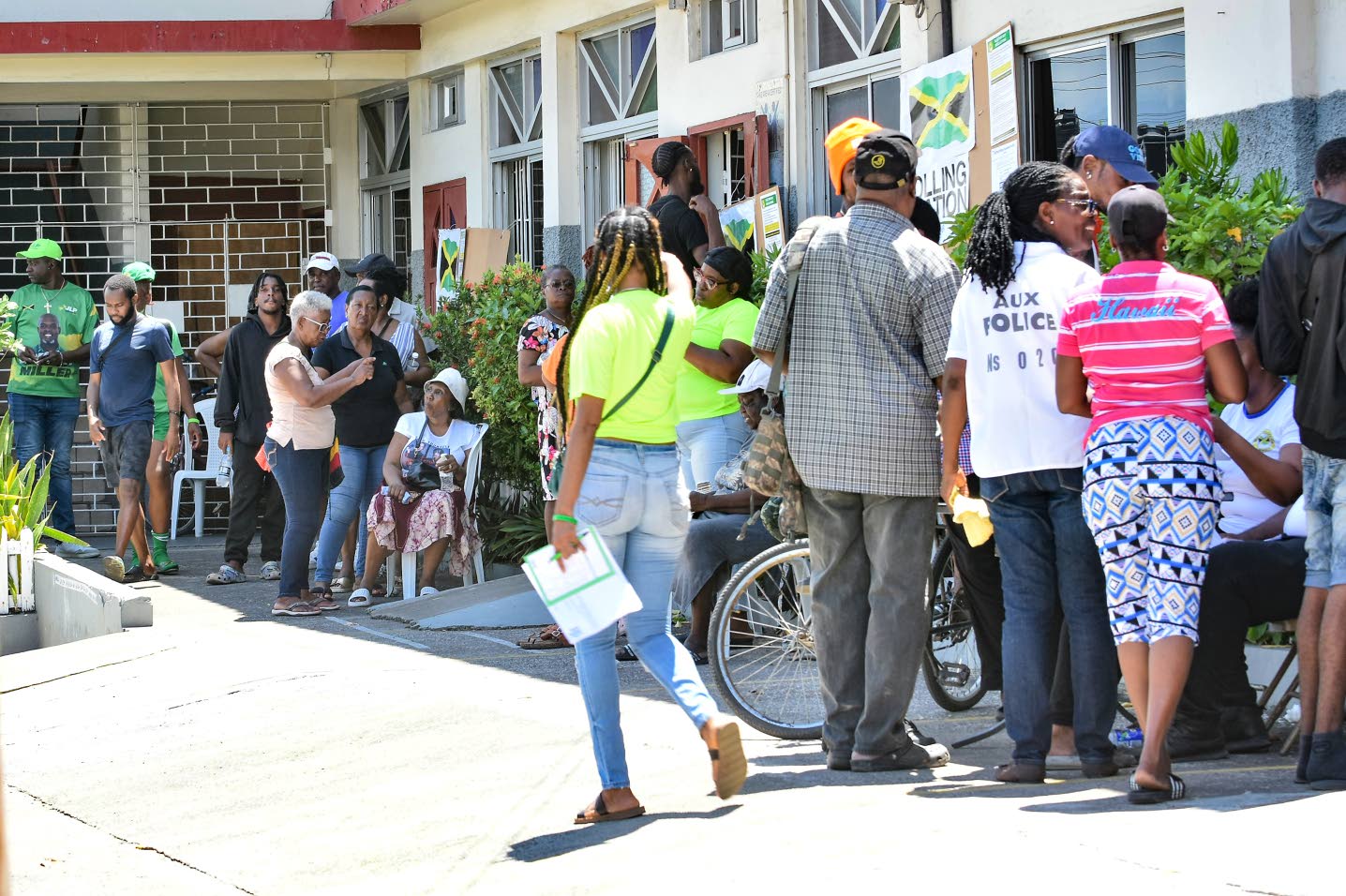
Jamaicans wait to cast their votes at Southborough Primary in Portmore, St Catherine, on election day, September 3, 2025. (Photo: Aston Spaulding)


