



Cabinet stability welcomed
Now on to economic growth, say business leaders
Two of Jamaica’s prominent business leaders are hailing the continuity evident in the composition of the 19-member Cabinet unveiled by Prime Minister Dr Andrew Holness on Wednesday and are urging that he uses this to spur economic growth.
The major developments among the appointees are the return of Dr Andrew Wheatley and Robert Montague to the Executive after seven years and three-and-a-half years’ absence, respectively, as well as the dropping of Marlene Malahoo Forte as the minister of legal and constitutional affairs. Her responsibilities now reside with Delroy Chuck in what has been renamed the Ministry of Justice, Legal and Constitutional Affairs.
Wheatley, who resigned as the minister of energy, science, and technology in July 2018 at the height of the Petrojam scandal, returns as minister without portfolio in the Office of the Prime Minister responsible for science, technology and special projects.
Montague is back after he resigned in March 2022 as minister without portfolio in the Office of the Prime Minister with responsibility for, among other things, the housing portfolio. He resigned in the face of a damning investigation report from the Integrity Commission which accused him of approving the issuance of gun licences to a person of questionable character when he was minister of national security.
The rest of the old guard, having retained their seats in the keenly-contested September 3 General Election won by the Jamaica Labour Party (JLP), are back to head their various ministries. They include Horace Chang as minister of national security and peace who will also continue as deputy prime minister; Fayval Williams as minister of finance and the public service, Floyd Green at agriculture, fisheries and mining; Edmund Bartlett at tourism; and Daryl Vaz at transport, telecommunications, and energy.
“The prime minister, as expected, did not make any sweeping changes. I think that [the] thing, in his opinion and in the electorate’s opinion, was that we’re going well, and because of that he decided to keep things as they were,” said Private Sector Organisation of Jamaica President Metry Seaga.
“I am happy to see that no major changes were made because, when you change ministers there’s a disruption in the ministries, so we’re happy that that’s not happening,” Seaga added.
He noted that Holness added two new ministers without portfolio in his office — Wheatley and Montague — who have been assigned to important areas.
“So I look forward to continuity and I look forward to what he said in his speech [at his swearing-in as prime minister] about unity with the Opposition and working together, and I look forward to the growth through the special economic zone. I’m very bullish on Jamaica, and feel that we’re in a good place and have a lot more to come,” Seaga said.
For his part, Seprod Group Chief Executive Officer and Managing Director Richard Pandohie noted that, “Many ministers have returned to their prior portfolios — a smart move that avoids the learning curve and lets them hit the ground running with their technical teams.
“But this period must be about more than continuity. Jamaica needs to unlock growth in a real way — at least five per cent per annum. That means short-term wins while investing in long-term sustainability. Every ministry must be tied back to growth, with clear deliverables. Productivity and leadership must come from the top,” the business leader added.
Listing his key priorities to move the gross domestic product (GDP) needle, Pandohie described national security as economic policy, pointing out that crime drains three per cent of GDP.
“While murders are down, Jamaicans remain fearful. Absenteeism for night-time work is high, and visitors stay behind all-inclusive walls. Until we fix this the economy cannot capture the full value of tourism and productivity,” he argued.
Pandohie said steps must be taken to ensure there is cheaper, reliable energy.
“Electricity costs are among the highest in the region. We must fast-track wheeling and renewables, and address theft creatively — without punishing legitimate households whose disposable income drives domestic demand,” he said.
On the matter of land titling and infrastructure, he said, “Title the land, connect farms with paved roads, and end favouritism in leasing State lands. Idle leases should be revoked and reassigned to those who will put them to productive use.”
Regarding tourism, Pandohie noted that arrivals are strong and said now there is “need to raise the spend per visitor, grow sports and health tourism, and deepen linkages with local suppliers so more value stays in Jamaica”.
In relation to the digitisation of the State, he said that permits and approvals remain a hidden tax and suggested that “Production and export processes must go fully online, with approval times cut by at least 50 per cent.”
The Seprod boss also said health care and education must deliver transformational change.
“These directly impact our people and our future. Too often we benchmark ourselves against the anaemic performances of the past, rather than where we ought to be,” he said.
Regarding the Ministry of Economic Growth and Job Creation, which is headed by the prime minister, Pandohie said clarity was needed.
“What are the targets? What are the pillars to get there? It is one of the most important ministries, yet arguably the one with the least clarity,” he said.
In his presentation after the Cabinet was sworn in by Governor General Sir Patrick Allen at King’s House, Holness emphasised that it was a holding Cabinet.
“This third term will also be about seamless succession and transition planning. You would have seen this as a number of our ministers have indicated their timelines, ensuring that there is significant renewal in leadership, thinking and approaches,” he said.
The prime minister noted that Vaz was first to indicate his timeline, and that Dr Chang had also done likewise. He suggested that Olivia Grange, the minister of culture, gender, entertainment and sport, will also be indicating a departure date.
“In the days to come I’m certain you will hear more indications of timelines,” said Holness.
“Organisations can only grow, remain relevant if they renew. The organisation that I lead is in the process of renewing without disruption, but we’ll do it in a balanced way. Continuity gives us strength, renewal gives us dynamism, and we’ll have both. This will allow us to carry forward what works, while creating space for what we can do differently,” Holness said.
The prime minister said as time passes “you will see the momentum of renewal accelerating, steadily reshaping not only the composition of the Government but also the way the Government thinks, acts, and delivers for the Jamaican people”.
In terms of delivery, he warned his ministers that their appointment was “not a personal prize”.
“I’m charging you to approach your responsibilities with humility, with discipline, but more so with teamwork,” he exhorted.
Stating that the composition of the Cabinet was carefully thought out Holness said, “It represents a leveraging of the knowledge and experience of the previous Government to continue the momentum to execute and complete efficiently, projects, plans, and programmes already in place, and to initiate new plans and commitments in our manifesto.”
“We’re not going to lose the momentum that we gained in our last term,” he stated, adding that the historic third term gained by the Jamaica Labour Party must be about unlocking Jamaica’s full potential and building a society that matches the greatness of our culture, people and history.
“Our vision is of a Jamaica where growth reaches every household, where our creative talent is rewarded as much as it is admired, where logistics, energy, technology and agriculture are engines of our prosperity, where families are strong and communities are safe, where Government is fast, fair, and responsive, and where Jamaica stands tall as a respected voice among nations,” he said.
“The work ahead is urgent and interconnected, driving inclusive economic growth that touches every household… converting our unmatched cultural power into economic power through creative industries; establishing Jamaica as the logistics hub of the region; leveraging the Caymanas Special Economic Zone; expanded ports and modern airports; leading the energy transition with solar, wind, hydro, and nuclear… building a clean and resilient economy,” he added.
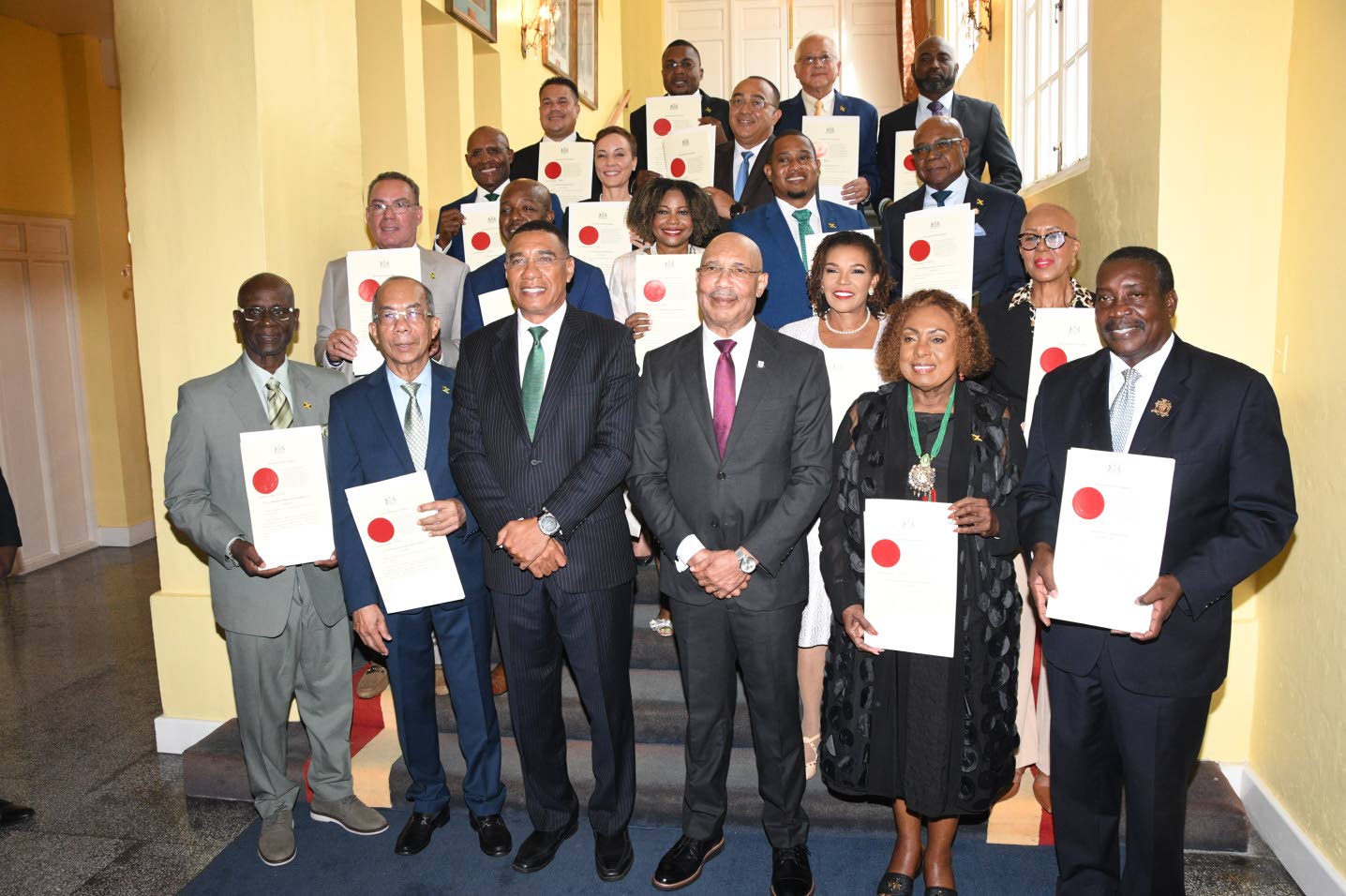
Prime Minister Dr Andrew Holness (third left front row) and Governor General Sir Patrick Allen (fourth left front row) take a group photo with members of the Cabinet after they were sworn in at King’s House in St Andrew on Wednesday. (Photo: Joseph Wellington)
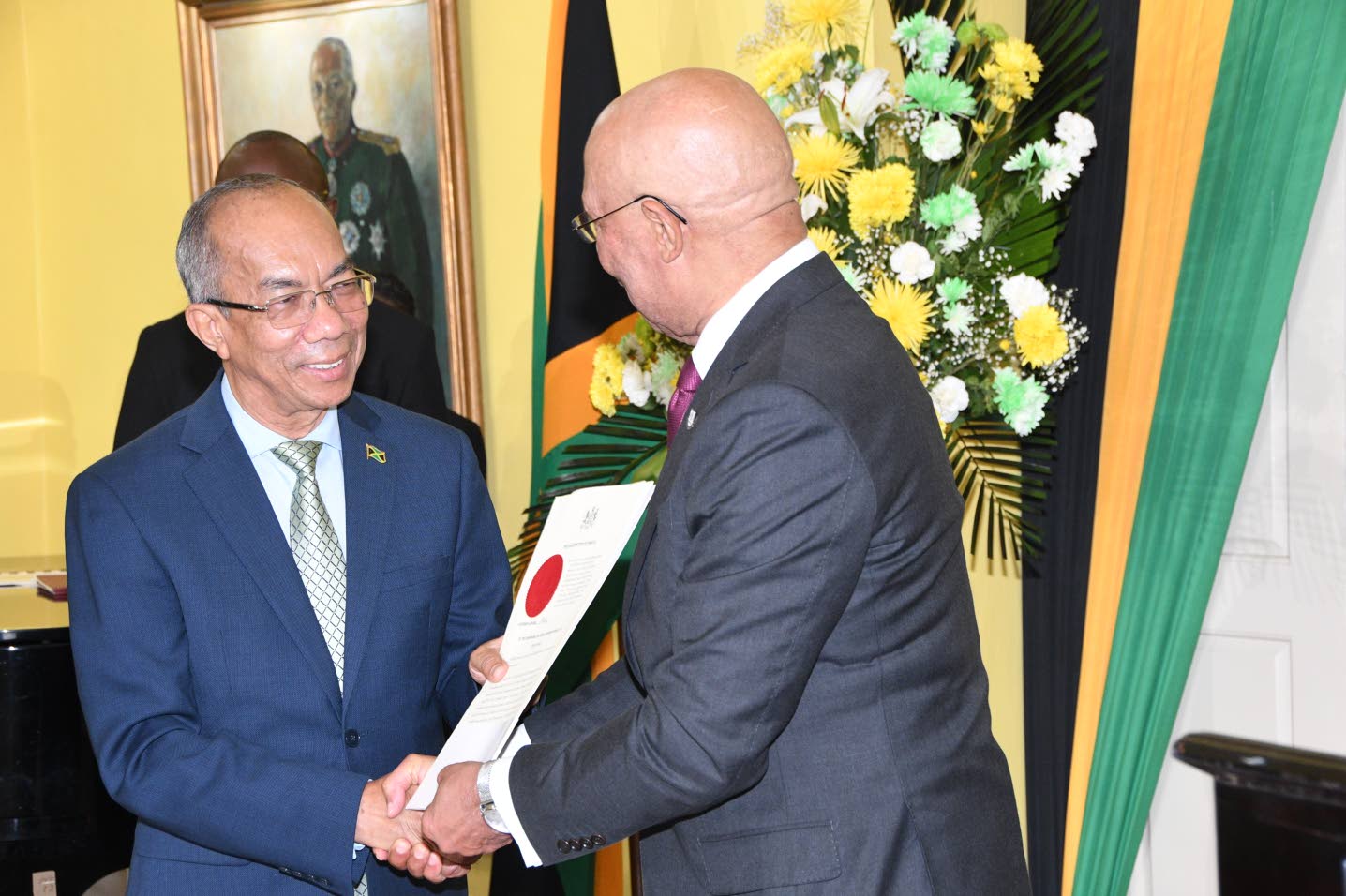
National Security Minister Dr Horace Chang (left) is presented with the instrument of appointment by Governor General Sir Patrick Allen at King’s House on Wednesday. (Photo: Joseph Wellington)


