



Anderson defends poll numbers…
Backs calls for probe of alleged irregularities on election day
JAMAICA’S leading political pollster Don Anderson has defended the accuracy of his latest polls in the aftermath of the September 3 General Election which was won by the Jamaica Labour Party (JLP).
In a near 50-minute presentation at the weekly meeting of the Kiwanis Club of Kingston on Tuesday, Anderson argued that he did not call the result of the election because the polling showed it could go either way.
After the votes were counted, the JLP won 35 seats to the 28 secured by the People’s National Party (PNP).
Anderson pointed out that the PNP, despite the loss, managed to bring out 97,000 more of its supporters than in 2020 when it went down in a landslide, winning just 14 of the 63 seats in Parliament.
He also noted that the JLP brought out just 5,300 more of its supporters when compared to 2020 and that the election was won by just 10,300 votes of the more than 820,000 cast, with the gap between the two parties being a mere 1.2 percentage points.
“It doesn’t get any closer than that,” Anderson remarked.
The noted pollster pointed out that he had the benefit of two years of polling which included 10 national and at least 50 constituency polls leading up to September 3.
He said both sides were in campaign mode for two years, beginning six months prior to the February 2024 Local Government Elections.
According to Anderson, he knew the election was going to be close as he watched the nine percentage point lead the PNP had opened on the JLP in the aftermath of the local government elections dwindle over five successive polls to under one percentage point at the beginning of August this year.
“We thought that the election was going to be an extremely close election and would be won by the party that brought out its best game, human resources, and I now say controversially, financial resources on the day,” said Anderson.
The pollster, who founded Market Research Services Limited (MRSL) in 1975, echoed the call by former Prime Minister Bruce Golding for claims of irregularities made by Opposition Leader and PNP President Mark Golding to be properly investigated as he took a different view from election observers who, for the most part, hailed the process as efficient, free, and fair.
“Despite the appearance of an efficiently run election, an election that has been given a clean sheet by election observers from the EU (European Union) and from the OAS (Organization of American States), there are many anecdotes that are circulating that suggest this might not exactly be the case,” said Anderson.
He said the anecdotes which have come to his attention and which could have impacted the outcome of the election were inordinately long delays for people waiting in line to vote; frustration of voters in being easily identified; inadequate provisions for the elderly and persons with disabilities, forcing some to leave without voting; claims of voter suppression; claims of significant vote-buying prior to and on election day; inconsistent voter verification procedures; queries about actual vote counting, especially in the St Andrew West Central constituency; queries about the “strange” Internet challenges where both Flow and Digicel suffered theft of their fibre optic cables during the counting of the ballots; and the reporting of the ballots.
“There are a number of factors which have been recorded and there are a couple more which didn’t come up significantly for me to mention them, but there are others,” Anderson said.
“Most of these — from the perspective of the persons channelling this information to us — most persons felt that these factors significantly affected people’s determination to vote,” added Anderson.
He told the meeting that he was aware of a situation in which a man left work to vote and got to the polling station at 10:00 am but was still in line at 4:00 pm.
The pollster and university lecturer acknowledged that it will be difficult to verify a lot of the anecdotal evidence and to measure the extent to which the election would have been impacted.
“They can’t be quantified very easily but in reality, if there is a modicum of truth in some, or all of these, then 39 per cent being reported as voter turnout is in fact not a true representation of voter turnout but of actual votes cast; it’s a big difference,” stated Anderson.
He suggested that, based on all that has been said, “a significant number of persons were not able to exercise their franchise on the day of the election”.
Anderson described the voter turnout as “unreal”, arguing that it did not line up with hype surrounding the respective campaigns.
He argued that the fever pitch of the crowds at the various rallies, the level of chatter on social media and across the country, and the initial indication from voters — more than 50 per cent of them saying they were going to vote — leave more questions than answers.
“When you think about all those factors it is in stark contrast to the expectations and it has left a significant number of persons in awe at this low vote count,” he said.
According to Anderson, in the first 10 days following the election there was “a very eerie silence in the country…and it’s difficult to read it but there’s been no huge celebration; there’s been no huge quarrels, it’s just been a very eerie kind of silence.”
He said there has to be real explanations for the low voter turnout as the country is still in disbelief.
Anderson argued that it is from this perspective that he strongly supports the call for a thorough investigation of the process, “for the sake of preserving our newly found reputation of free and fair elections.
“We cannot afford to sweep such claims under the carpet. Instead, a thoroughly independent enquiry should be conducted if we’re serious about preventing further suspicion of the political process, growing reservation about voting, and cauterising the growing level of apathy which is bordering on dangerous levels and which is threatening our democracy”.
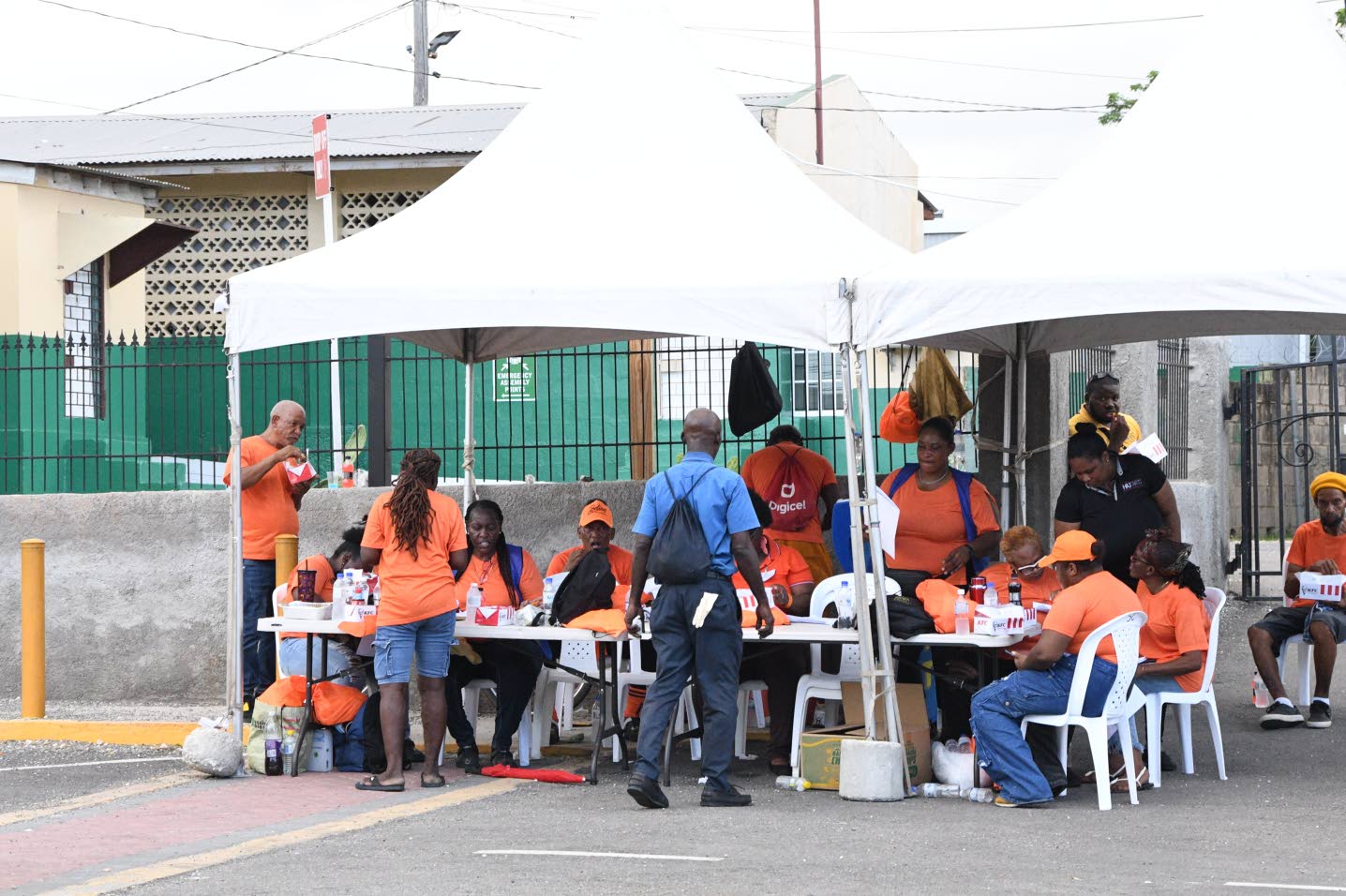
People’s National Party outdoor agents at a polling station in Kingston Central on election day, September 3, 2025. (Photo: Joseph Wellington)
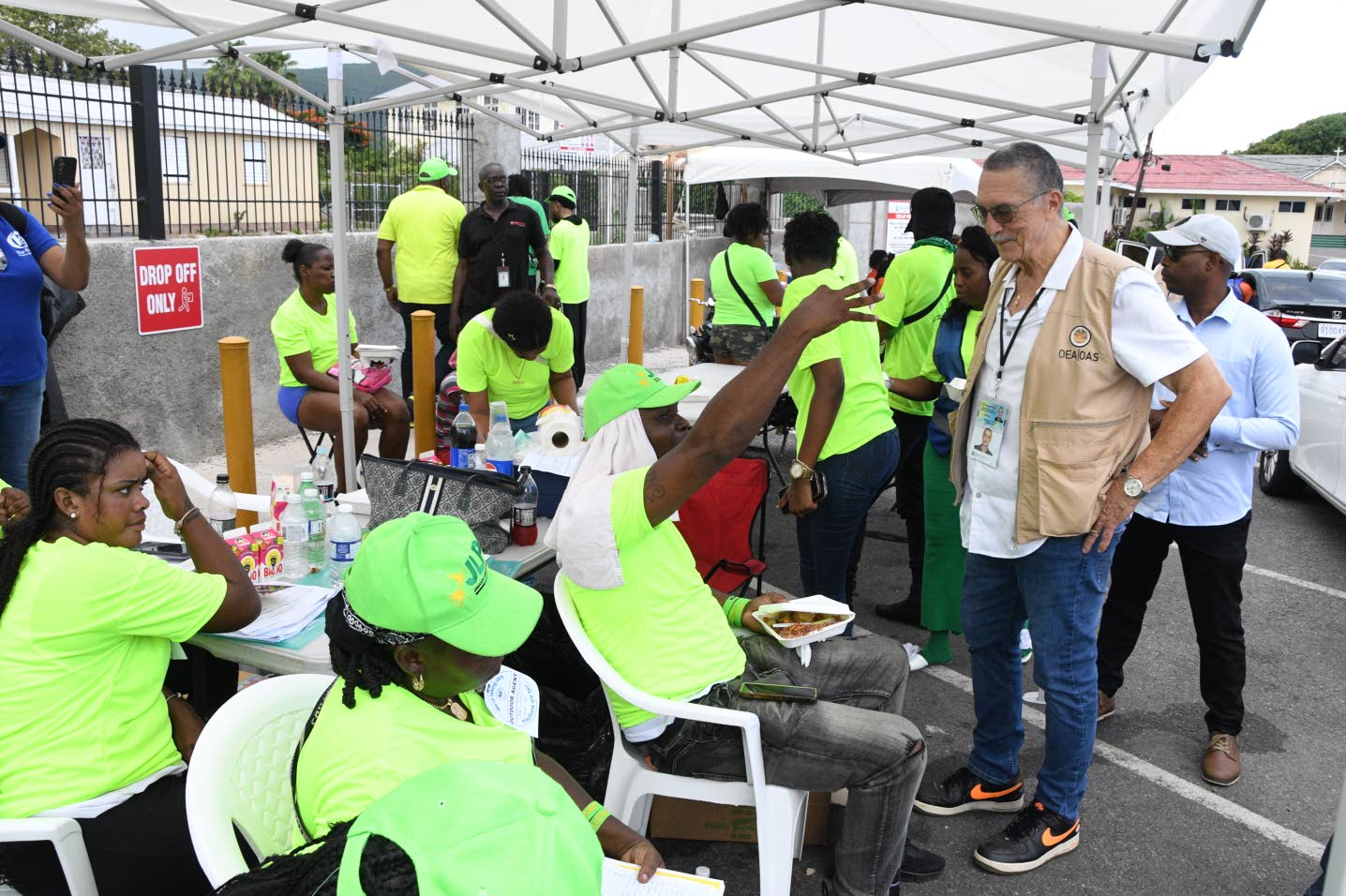
Head of the Organization of American States Election Observer Mission to Jamaica Dr Kenny Anthony (right) speaking to Jamaica Labour Party outdoor agents at a polling station in Kingston Central on election day, September 3, 2025. (Photo: Joseph Wellington)


