Jamaica eyes greater share of global tourist market
…new ‘passion points’ being explored even as better infrastructure needed
As Jamaica looks to capture a larger share of the global travel market, the expansion of traditional “passion points” and greater local involvement have emerged as key priorities for policymakers.
Speaking at a curtain-raiser event for the Jamaica Product Exchange (JAPEX) 2025 conference taking place this week at the Montego Bay Convention Centre in St James, Tourism Minister Edmund Bartlett declared 2025 a “seminal year” for the local tourism industry — one marked by innovation, collaboration and a renewed strategic direction.
“This year is going to be one in which we will adopt new approaches to tourism and deepen stakeholder consultations. I intend to begin that process this week and it is poised to be the most transformative in the history of Jamaican tourism,” Bartlett told delegates gathered for the event held at Harmony Beach Park in Montego Bay earlier this week.
Pointing to seismic shifts in global tourism patterns, Bartlett noted that within the next 10–15 years, an additional 1.5 billion tourists are expected to join the 1.4 billion that currently traverse the globe in search of new experiences.
“Ten years from now about three billion tourists will be travelling across the world and the focus will be placed on where they’re coming and also where they will be coming from. Our job is to be right in the middle as we lead them to Jamaica — our mission therefore is to develop the products around the passion points of these visitors,” Bartlett said.
Looking to close on its ambitious 5x5x5 strategy in which the country looks to welcome five million visitors and secure US$5 billion in tourism earnings by the end of 2025, Bartlett said the aim is to set new targets that will usher in a another phase of growth for the industry over the next five years.
“We are excited about the prospects of 5x5x5 but we will now look beyond that to focus on the next five years up to 2030. We want to make the next five years a period of serious growth, development and inclusive tourism. One that will also see a new vista for involvement of the local Jamaicans in this rich lucrative and elongated value chain,” he stated.
“Tourism has worked for us as a driver of the economy but we want it to work more for the people of Jamaica and so the new concept of ‘local first’ will begin to be formulated in this era. We will develop policies, legislation, and regulatory frameworks to make this a reality — with global partners playing a key role in this transformation,” the minister added.
The annual JAPEX marketplace event being held this week in Montego Bay is set to welcome well over a hundred buyers from more than 25 countries — a number of which represent emerging markets in which Jamaica continues to scout new growth opportunities.
“We hope this marketplace will not only be a gathering of buyers of sellers but a point of connection as that’s what tourism is about,” the minister further indicated.
Director of Tourism Donovan White further underscoring the sector’s evolution during a recent interview with the Jamaica Observer said that Jamaica has long moved beyond its traditional identity of sun, sea, and sand.
“We’ve repositioned the destination around what makes us unique — our people, food, entertainment, culture, and topography. Today’s travellers are motivated by passions, and we’ve built a strategy to align our offerings with those interests,” he told the Business Observer.
The Jamaica Tourist Board having intensified its efforts to promote events, community tourism, and cultural experiences has sought to provide deeper engagement for visitors and more economic opportunities for locals.
Through a recent collaboration with the Jamaica Social Investment Fund (JSIF) and the World Bank under the Rural Economic Development Initiative II (REDI II), government now seeks to channel over $4 billion into agriculture and tourism. The two-year programme aims to reduce poverty, improve livelihoods, and stimulate long-term economic growth in rural areas.
One of the island’s most successful tourism offerings currently is its expanding event tourism portfolio, particularly Carnival. Out-turn from the well-attended event this year is expected to significantly surpass the $95.4 billion in total economic contributions recorded in 2024. Supporting over 115,000 jobs — 45 per cent more than it was able to deliver pre-COVID, the event also provides substantial direct and indirect economic benefits carrying a return on investment (ROI) of $130 for every dollar invested.
Other key events drawing international attention include the Jamaica Food and Drink Festival, Rebel Salute, Dream Weekend and the Blue Mountain Coffee Festival among several others.
“We’ve taken a deliberate approach to reposition events and entertainment over the past three years. Carnival, party weekends and Reggae Sumfest are now attracting more international travellers,” White explained, while indicating that factors such as a younger travel demographic and rising interest from international promoters have been fuelling this trend.
“As we look to some of those new markets, we also want to deepen our message in order to attract a broader array of travellers who are seeking authentic reasons to choose Jamaica,” he said.
The director, in citing emerging sectors such as health, sports, and faith-based tourism as the next frontiers for development, said the buildout of these remain heavily dependent on greater infrastructure investment.
“Health tourism, for example, will require specialised services in medicine — services that are either unavailable elsewhere or can be offered at more competitive prices locally. Sports tourism similarly will also need significant infrastructure such as stadiums, arenas and museums,” he said.
While these ambitions continue to unfold, White said that Jamaica is still making some effort to accommodate growing interest. He referenced events such as the NCAA Jamaica Invitational Opening held in Montego Bay as one such activity that showcases the country’s potential in the sports tourism arena.
“Having the right physical enablement remains part of the wish list for our policymakers as they continue to look at how we can develop in that regard. A new initiative by the Ministry of Sports to redevelop the National Stadium will go a long way in helping us to provide the kind of facilities that meet international standards and will attract travellers who come in search of these passions,” White said.
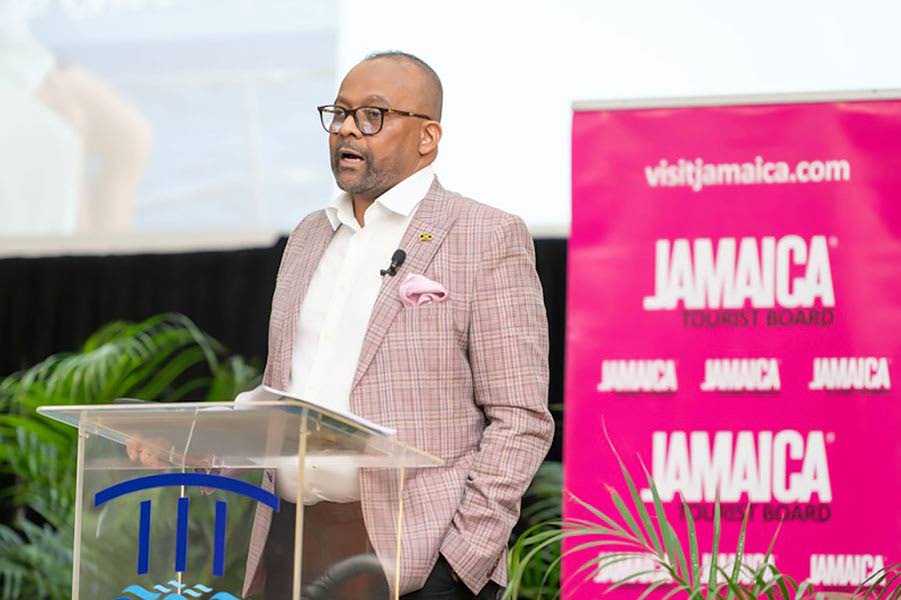
WHITE…we’ve repositioned the destination around what makes us unique — our people, food, entertainment, culture, and topography. Today’s travellers are motivated by passions, and we’ve built a strategy to align our offerings with those interests