Carib Cement delivers flood relief to Calabar
After decades of flooding woes, relief has finally come to Calabar High School with the commissioning of an $8-million concrete road and flood mitigation project by Carib Cement Company (Cemex) — an initiative warmly welcomed by the school’s stakeholders as a well-needed solution.
The project, which includes a newly paved concrete road and modern drainage system, is being hailed as not only a means to ameliorate the persistent flooding issue, but also as a milestone in the school’s ongoing development plans.
Chairman of the school board Reverend Karl Henlin told guests at the handover ceremony on Thursday that he was extremely grateful for the interest and commitment that Cemex has placed in the betterment of the school. He added that the improvement would also ease tensions with residents of neighbouring Calabar Mews, while improving daily life on campus.
“On behalf of the Calabar High School family I would like to say thanks to Carib Cement Company for the generous contribution that they have made to the ongoing development of our school by assisting us in our infrastructural renewal and development,” Henlin said.
“My task today is to say thanks to you but also to say that this contribution aids us in many ways, not only by offering access to the facilities but also silencing the constant complaints we’re getting from our neighbours who are always complaining about how Calabar floods their premises from time to time,” he said.
Also extending gratitude to Cemex was Jamaica Baptist Union President Reverend Dwight Frazer, who said the contribution of the new drainage system would remain as an important monument in the school’s history and as a signal to students and stakeholders to continue the tradition of pursuing initiatives that will result in the improvement of their alma mater.
“We are truly grateful for the contribution that has been made, not just that which is seen with the naked eye but the thinking and engineering that have gone into providing not just the road but the system to deal with the problem that we’ve had with water on the campus,” Frazer said.
“We see this not only as a significant contribution at this time but as a promise of continuing contribution and an invitation to others, like-minded, to continue to think of and contribute to the well-being of boys in the community and their families as the school continues to improve,” Frazer added.
Principal Sian Mahay Wilson, who presented Carib Cement Managing Director Jorge Martinez with an appreciation plaque, also expressed gratitude for the development. She told the
Jamaica Observer she was feeling a mixture of relief and gratefulness, noting that the school had been plagued by the water impediment for more than 30 years.
Mahay Wilson also acknowledged the significance of collaboration between corporate Jamaica and the school which depends heavily on the Ministry of Education’s budget, and which, she said, is simply not enough.
“This has been a pretty long-standing problem. Many have come along — a lot of minds, a lot of visits, a lot of work — and I am relieved that it is complete. There is still some work that needs to be done in the surrounding areas to bolster what they have done, but I tell you, I am grateful because these are not projects that the school, through the Ministry of Education, can take care of on their own without private partnership with corporate Jamaica and their dedication to social responsibility,” said Mahay Wilson.
She added that she was especially thankful because the project was completed in time to face the rainy season.
“I’m also happy that it happened just in time for the rainy season, and we got a chance to see it at work a few days ago when Kingston had the heavy rains, and so I am very happy,” she said, referencing last Friday’s deluge that resulted in flooding and property damage.
In the meantime, Martinez dedicated the contribution to the betterment of the learning environment of the all-boys’ school’s present cohort. He emphasised that Cemex was dedicated to enhancing the school’s capacity to handle rainfall.
“This intervention addresses a long-standing issue and delivers real, tangible benefits to the school community. They not only improve the safety and resilience of the physical infrastructure but also help safeguard educational continuity for the hundreds of students and staff who depend on this facility every day,” said Martinez.
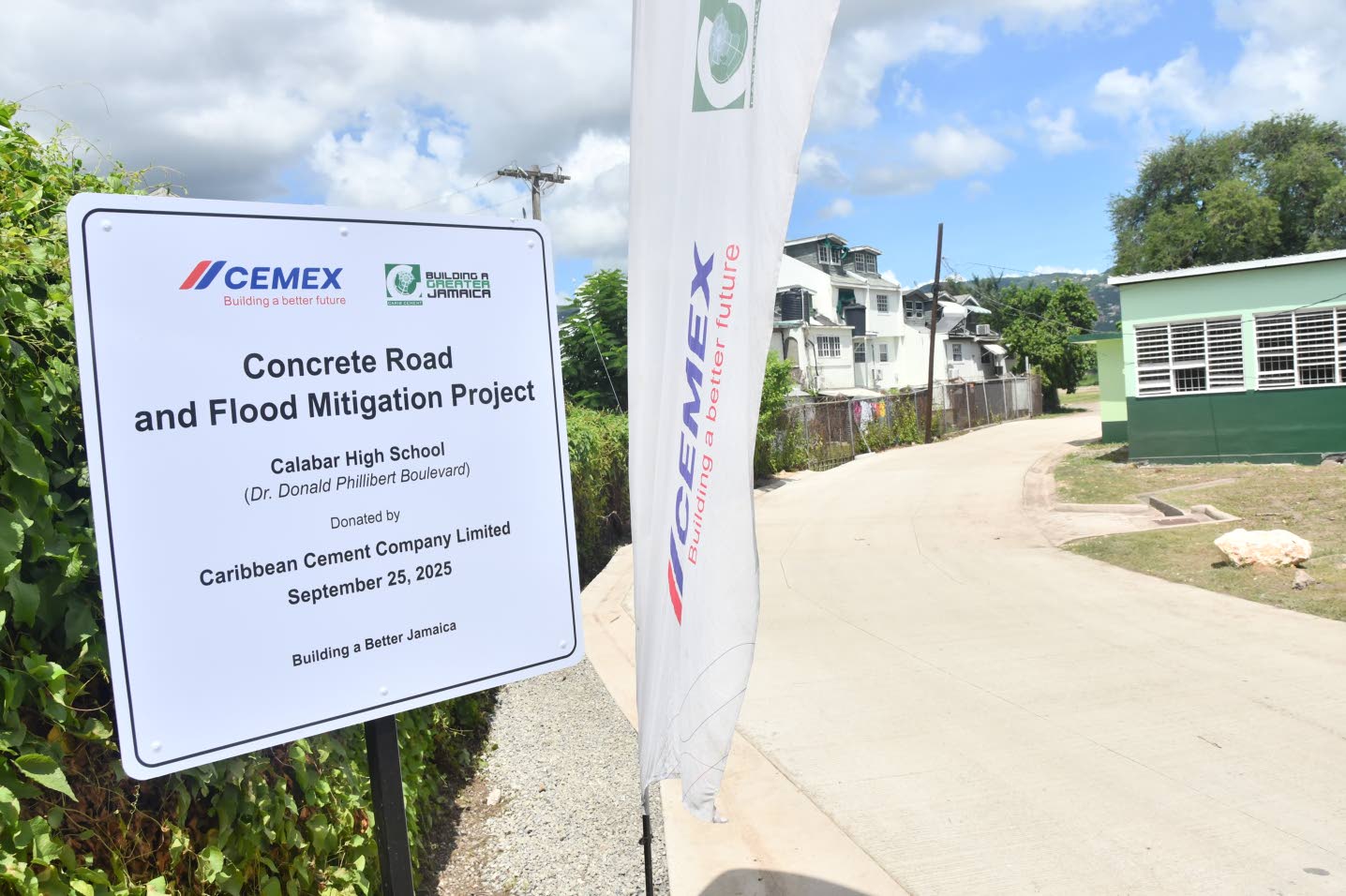
The newly installed concrete road and flood mitigation project at Calabar High School is seen on Thursday after it was commissioned by Carib Cement Company.