



Digicel begins roll-out to solarise half its mobile network
DIGICEL Jamaica has started work to solarise more than half of its 930 cell sites, with installations already underway through a partnership with United States-based Caban Energy.
The multimillion-dollar investment is aimed at strengthening the company’s network against weather-related disruptions and frequent blackouts, while cutting its dependence on diesel.
Over the next 12 months 511 sites are expected to be fitted with solar and battery systems, creating an additional layer of back-up power at a time when demand for mobile data “never stops”, according to Digicel Jamaica CEO Stephen Murad.
“As we all know, the Caribbean is one of the most climate-vulnerable regions in the world. The impact of Hurricane Beryl last year was a stark reminder of how critical it is to strengthen our infrastructure — not just to recover, but to withstand and adapt,” Murad told guests at the ribbon-cutting ceremony to launch a landmark solar partnership at one of Digicel’s sites close to the Norman Manley International Airport in Kingston on Friday.
Among them were country managers for Digicel’s other businesses across the Caribbean.
Last year July, Hurricane Beryl knocked out power across large sections of the island. At peak impact more than half of Digicel’s sites lost grid power, with a quarter operating solely on generators and batteries. Recovery stretched into weeks.
Murad said the new roll-out represents a direct response to the Government’s call for telecoms providers to strengthen service continuity during crises.
“We made a commitment to the Government to invest in renewable solutions that will keep customers connected. This solar roll-out is a critical step in fulfilling that promise,” he said.
Caban’s technology will generate electricity onsite and store excess power in battery packs, reducing downtime during outages and cutting fuel costs. Digicel estimates the shift will provide more than 15,000 megawatt hours of clean energy annually while avoiding some 38,000 tonnes of carbon emissions.
For Caban, the initiative is as much about resilience as sustainability.
“Much of the world’s infrastructure is proving to be no match for increasingly severe weather,” Caban Energy founder and CEO Alexandra Rasch Castillo said during the launch.
“In the Caribbean it is imperative that we rethink how critical systems like telecommunications can be powered sustainably and resiliently. This project is about protecting what matters most — the connections that bind us all,” she said.
Jamaica is the first market to benefit but Digicel and Caban say the partnership will extend to the group’s 25 other markets, many of which face the same risks of grid instability and climate-driven disasters.
“This project is just the beginning. Jamaica is the first market but over the next year we’ll see this initiative expanding across 25 markets in the region. Together with Caban Energy we’re setting a new standard for telecom infrastructure — one that’s clean, reliable, and future-ready,” Murad said.
He described the initiative as a “major milestone”, pointing out that the company has also reinforced critical sites with back-up power, doubled its fleet of mobile generators and satellite equipment, upgraded network monitoring systems, and deployed mobile cell sites after Beryl to speed recovery.
“It’s about ensuring that when the grid goes down our network stays up. It’s about keeping families connected, businesses running, and communities informed,” Murad said.
Founded in 2018, Caban combines lithium-ion battery packs — assembled at its Plano plant in Texas, USA — with proprietary energy management system (EMS) software and long-term service contracts. By shouldering capital expenditure and operations and maintenance risk, it offers tower companies and mobile network operators an alternative to diesel-heavy self-generation — still common across Latin America — while guaranteeing predictable energy fees. The company says it already has live systems in 12 countries and contract wins with several of the world’s largest telecom operators.
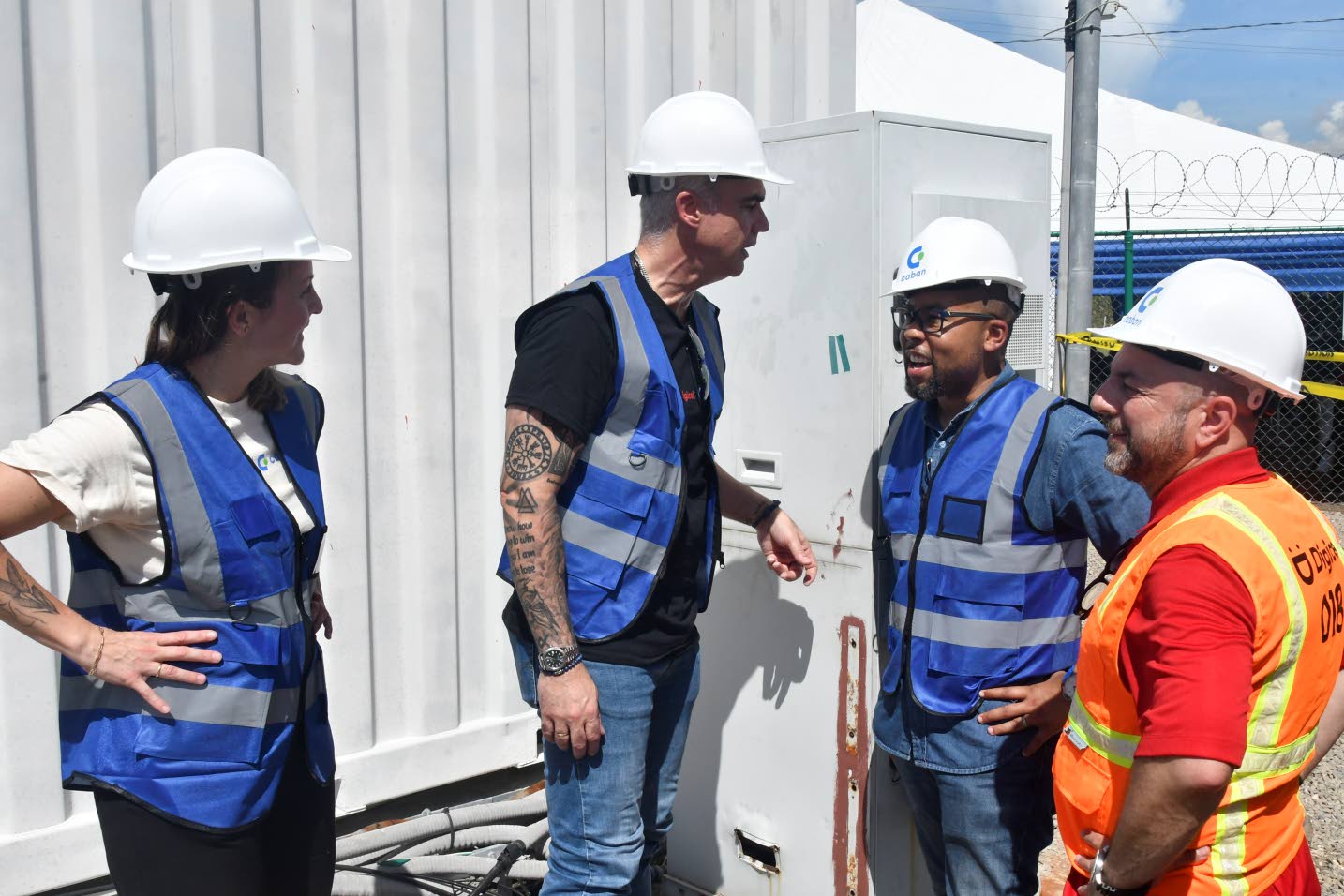
Caban Energy CEO Alexandra Rasch (left) in discussion with Digicel executives (from second left) Group CEO Marcelo Cataldo, Chief Technical Officer Bjorn Reynolds, and Digicel Jamaica CEO Stephen Murad at the launch of Digicel’s solar roll-out project in Kingston on Friday. (Photo: Karl McLarty)


