



Teachers’ colleges vital to fate of special needs students, says Crawford
MONTEGO BAY, St James — State minister for education and youth, Rhoda Moy Crawford has called on teacher training institutions to recognise their role in preparing graduates to meet the needs of students with special needs.
“Every teacher will be a teacher of our special needs students in the future. This is bound to become a statistical fact as the number of special ed[ucation] children continues to increase,” she said while addressing an event staged to mark Sam Sharpe Teachers’ College’s 50th anniversary Monday morning.
“The future of teacher education in Jamaica must ensure that every teacher graduates with skills, empathy and creativity to support the students with exceptionalities,” Crawford continued at the campus of the school in Granville, St James.
Jamaica, like many other countries around the world, has in recent years seen an uptick in children with special needs, and this has been accompanied by ramped-up advocacy. There are a number of schools across the country which cater to children with special needs but critics argue that these facilities are not enough and that challenges come with enrolling children with special needs in the general public school system.
Despite difficulties, Jamaica’s education ministry has been working on developing its special education services, which are delivered through a combination of public special schools, units within regular schools, and private education.
Reports suggest the system focuses on early identification, individualised education plans (IEPs), and specialised support such as speech therapy, occupational therapy, and remedial teaching.
“Every child, regardless of ability or circumstances, has the right to learn, to thrive, and to contribute meaningfully to society,” the state minster insisted Monday.
“Yet, too often children with special needs face barriers — physical, social and intellectual — that prevent them from realising their full potential,” she lamented.
This is where, Crawford explained, teachers’ colleges such as Sam Sharpe come into the picture, providing all their trained teachers with the skills necessary to meet the needs of students, not just teachers dedicated to the particular area.
“You are preparing the men and women who will stand at the front of inclusive classrooms,” she stressed.
Research shows that special education can take place in various settings, including general education classrooms, resource rooms, or specialised schools, depending on an individual’s needs.
“This support is required, whether [to address] illiteracy, numeracy, behavioural development, or physical and emotional support,” Crawford stated.
“Special education must not be a side programme. It is not an afterthought. It must be part of the core DNA of training for all teachers. No child must be left behind,” she insisted.
Crawford, who is a teacher by profession, was speaking in her first official address since being named state minister in the Andrew Holness-led Administration that won the September 3 General Election.
During her speech she also touched on another long-standing issue of concern.
“Another area that demands urgent attention is the education of our boys. Across Jamaica and across the entire Caribbean we see troubling patterns. Boys are underperforming in literacy and numeracy, boys are more likely to disengage from schools, and boys are disproportionately represented among those who drop out before completing secondary education,” said Crawford.
She argued that this goes well beyond an educational issue and should be viewed within the context of national development.
“When our boys fall behind, entire communities fall behind. When our boys are not adequately engaged in school they are more vulnerable to negative alternatives: violence, unemployment, and cycles of poverty,” Crawford warned.
“The future of our nation depends on finding a way to educate our boys. As a ministry we do not presume to have the solution to this question. We need institutions like you to help us to figure it out,” she told educators at Sam Sharpe Teachers’ College.
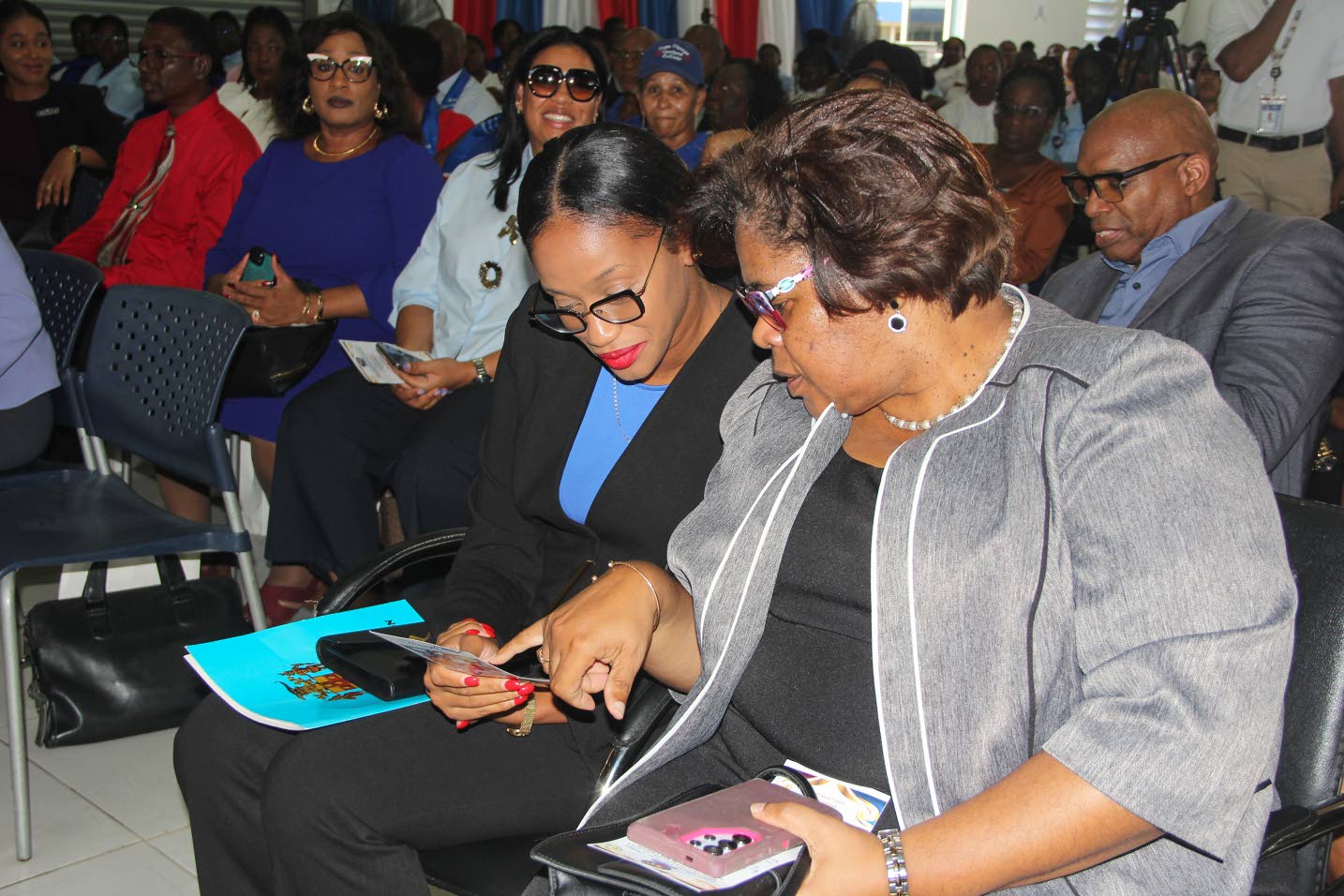
State minister in the Ministry of Education and Youth Rhoda Moy Crawford (left) and Region Four Director Dr Michelle Pinnock engage in conversation, Monday, during an event staged to mark Sam Sharpe Teachers’ College’s 50th anniversary.


