



Dream takes flight
Jamaican merges passion for drones, platform to inspire youth
WHEN he was younger, Dervon McKellop told his friends he aspired to become a professional drone pilot, but they laughed. Today, he stands as the man who led Jamaica into its first-ever Drone Soccer World Cup — stamping the island’s name in a sport that very few locals even knew existed.
Drone soccer, a sport born in South Korea, involves two teams flying drones encased in protective spherical cages. Each side defends and attacks, with a designated striker aiming to fly their drone through a circular goal. Matches are played in timed sets, demanding both precision flying and tactical teamwork.
Jamaica made history recently as the first Caribban country to compete in the Drone Soccer World Cup held in Jeonju, South Korea, with a seven-member team that included high school and university students. The tournament, organised by the Federation of International Dronesoccer Association (FIDA), was held from September 24 to 27 and is described as the world’s largest competition for the drone-based sport.
But for McKellop, who is the president of Jamaica Drone Soccer as well as a player on the team, the journey into the sport was never about novelty but about a chance to merge his lifelong passion for drones with a platform that could inspire Jamaica’s youth and showcase the island’s potential on a global stage.
“My background, originally, is in information technology and cybersecurity. So I’ve been flying drones for more than 10 years, both as a recreational pilot and as a licensed, commercial drone pilot [and]…prior to me really delving deep into drones I would have flown drones for recreational as well as creative purposes,” he explained in an interview with the Jamaica Observer.
The decision to form Jamaica Drone Soccer was bold. Within months of launching the programme McKellop had his sights set on the world cup in South Korea, but the path to Jeonju was far from smooth.
Funding was the first major hurdle. McKellop recalled that letters were sent to government ministries and agencies, but there was little response. Efforts to attract sponsorship also fell flat, and a GoFundMe campaign struggled to reach even a fraction of its target. At times, the dream looked out of reach.
“We would have spent more than $10 million already, just by me travelling back and forth to Jamaica on a plane, booking Airbnb, car rental — more than $10 million that have been spent just by trying to promote the sport,” McKellop, who spends most of his time in Canada and the Cayman Islands, recounted.
With time running out he noted that players were asked to pay for their own flights, while Jamaica Drone Soccer covered accommodation and equipment.
Several students, including two promising girls from St James, were forced to miss the tournament after failing to secure visas on time.
McKellop admitted that the setbacks were frustrating, but he refused to abandon the mission.
“I started looking at my reputation — now it’s on the line. A programme that has good potential is going to be on the line so I said, ‘We have to find a way,’ ” he expressed.
It was then that support began to trickle in. The Cornwall College Old Boys’ Association stepped up with a donation to the GoFundMe account, easing some of the financial strain.
“In August I came home [to Jamaica], and as a technical advisor for the only high school drone pilot training programme and certification programme in Jamaica [at Cornwall College] with…[the] old boys [association], I came to deliver my portion of the training and I came with the drone soccer stuff…I delivered the training, and we had some drone soccer demonstration, and then from there that’s where I started looking at ways where I could get the Cornwall old boys and other folks involved in the programme, and they came through by donating some money to the GoFundMe. Other folks came through and started donating US$20, US$20, US$50, US$100 to the GoFundMe,” he told the Sunday Observer.
The contributions weren’t enough to cover all expenses but he noted that they provided a crucial lifeline for the team. Through sponsorships from Drift Enterprise UAV Services, for which McKellop is the chief unmanned aircraft system officer, the team got the needed equipment.
“…We got to the point where we said to the team members, ‘Guys, we’ll try and find the money,’ and eventually some of the players paid their own plane fare while the organisation covered hotel accommodation,” he said.
Despite the late scramble, the pieces began to fall into place.
“It came down to the wire,” McKellop said. “We ended up leaving earlier than planned because the plane tickets were so expensive that if we never left earlier, this whole dream of going to South Korea was going to become just a figment of our imagination.”
Despite all the setbacks, however, the Jamaica team arrived in Jeonju and was met with encouragement and respect.
According to McKellop, the officials from FIDA praised the team’s determination, with one executive telling him: “Dervon, you are a celebrity in Korea. Everybody is impressed by the work that you guys are doing within the six months of you joining FIDA.”
The competition itself was daunting. Many of Jamaica’s players had never flown the larger Class 40 drones used in international play, yet with hastily built makeshift goals and improvised training sessions, they adapted quickly.
“I literally threw my team out in the deep to swim, but I never leave them alone to drown,” McKellop said.
Against the odds, Jamaica did more than just participate, they won matches, stunned seasoned opponents, and walked away with two top honours — the Spirit of Drone Soccer Award and the Best Rising Star Award in the Class 40 category.
“We came home with two of the top awards at the Drone Soccer World Cup as first-timers, doing this for just six months, with no formal training facilities in Jamaica — and I believe the sky is more than the limit for us in Jamaica,” he said proudly.
But the world cup was only the beginning. McKellop’s long-term vision is to create a Triangle of Drones — a model linking education, sport, and workforce development. Through this framework students can be introduced to drone technology in schools, compete in structured leagues, and eventually pursue careers in aviation, robotics, or engineering.
“When that student transitions from either education to sport and then from sports to workforce, that student is now using the skills that he or she would have learned to now be either employed into the drone industry or to pursue a career in some form of aerospace or aviation,” he explained.
Jamaica Drone Soccer is now planning workshops, grass roots programmes, and further school tours. McKellop also hopes to work with ministries and private companies to build a national structure for the sport — similar to how football is supported across the island.
“Now one company has believed in the potential of the Jamaica Drone Soccer team, which is Drift Enterprise UAV Services…I believe now is the time that corporate Jamaica and the Government of Jamaica should come on board to support this programme, to support this initiative, because drone soccer and drones in school is a programme that changes lives,” he said.
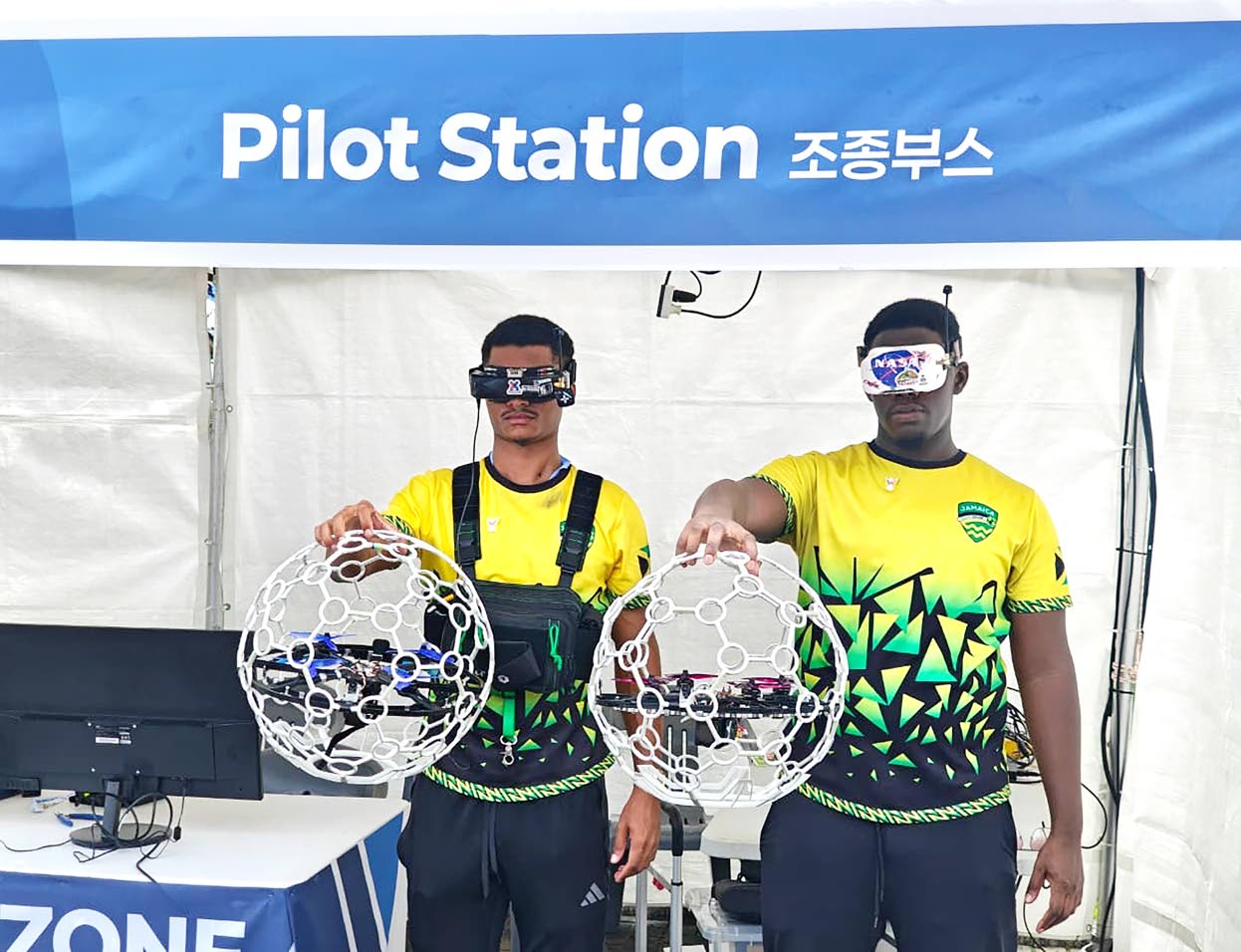
Timothy Lee (left) and Carl Heron each hold their drone aloft at their pilot station during the Drone Soccer World Cup in South Korea.
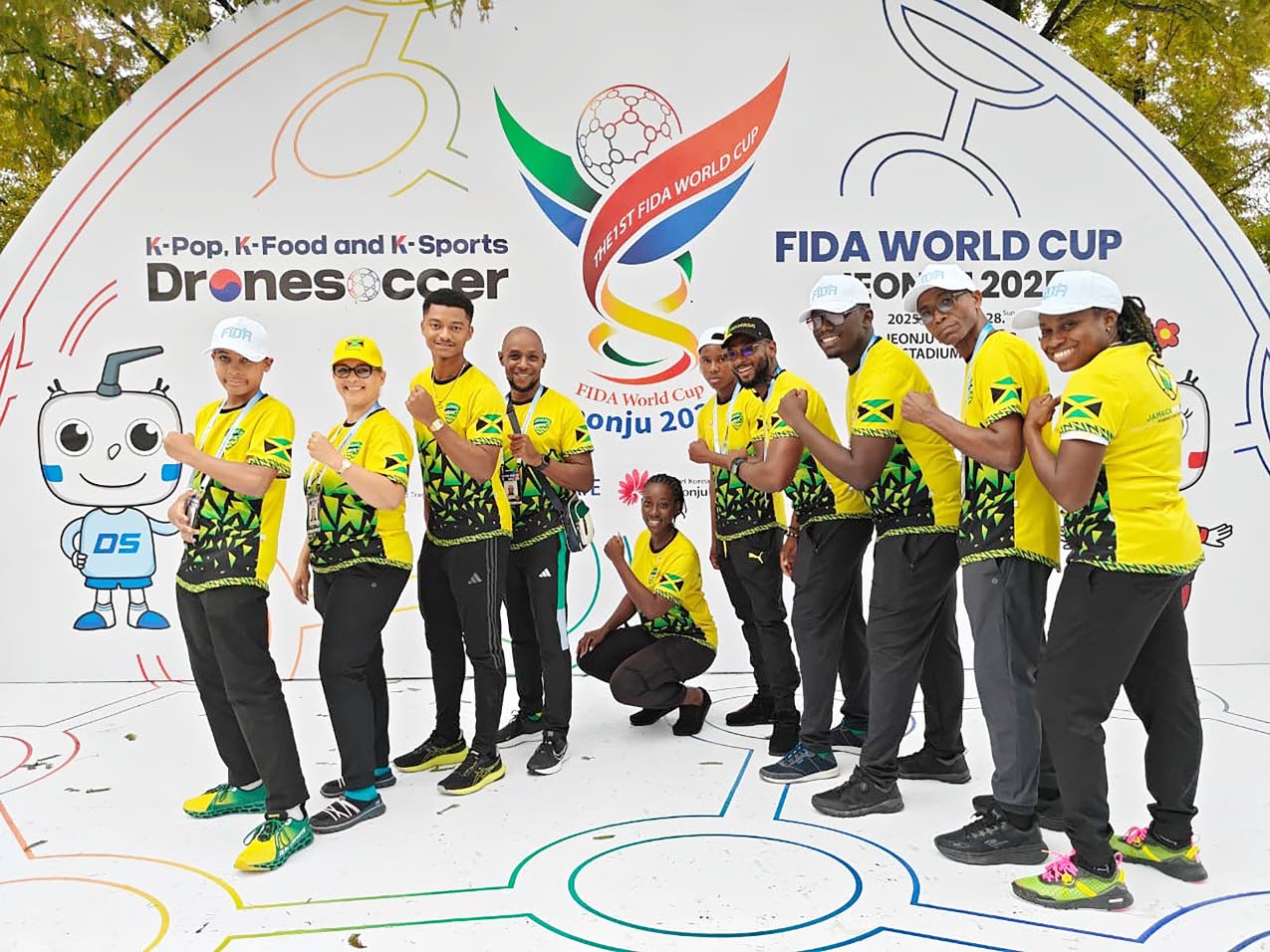
Jamaicans decked out in their national colours in South Korea for the Drone Soccer World Cup in Jeonju are (from left) Joshua Forbes, Carol Thompson-Forbes, Timothy Lee, Hilzan Goulbourne, Jhanae Bailey, Addison Clarke, Dervon McKellop, Carl Heron, Keith Carter, and Trudy Swaby.


