The road less travelled
Now that the election campaigning is over and the population has had to figure out what constituted realism versus fantasy and false promises from both sides of the political divide, and the Jamaica Labour Party has been duly returned for a third-consecutive term in office, it is now time to settle down to address the real concerns and challenges that face us as a nation.
And while the theme of continuity has been echoed both from the side of the Government as well as the citizenry, to suggest an uncritical continuation of governance is to suggest that a measure of efficiency and perfection had been achieved. It is clear that some rethinking and revisioning needs to be undertaken in relation to some of the approaches that have been pursued in the past, whether intentionally or by default.
I would proffer the notion that many of the measures of productivity of our workforce are those which relate to quantitative measurements, whereas there is a qualitative dimension which relates to the well-being of the workforce and which needs to be added to the discussion and be addressed with a measure of urgency.
In this regard, I would like to focus on one area which has become a kind of tag line for representatives of the Government and the private sector, namely, productivity and the growing of the economy as a priority.
Sometimes the issue is presented in such a way that it appears that the workers are to be blamed for low output and an attitude that may be likened to a condition of malaise. At other times the low wages paid to many workers and the conditions that prevail at the workplace receive a share of the blame.
Without attempting to claim any kind of originality to the perspective I seek to offer, I would like to draw attention to what exists regarding transportation that has evolved over several decades, determined in part by an absence of a clear policy and that which has been politically expedient and mere crisis management at times.
One consequence is the existence of a system of public transportation characterised by indiscipline, an example that is now followed and superseded by many motorists, and the flow of traffic that is apparently self-regulated, so that by the time many workers get to the workplace they are stressed and drained of the creative energy with which they began the day. It would be interesting to see a study being undertaken to measure even the impact of this system on the students of all ages beyond the focus on nutrition as they begin the day in the classroom. My own experience a week ago highlights the dynamic at a personal level. After spending one hour between 6:00 am and 7:00 am from within the environs of Kingston to reach a medical appointment in Cross Roads, it was no surprise that my blood pressure reading was elevated.
Older residents will recall that the city of Kingston had a system for public passenger transportation by the Jamaica Omnibus Service which can be deemed to have been efficient compared with anything that exists across the public transport sector today, but which was terminated by the Government of the day without any clear policy for its replacement and improvement. Instead, things degenerated into the minibus phenomenon which became a bit of a free-for-all and one of the most dehumanising and indisciplined operation for passengers, especially schoolchildren. In addition, it introduced a system of private ownership which brought into the mix politicians, police officers, and others for whom there was a clear conflict of interest, and that made it impossible to bring order to the system. It was this system that drove many people to invest in a car when they could hardly afford it in order to maintain a sense of dignity and to arrive at the workplace without feeling distressed.
Spanish Town had its own transportation system with two major carriers operating the route. So did most rural towns and communities have what was primarily a morning and evening bus service operated by privately licensed individuals who became institutions in their own right. For other parts of Jamaica there was the Jamaica Railway Corporation that provided passenger as well as cargo service to much of the island from Kingston to Montego Bay and Kingston to Port Antonio. Like the Jamaica Omnibus Service, the Jamaica Railway Corporation was discontinued without any plan for its replacement, even as many of the men who owned the rural bus service just aged out and died, with the service they offered suffering a similar fate.
These systems were not perfect, but they served the needs of the people of the day and functioned in a way that kept the people of this nation able to attend school and to travel to and from the workplace.
The way forward beyond the disintegration of the existing systems was determined by governments without any clear policy and implementation direction but rather crisis management. Since that time, much of what has prevailed has been transportation initiatives undertaken by the opportunistic and the entrepreneur, who has usually been, in part, a small man, and some others with conflicts of interest as noted.
The Jamaica Urban Transit Company (JUTC) has been created to solve the transport problems of the city of Kingston, with subsequent inclusion of Montego Bay, and in more recent time an expansion into other areas. So far, the JUTC has not proven itself to be a success story, but it still needs to prove itself to be an efficiently run institution and not a feeding tree for supporters of both political parties when in power.
While the governments of recent decades have done much to improve the road network across the country and which has undoubtedly contributed to the growth and development of the economy, the reality at the end of the road is that they all lead to “dead ends”. So the two toll roads deposit their vehicles each workday morning into the city of Kingston, in which there are no additional roadways being built or effective traffic control, even as there is an exponential increase in the number of vehicles in the city and those attempting to enter the city.
As I find it necessary to traverse the city of Kingston from various directions and at various times of the day, it is then that I become deeply aware of the seriousness of the problem of transportation, its connection with the concern about growth and productivity, as well as the well-being of our workers.
What appears to be now an irreversible problem is that of the policy or pragmatically determined decision to make taxis the major form of public transportation for the city of Kingston. While on the one hand the multiplicity of vehicles that make up the fleet of taxis has been treated as a source of revenue through import and other duties paid into the public coffers, it has led to a situation in which taxis control the culture of the road with the Government, police and Transport Authority playing a game of cat and mouse. If in any doubt, just check and see, for example, who is in charge of Red Hills Road any workday from about 5:30 am.
Logic dictates that it takes about eight taxis to carry the same number of passengers as a JUTC bus. But these are a rare sight and, being unable to engage in the recklessness with which many taxis navigate the roadways, some residents do not find them an attractive option. It is stressful enough to be a passenger in one of these taxis for many, but just as stressful for motorist who, living in Kingston or entering Kingston each morning for work from just about any direction, and who must spend up to two hours in long lines, with blocked intersections with no police to enforce order, and with unruly motorists who now form third and fourth lanes and then block intersections when traffic lights change.
While some motorists give vent to their anger and distress through what has been termed road rage, many motorists and passengers arrive at their workplace feeling as if they have gone through a whole day already. The Government and bureaucrats would do well to calculate how many productive hours are lost from people with diverse levels of skill and competence before they are able to get to work, and how their state of mind impacts their level of productivity for each day.
In a recent interchange with a receptionist at her desk in a medical facility, she pointed out how this stress is brought to work by staff, citing an instance in which a colleague was in a disruptive mood before she even said good morning to her colleagues, only to realise that it had nothing to do with the people at her workplace but the baggage from the struggle to get to work. I suggest that her response is not just about her mood but the frame of mind with which she must engage productivity and performance on the job.
While we dabble a lot in conversation about artificial intelligence (AI) and the benefits of technology, is it not possible for the traffic lights of the city of Kingston to be synchronised in such a way that they are integrated to take care of the traffic and be automatically modulated to deal with the flow of traffic in and out of the city in a better way than seems to exist at this time?
Additionally, there exists a situation at the foot of Red Hills in St Andrew where six roads converge and without there being traffic lights. It is not only a major transit point but a location of major delays and confusion each workday morning and evening, and constitutes a very dangerous situation with some serious accidents waiting to happen. It is not beyond the realm of possibility to handle complex intersections.
It is often asserted by the cynics that conditions of the roads and the physical environmental degradation are not observed by the responsible leaders and technocrats until they reach crisis proportions because they travel by other routes than the public. Failure in this regard has clear implications for growth and productivity of the nation which is determined by the state in which workers arrive at the workplace. In this new term, let it not be said that these are the roads less travelled by elected representatives and public managers and technocrats who have within their mandate and job description the opportunity and responsibility to make a difference to this aspect of the nation’s growth and productivity.
Howard Gregory is retired Anglican archbishop of the Province of the West Indies and lord bishop of Jamaica.
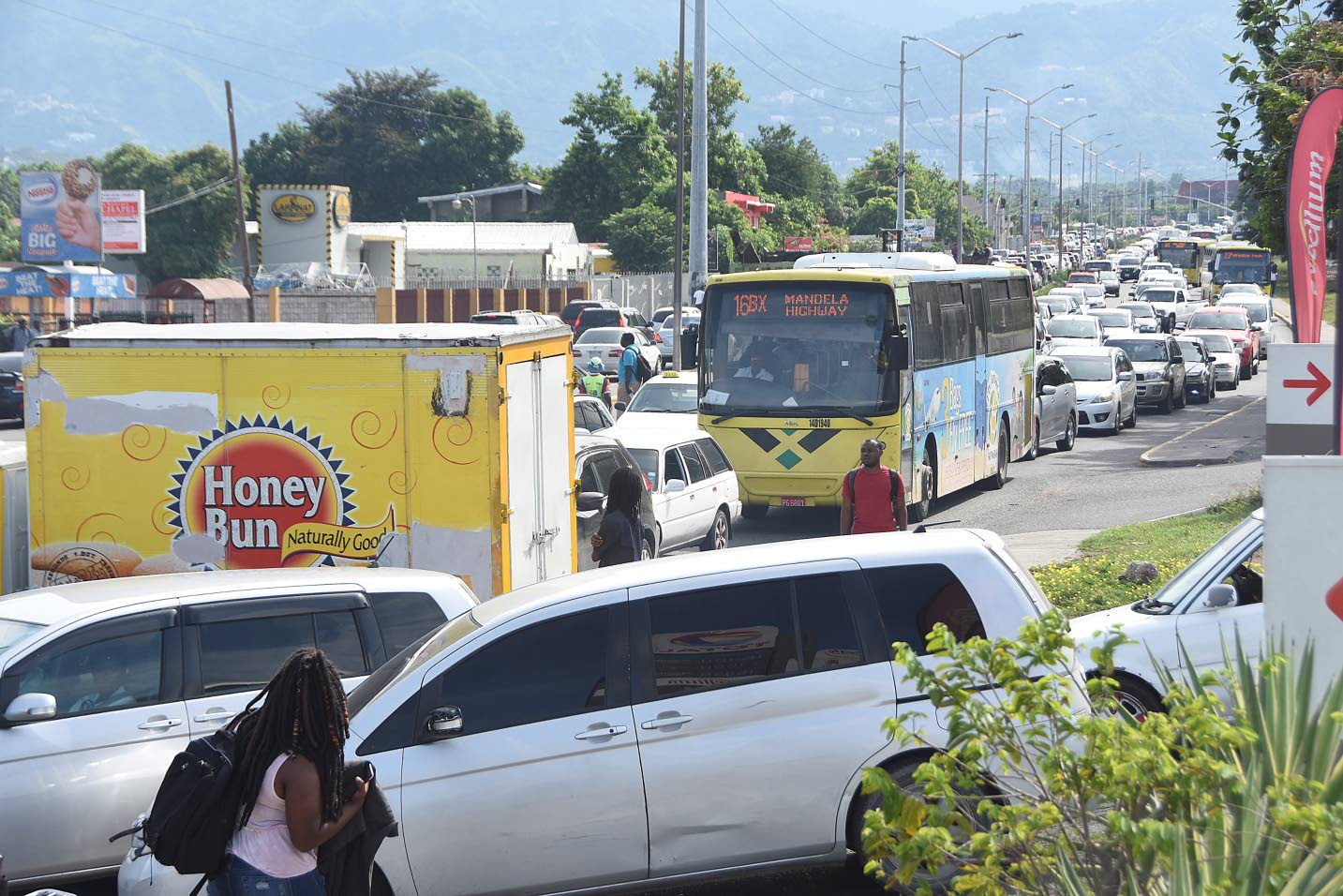
Motorist sit in traffic on Washington Boulevard during the morning commute. (Photo: Garfield Robinson)