



Tap, Sell, Grow
The quiet payment revolution fueling Jamaica’s small businesses
SHERINA Whyte watched a well-dressed delegate from the International Seabed Authority hesitate, then walk away from her Waah Gwaan Cafe location on King Street in the heart of the nation’s capital. They wanted a latte, but they had no Jamaican cash, and her old card machine was a relic in their cashless world. It was a sale lost — a story of frustration repeated daily for Jamaica’s small businesses.
Unlike her Jamaican customers who would do bank transfers, Whyte said these delegates, in Jamaica for meetings only, would not.
“They’re not doing bank transfers,” Whyte, co-founder of Waah Gwaan Cafe, shared. “Before, we used to lose a lot of sales. Unless they really wanted to try something new, they wouldn’t come back,” she told the
Jamaica Observer in a recent story.
That story is familiar to Beris McKay, general manager of DJ’s Cafe Seven Spices. For years his business relied on a traditional credit card machine, spitting out paper receipts that had to be filed away.
“If you’re having a dispute, you’d have to wait for hours or days to find that receipt,” he says. “We were dreaming of something integrated, something paperless.”
For these two entrepreneurs, and for thousands of other micro, small, and medium-size enterprises (MSMEs) across the island, a fundamental shift is underway. It’s a move away from the friction of cash and clunky technology towards a sleek, digital-first way of doing business. And it’s being powered by a tool that fits in the palm of their hands.
The Pains of the Past: Lost Sales and Paper Mountains
The challenges were more than mere inconvenience; they were barriers to growth and efficiency. For Waah Gwaan Cafe, which serves authentic Jamaican coffees, herbal teas and sandwiches from both its brick-and-mortar location on King Street and its unique solar-powered truck in downtown Kingston, the old system’s slow fund clearance was a critical issue. “With other card machines… it used to take like two or three days to get the funds to use,” Whyte explains. “You know, it’s a small business. Cash has to turn over.”
Over at DJ’s Cafe Seven Spices in New Kingston, McKay’s ambition was to create a modern, seamless operation modelled off
Shopify, an e-commerce website, and iPads. The snag? A separate, physical card machine and the paper trail it generated. Growing up and learning to do things to safeguard the environment, he wanted the solutions to align. “We wanted to go digital with everything. We don’t want any paper in our environment,” he told
Sunday Finance.
The Pivot: A Discovery,
Crucially, the shift to a new system felt less like a corporate roll-out and more like a discovery made by savvy business owners.
For Whyte, it was a moment of serendipity. “I was scrolling online on
Facebook and I saw NCB advertising. I said, ‘You know what, let me just send them a message and give it a try.’ ” The onboarding was swift. “The longest part was the opening of the account, and it still didn’t take long, just about an hour,” she said.
For McKay, it was the final piece of a puzzle he was already solving. As DJ’s Cafe Seven Spices built out its digital storefront, NCB began advertising its ePOS solution. “We realised we could get rid of the machine and the iPad could really become the credit card machine,” he says. “So we get rid of one device and now we actually can go paperless as well.”
The Payoff: Efficiency, Insight, and a Digital Footprint
The impact has been transformative. For Waah Gwaan, the change was immediate and dramatic. “It has drastically improved the efficiency of transactions. I would say, double,” Whyte states.
During major conferences for the International Seabed Authority, this was the difference between lost and captured revenue. “It has doubled our revenue because most of [the delegates] are cashless.”
The speed of settlement is a game-changer for cash flow. “It’s the next day your transaction is settled… Even on a weekend, we did an event for the Grace Food Festival and by the Sunday, the funds were in the account.”
At DJ’s Cafe Seven Spices the benefits are operational and philosophical. Transactions are faster. Disputes are resolved instantly by pulling up digital records. “You can email the receipt. It speeds up the process; you don’t have any paper to file,” says McKay. This aligns with their goal to reduce their environmental footprint. “We feel like, less trees, less paperwork… It’s all positive.”
Perhaps the most significant benefit, however, is one they are only beginning to tap into — the creation of a formal digital footprint. Every tap-and-go transaction builds a financial record, a history that can help MSMEs, often deemed high-risk, access credit and other financial products.
The Bigger Picture: A Nation of SMEs Catches Up
The experiences of McKay and Whyte are not isolated. They are part of a broader, deliberate push to bring Jamaica’s small business sector into the digital fold. According to data from NCB, which provider of the aforementioned ePOS platform, over 4,000 active terminals are now in use since its July 2024 launch, and a resounding 85 per cent of these merchants are MSMEs.
The bank identifies the single biggest barrier not as technology but as “cultural comfort”. This is echoed in the day-to-day experience of the merchants. McKay notes that about 30 per cent of his customers are initially hesitant. “It’s just human nature,” he says. “We are used to things happening in another way.” The strategy, for both the bank and the business owners, is continuous education and patient support.
The economic multiplier effect is potent. Digitisation reduces reliance on cash, creates auditable records for tax and finance, and funnels more transactions through the formal banking system. For the businesses, it means safer transactions and easier reconciliation. For the economy, it means higher financial inclusion and stronger deposit flows.
The Road Ahead
The revolution is far from over. For the entrepreneurs, the future is bright and expansion is on the horizon. Sherina Whyte envisions more mobile units and regional reach. Beris McKay is focused on perfecting his integrated, digital-first customer experience. They have both learned that in today’s economy, the most important recipe for success involves more than just great food and smoothies; it requires a seamless, modern way to get paid. The gentle tap of a card or phone is becoming the sound of growth for Jamaica’s small businesses — a signal that they are open for business in a digital world.

The storefront of Waah Gwaan Cafe in downtown Kingston.
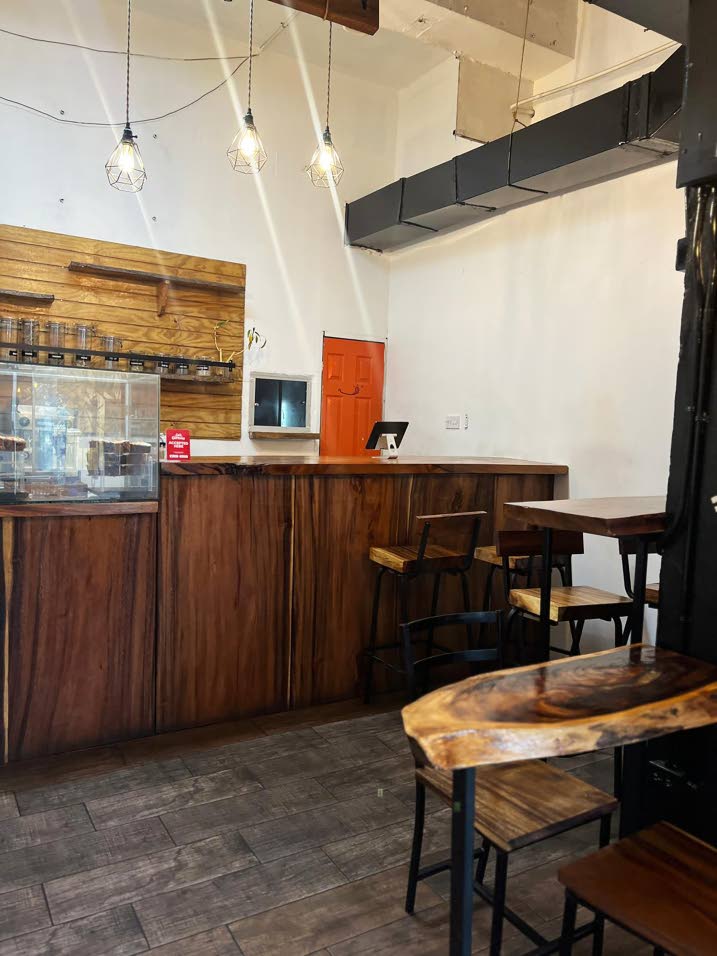
Inside Waah Gwaan Cafe where customers go for smoothies, herbal teas and sandwiches..
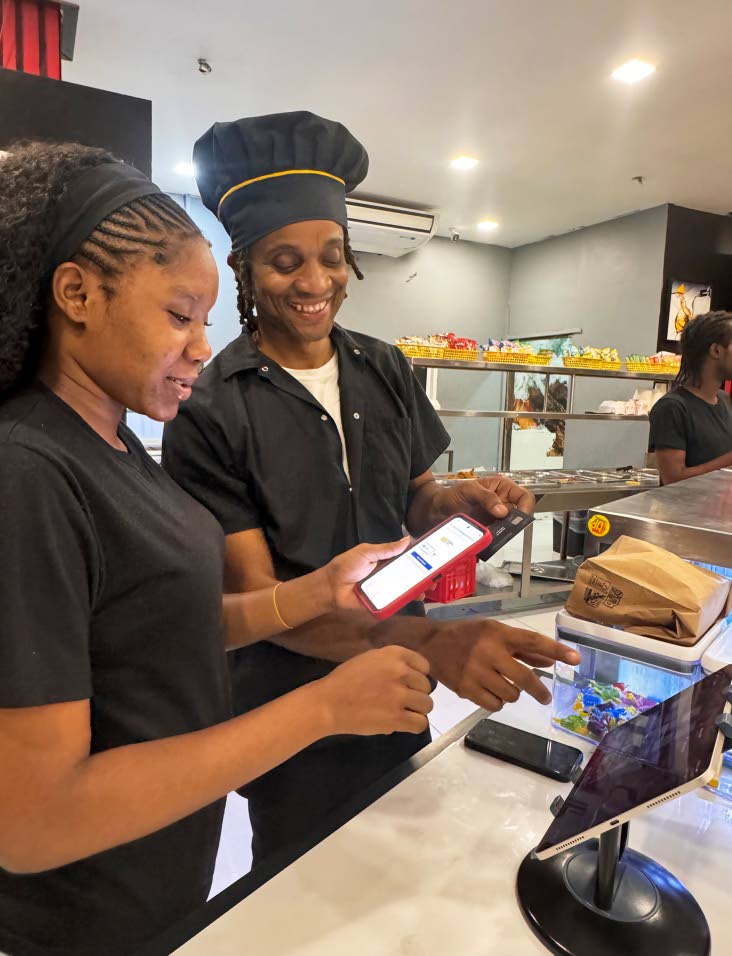
Beris McKay (right) observes as a cashier uses the e-Pos machine to conduct a transaction..


