



Indecom makes 11 recommendations aimed at reducing police killings
THE Independent Commission of Investigations (Indecom) has made 11 recommendations to the country’s legislature, which it says are aimed at “reducing the number of security force fatalities, which have increased since 2020”, to enable what it describes as “the return to an operating environment where the risk to life is lessened in planned operations”.
The recommendations, which are contained in the Special Investigative Report: Planned Police Operations tabled in the House of Representatives on Tuesday, comes at a time when 47 police officers have been charged with criminal offences during the period January 1, 2024 to 30 September 30 2025. Of that number, 13 have been charged with murder, and the greater majority relate to assault allegations.
According to Indecom, in the five years since 2021, the number of persons killed in security force shooting incidents have increased each year, and particularly in 2024 and 2025.
The commission said in 2019, the number of people killed during a Panned Police Operation (PPO) was the lowest, at 10, while in 2021 PPO fatalities was nine per cent total fatalities, when eleven men were killed. It stated however that “since 2022 there has been a marked and disquieting increase in fatal shootings occurring during PPOs”.
Said Indecom, “from the low of 11 persons fatally wounded in 2021, to 76 in 2024, it represents a 591 per cent increase in deaths arising from planned police operations in 36 months”. The commission said “this continuing policing tactic is observed in the first seven months of 2025 (January-July), where 97 people have been killed during PPOs, representing 51 per cent of the 190 fatalities in 2025 (at 31 July)”.
Tuesday, Indecom, which in its report said an analysis of the PPOs in the study showed the absence of senior commander (superintendent rank and above) in some cases where a fatality occurs, recommended that “a senior officer rank of inspector or above should be present, on all planned operations”.
It said “junior officers at constable to sergeant rank should not be undertaking ‘snap raids’ without the requisite planning or involvement of the inspector or above rank”. According to Indecom, in 2022 the number of PPOs where teams were led by a cop below the inspector rank was four of the 21 PPOs.
Indecom also said “in three of those instances there were no recorded plans available to the commission”. It said in 2023, “a further four PPOs were led by a sergeant rank or lower”, while in 2024, 24 PPOs were led by an officer below the rank of inspector.
“The commission regards the absence of senior rank and effective oversight as a likely contributor to the increase in fatalities,” Indecom declared.
In the same breath it said “planned operations and entry to private homes to search or arrest should always be accompanied by a search warrant, unless other legislation exempts the necessity for a warrant”.
Indecom, in noting that a few PPOs in its current review had occurred without documented plans or warrants, was keen to point out that “the pattern of attending upon persons, subject to current murder charges, on information received, without written plans, warrant or involvement of senior officers, is not conducive to the Jamaica Constabulary Force’s (JCF) strategic obligations to ensure ‘right to life’ protections”.
Furthermore, it said, “Eyewitness testimonies from citizens in these cases provide a quite different account”. In the meantime, Indecom called on the constabulary to “ensure that a standardised search warrant form is utilised across the force…”
It said “consideration should be given for Justices of the Peace (JPs) to time their authorisations, in addition to the date on a search warrant”.
“All warrants should be legible to identify the JP authorising the document. JPs must also ensure that all search warrants, authorised by them, are applied for under the correct legislation,” it said.
In the meantime, Indecom said “all planned operations must be subject of proper planning and documentation. Adherence to the JCFs Use of Force and Firearms Policy must be reinforced and records must demonstrate compliance with the policy”.
The commission said “due consideration is to be given to information and/or intelligence which demonstrates that alternative options have been considered or acted upon, to interdict the person, especially where it is known the subject is already reporting regularly at a police station or appearing at court”.
Indecom said while it is cognisant of the hurdles faced by the JCF in its procurement programme and recognises the steps already taken in the deployment of body worn cameras, it remained unmoved in its insistence that “body worn camera resources be shared and some re-allocated away from other public facing engagements to equipping Fugitive Apprehension Teams lead officers as a matter of priority”.
And the commission, which had expressed alarm at “an increasing operational practice of the removal and/or destruction of private closed circuit television (CCTV) equipment from premises where shooting occurred”, declared that “the removal, destruction or tampering of CCTV equipment, whether private or public, by JCF officers, whilst on operations, is not permissible”.
“A clear force instruction from the commissioner’s office should make clear that such action is prohibited, and with appropriate sanctions in the event of non-compliance,” it maintained.
Indecom also called for “greater regard to the control of persons once confronted and detained and prior to searching”.
“Such persons should be physically restrained from being able to seize or gain access to any firearm or weapon once under police control. Use of handcuffs and/or plasti-cuff ties should be available and utilised in all planned operations. All recovered firearms should be formally and correctly placed within a forensic recovery bag for transport and photography. The collection of firearms and placing in informal packaging, wrappings, coverings or pockets should desist. Such equipment should be available on planned operations,” the commission stated.
Indecom earlier in its report had said a further feature of some PPOs, which results in fatal shootings, was the omission to control and secure the subject person once the police have domination over that person. It said recent cases in 2024 and 2025 record, from both police and civilian accounts, that suspects have been able to secure access to a firearm after they have been detained, to threaten the officers, resulting in their death.
“Such fatalities are wholly preventable if the correct risk assessment and officer safety measures are implemented. Such scenarios present a grave risk of harm to police officers, who can quickly become vulnerable when suspects are so readily able to have free movement to apparently seize a firearm. Officers should have total control over the environment, and the suspect, who is already identified as dangerous. In these cases and others, there are no witnesses to the shooting incident,” Indecom pointed out.
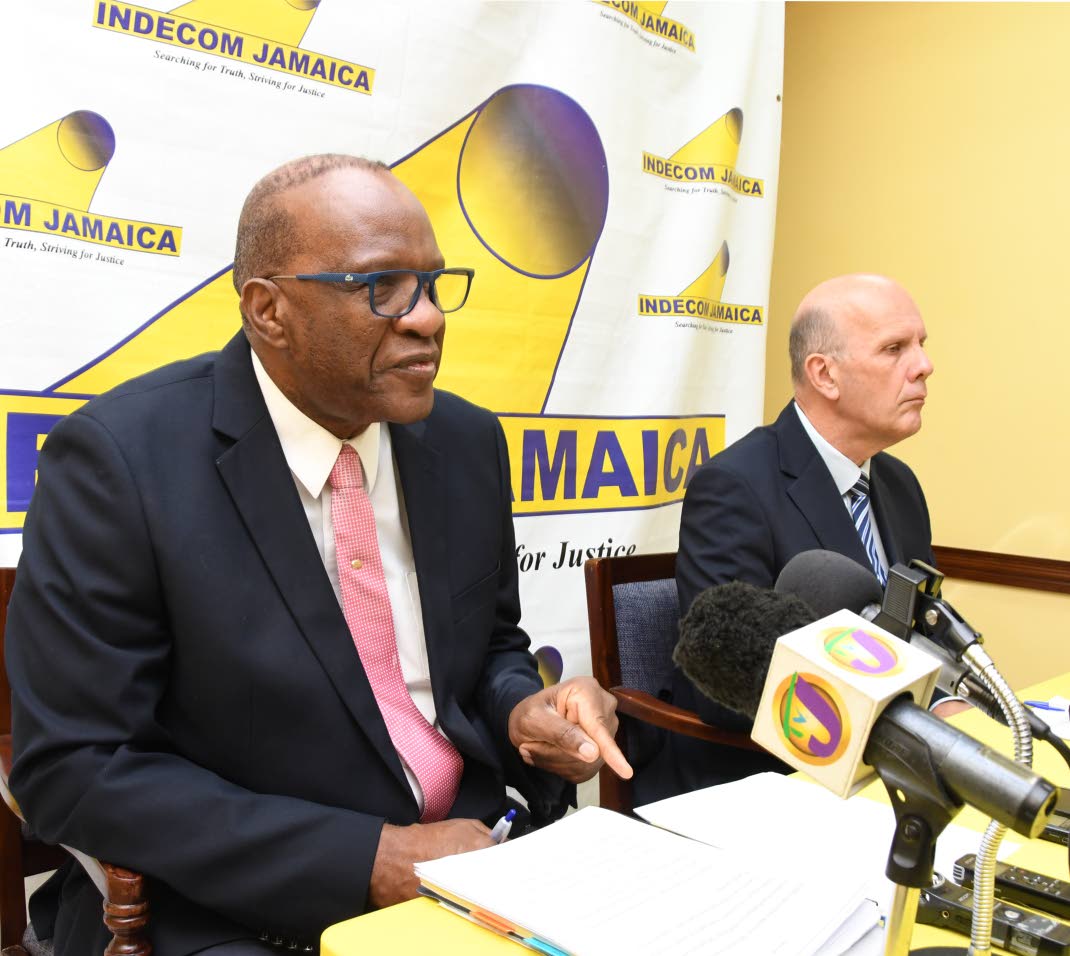
Indecom Commissioner Hugh Faulkner (left) addressing a media briefing, while Deputy Commissioner Hamish Campbell looks on. (Photo: Joseph Wellington)


