‘You don’t have to suffer in silence’
Jamaicans facing mental health challenges urged to access available support systems
MANDEVILLE, Manchester —Against the backdrop of recent suspected cases of suicide in Jamaica, a psychiatrist is warning that vulnerable people might be influenced by reports and posts online about these incidents.
Dr Dorethy Garvey, a consultant psychiatrist, told the Jamaica Observer on World Mental Health Day last Friday that sensational reporting of suicide cases can be very influential.
“The literature has told us that there are persons who may be influenced to actually make attempts or even [commit] suicide having that event happening in their community or having heard about it through the media,” said Dr Garvey.
“One of the things that we think about in terms of being able to curb [incidents of suicide] is how these things are reported and there are guidelines for the media to be able to report in a way that is not overly sensational and sort of just putting the wrong focus… You don’t want to glorify it. You don’t want to make it so sensational that persons see this as an option and hence the need for these guidelines to be known by all these media houses,” added Garvey.
Similar concerns have been raised by consultant psychiatrist Dr Saphire Longmore who recently told the Observer that the sensationalisation of suicide cases can result in copycat behaviour.
Dr Longmore pointed to a research article in public health publication CDC Stacks, which listed recommendations for reporting on suicide.
The article stated that more than 50 studies worldwide have found that certain types of news coverage can increase the likelihood of suicide in vulnerable individuals.
Dr Garvey said vulnerable persons’ proximity to reported cases is also a factor.
“Some persons, depending on where they are, can be triggering to commit suicide and you know we have seen this played out sometimes when it happens. The admissions may increase in the hospitals or even persons turning up in offices [clinics] in the community,” she said.
According to Dr Garvey, awareness is the foundation of treating with suicidal thoughts.
“First of all, we have to know something about the signs and symptoms when one is not well mentally or emotionally, so education, knowledge, information,” she said.
“Get the information, read up on it, what is depression? What is anxiety? What are psychotic disorders? And what are some of the things that would inform us as to the fact that somebody may be thinking suicidal?” said Dr Garvey as she encouraged Jamaicans to do research on mental health.
“Know the warning signs…and if you don’t know there is lots of information whether on Google or the Internet or in the health centres. We can find reputable websites that can give information or go to your doctor. Go to your health centre and ask about these things,” she added.
Dr Garvey emphasised the need for relatives and friends to listen keenly to vulnerable individuals and notice warning signs of suicidal thoughts.
“Having known that then in your daily relationships with people, you are going to be looking out…Listening is very important, so we listen to what people say. When we see what people do,” she said.
“When we see how they react and respond, it is going to say to us, based on the knowledge we have, let me probe a little more. Let me see how best I can support this person. [We] would ask ‘how are you? How are you really doing today?’ added Dr Garvey as she noted that people have a way of responding, “I am fine.”
She pointed out that although there are warning signs for people with suicidal thoughts, some try to conceal their challenges.
“Everything cool and people do that, but people will mask a lot, but you have to know when people are masking too and then go deeper than that to say how I feel, I suspect. ‘Tell me really what is going on,’ so when we know and it is going to now match with some of the possible warning signs that we have read about. Then we will suggest to individuals, ‘you don’t have to go through this alone. Let us help. Would you like to see a mental health professional or let us go to your doctor?’ That is a good place to start,” said Dr Garvey.
“Helping people to understand that treatment is available. We don’t have to suffer in silence and if you are doing something to help your own mental health or to help the health of somebody else then let me just put it frankly or bluntly, there is no madness in that, [it] is positive, if you are taking care of your health, that is good health,” Dr Garvey added as she urged Jamaicans not to stigmatise individuals with mental health challenges.
“Let us not be bogged down with stigma, because we know that is one of the things that keep people away from getting access to the care they need, if we are doing what is right for our health, there is no madness in that,” she said following a sensitisation session at Mandeville Regional Hospital.
In the meantime Dr Judi-Anne Brown, resident in psychiatry at the hospital, said its focus — in light of this year’s theme of ‘Access to services: Mental Health in Catastrophes and Emergencies’ — targeted staff at the facility.
“We had three presentations, one from the Jamaica Constabulary, the Jamaica Fire Brigade and we had Nurse Fay Tee, who is now a counselling psychologist, who gave us a guide on psychological first aid, that is how to respond when persons are in distress,” said Dr Brown.
“This event targeted all staff members at the hospital — doctors, nurses…[and] others. We are trying to promote awareness. We are trying to promote open conversations and allow persons to know if they are struggling. Here is a place where they can come,” she added.
Dr Brown pointed out that the Southern Regional Health Authority, which covers Clarendon, Manchester and St Elizabeth, offers mental health services.
“In the region there are multiple mental health clinics and also you have private psychiatrists and psychologists, so help is available,” declared Dr Brown.
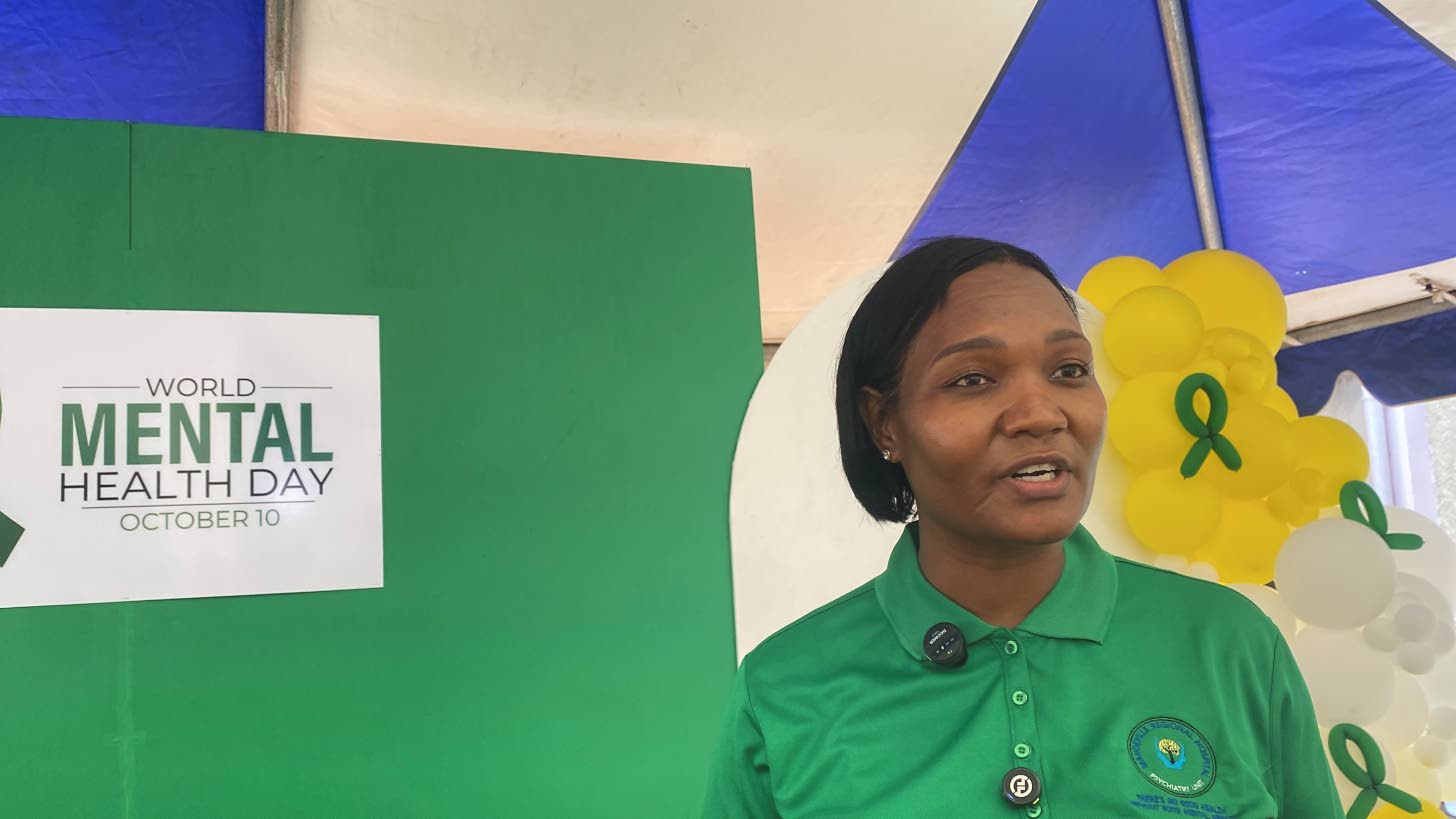
Dr Judi-Anne Brown, resident in psychiatry at Mandeville Regional Hospital speaking with the Jamaica Observer last Friday. (Photo: Kasey Williams)