‘I don’t think I could take the racism,’ says Louis Christie
How Royal Institution of Chartered Surveyors came to Jamaica
CONFRONTED with racism while pursuing a Diploma in Urban Estate Management in England in the 1970s, Louis Christie decided to do something about it.
He returned to Jamaica, determined to have the course taught locally so his countrymen would not have to suffer the indignities he had faced abroad.
Christie never entertained the thought of remaining in England after he got his diploma from Polytechnic of Central London (later renamed University of Westminster) because he knew he’d be unable to bear the brunt of those who considered him less than.
“Honestly, I don’t think I could take the racism,” he said during a recent interview with the Jamaica Observer’s Real Estate on the Rock.
Four years after he flew to England, diploma freshly earned, Christie returned to Jamaica by ship. He dreaded being nauseous during the 11-day trip but it made financial sense to go by sea as he was on his way home with a Volkswagen Passat.
“If I travelled by plane and sent the car by ship I’d have to pay £480 to transport the car home. When I travelled on the ship the car was part of my luggage; I only paid £100 so I saved £380,” Christie told the Sunday Observer with a chuckle.
He still remembers the fun he had on the Norwegian cargo vessel that took him and his car back to his homeland.
“Every night we had a party! They started it the first night — the captain’s party — and afterwards somebody else, and then myself. There were about seven of us as passengers, plus the crew; everybody come down and the whole a wi drop leg. We enjoyed it!” said Christie, his voice full of joy at the memory.
“What I find with life is that happiness is the key — you’ll live long,” added the 86-year-old.
These days Christie is a respected member of the Royal Institution of Chartered Surveyors (RICS), known for the role he played in having the University of Technology (UTech), Jamaica offer a degree programme that would open the door to that international body. The former lecturer is also a valued member of the Victoria Mutual Building Society team.
When Christie looks back at his life, he is content because he’s done what he set out to do. He has watched, over the years, as students from Jamaica and other parts of the Caribbean earn their degrees at UTech, Jamaica — many of them going on to do great things.
Read on for more of Louis Christie’s inspirational story.
Tell me how you ended up going to England to study in 1973.
Louis Christie (LC): “Let me go back to the beginning. At primary school I was considered to be bright, and I thought that I would be using the academic route to make my living. At first I thought I would like to be an agricultural instructor, that I’d go out and teach farmers. I’m from a farming family, so I wanted to do something to help my own people.
“I did my local exams, and then I went to the Jamaica School of Agriculture. I made it clear from I was there that I want to go in the extension service, where I could serve farmers. I was fortunate enough to get that position [after I finished studying there].
“I served them for quite a while and then I said, ‘I’d like to move on,’ because I think I could manage a little more studies. By then I was in my mid-30s. I said since I was going to return and serve the Government, they should assist me with the cost, and they did.
“I got a scholarship to go there and I studied urban estate management — so I have training in both agriculture and urban setting.
“When I returned, I went to the land valuation office…On my holidays, when I was in England, I worked with the Inland Revenue Office; they even promised to give me a job there when I finished my studies. I had to tell them that I could never do a thing like that because I was there on a scholarship, I couldn’t afford to send myself to England to study so I would return [to Jamaica]. I thought if I had a fall-out with the Government here, I could always sail back to England but honestly, I don’t think I could take the racism; I didn’t like it. I saw it up front and close; I couldn’t live with it. I don’t think I could sleep well.”
Give me an example of the racism you experienced while studying in London for those four years.
LC: “One morning, when I was in the first year of the course, I went to class early. I got there and you know what I saw on the board? ‘Vote National Front and let us have a truly White Christmas.’ The National Front was the extreme right, right wing of the British political system.
“There was [an eraser] there so you could rub it off the board, but I didn’t do that. I acted like I can’t read, so it doesn’t matter. I had to do quite a bit of ignoring [while studying in England]; I learned to deal with it, though, because I told myself, ‘I am here for a limited time. As soon as I get my documents I’ll be going home and I will be going home to practise my skill.’
“One of the first things I did for myself [when I returned to Jamaica] was to find a place where I wanted to live. I acquired it and I’m still living here 40-odd years later.”
How did your encounters with racism in England influence your decision to have the course offered in Jamaica?
LC: “While I was over there [completing] the course, I said to myself, ‘It isn’t fair for us to be sending people so far away to study. The best thing for us to do is to try and organise the course out in Jamaica.’ And so when I returned, Lascelles Patterson and I, we went to the Jamaica School of Agriculture and tried to see if we could get the course established out there.
“[They showed no interest but Dr Alfred Sangster — at what was then CAST [College of Arts Science and Technology] then later became UTech, Jamaica — did].
“In short order, the course was established at UTech. [Those who had studied abroad] volunteered to get the course off the ground, [taking turns to teach from 5-8 pm after their full-time jobs ended for the day].
“We did that to the diploma level until the Royal Institution of Chartered Surveyors (RICS) recognised the level of work we were doing. We applied to them to get approval so that when students finished the degree course at UTech they could go on to do the professional thing — which is the RICS designation. They agreed.
“In those years we had to do all sorts of things — you would think that I was a headmaster — but we all came together. Some may not know the name Lascelles Patterson but I can tell you, he was the most influential person in getting that course established. He was a good man.
“Even when I was to go away [to England], he helped me to get admitted, because it’s not that we were not qualified but the racism thing? To get accepted, that was the big thing. The late Mr Patterson assisted me and I have deep respect for him.”
How did you balance teaching with your full-time job?
LC: “We shared it up. We had about six or seven different subjects and I would go, I think, two evenings a week.
“When they started the degree thing, now that is where a little problem would arise. We had to get consent from our full-time employers, but I didn’t have any problem because by then I had retired and I was at the Victoria Mutual Building Society.
“I have the deepest respect for them.
“I worked assiduously down there and they showed me respect, I must say.
“At one point, when I hadn’t even worked there for very long, I had surgery to do and I went to the hospital. The morning when the surgery was to be done, that nine o’clock they had a morning prayer and I understand that a lot of what they dealt with was my going into the hospital and their hope for a safe surgery.
“That brought tears to my eyes. Even now, every time I talk about it, my eyes water.
“[When] I went to VMBS I said, ‘I don’t think I’m going to stay more than five years.’ I’m still there.”
What are some of the high points from teaching at UTech, Jamaica over the years?
LC: “When I go overseas to RICS meetings I see people from Dominica who we trained at UTech with us, people from St Lucia. We don’t get people from Barbados or Trinidad but any of the other smaller islands, you see people. So, I’m happy.
“What I wanted to see was the course established in Jamaica so we can train our people [but it became so much more].
“Of all the things I’ve accomplished I can say I have had two [PhD students] who graduated from our programme:
[One of them is Dr Tina Beale, principal of the Real Estate Training Institute] and [with whom] we had our regular quarrels in class. She was bright…and I enjoyed teaching people like those — they can talk back. When they go out there they are to be leaders, not followers.”
Is there anything else that you want to do that you have not done yet?
LC: “I think I’ve accomplished everything. I should be writing a book now.
“I’m from St Ann. The good thing about being in the rural area is that you don’t have much distraction, but the big disadvantage is you don’t have too many mentors. You have to chart your own course. I think I have accomplished all that I wanted to do and I should really write a book.”
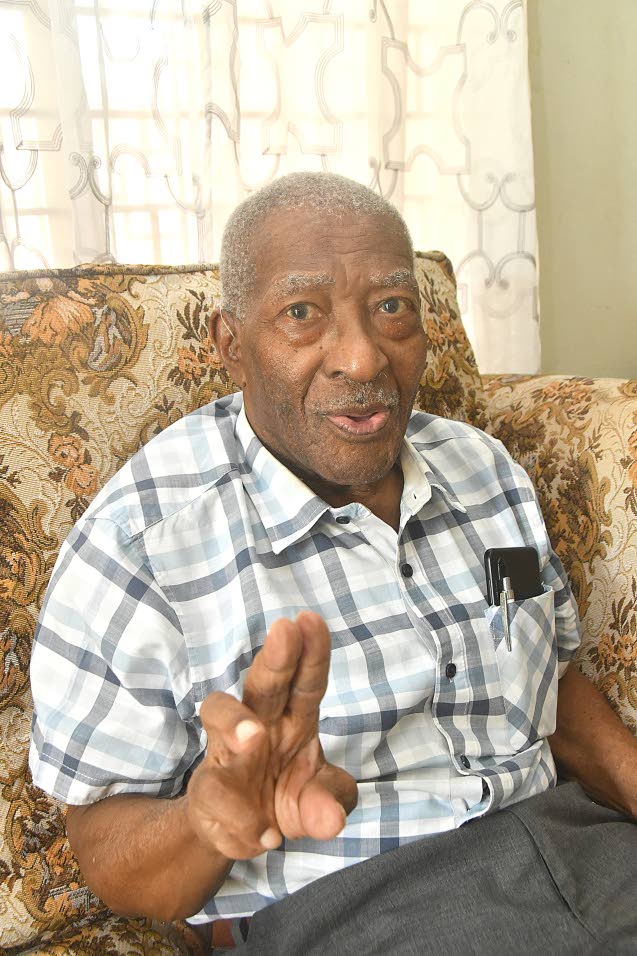
Louis Christie speaks from his home in Kingston. (Photo: Garfield Robinson)