



There is still hope for Shai in Tests
Of all the issues that have puzzled me about cricket over the years, the one that has probably perplexed me the most was Shai Hope’s ineffectiveness as a Test batter. His aptitude for the 50-over game has been stunning, and recently he’s been quite effective in the 20-over game as well. But he was quite unproductive in Tests for a long time.
Hope is, for sure, one of the game’s foremost One-Day International (ODI) batters. He averages 50.24 in 142 games and has 18 ODI hundreds to his name, and few things in cricket are more certain than that whenever Hope bats in ODIs he makes runs. It is a certainty, too, that those runs will be attractive ones and that he will look like a player fit to be ranked alongside the very best.
But dress him in whites, and he is lost. He might lure you into nodding approvingly at an effortless drive through the covers, or he might elicit “oohs” and “aahs” from the throng with a nonchalant flick off his legs. But then soon afterwards he’ll have that same gathering shaking their heads in despair at a needless and seemingly casual dismissal.
That was not always the case. After a slow start to his Test career in 2015 he reached his pinnacle with twin hundreds at Headingley, Leeds, in 2017 during the second Test of that year’s visit to England. To understand the enormity of that performance we should consider that the West Indies were humiliated in the first Test, falling to defeat by all of an innings and 209 runs after scoring 168 and 137 in the game. Additionally, nobody had scored centuries in both innings of any first-class game at the venue since it started hosting games in 1890.
Hope’s batting led his side to a victory that everyone thought impossible after their first-Test drubbing in Birmingham. Pundits, fans, and past players had all written their version of West Indies cricket’s obituary after the Birmingham debacle. And so the Barbadian presided over something akin to a resurrection, one that revived confidence, allowing Caribbean cricket fans to think that maybe their cricket wasn’t totally dead after all.
Headingley did not provide comfortable batting conditions. The ball darted around, especially early in his first innings. Batting first, England only got to 258 in the first innings, with only Ben Stokes (100) and Joe Root (59) making significant contributions. The West Indies were reduced to 35/3 when Hope joined Kraigg Brathwaite (134) in the middle for what turned out to be a partnership of 246. For him to then have returned in the second innings to make 147 was one of the more monumental performances in West Indies cricket history.
After Headingley, however, it was as if Hope’s Test-match batting form fell off a cliff. The West Indies next had two Tests against Zimbabwe, where he made an undefeated 90 in the first game at Bulawayo. But after that there was nothing, and his red-ball batting entered a period of despondency, one from which he could not extricate himself — until now.
In the 50 or so innings he played after Zimbabwe, he went past 50 only twice. But in the second Test against India in New Delhi the stylish right-hander scored a highly composed 103 in the West Indies’ second innings after they followed on 270 runs behind. This time his heroics didn’t lead to victory. But his innings signalled a welcome return to form from a player who had showed that he could walk in elite company.
Hope recently returned to whites as the West indies’ wicketkeeper-batter during the Australian series in the Caribbean. His red-ball batting woes continued, however, albeit in difficult batting conditions, and he only managed 113 runs in the three games. And it may be significant that his return to run-scoring coincided with him being relieved of the wicketkeeping gloves, which allowed him to bat at four in the order as opposed to six since his return.
Hope’s innings, along with a century by opener John Campbell and solid contributions from Chase and Justin Greaves, forced the game into the fifth day. The West Indies still lost badly — India declared their first innings closed on 518/5 — but Caribbean fans would have felt heartened that they put up something of a fight.
Now we should not make too much of a single innings. Hope will need to repeat this kind of performance several times over to be convincing. But this knock restores faith in his capability as a Test batter of high class.
And yet his failures in the red-ball format over the years is still baffling to many observers. We know that the red-ball format is different from the white-ball formats and requires somewhat different qualities. Also, Test cricket requires prolonged focus in addition to skill, and it could well expose frailties that are not as detrimental in the limited overs games.
Fielding placements differ. Wickets are more important in the longest format, so more fielders are often placed in catching positions, like the slip cordon for example. Bowlers in the Test format might be more willing to employ seam and swing in a more concentrated effort to dismiss batters rather than restrict their scoring.
Batters normally face more short-pitched bowling in Tests, and Hope has shown some vulnerability to the high bouncing delivery. He also gets caught off the edge more often than he’d like. But we have seen him excel against good bowling and so we know he can produce against the very best bowlers around.
Hope has had prolonged rough patches in Tests. But he has soared to great heights on occasion too, and we have seen enough to know he can reside at those high levels. He needs to go from here and bat like we know he can. And maybe he’ll end up with a Test record more in line with his outstanding capability as a batter of high class.
Garfield Robinson is a Jamaican living in the US who writes on cricket for a few Indian and
English publications. Send comments to the Jamaica Observer or garfield.v.robinson@gmail.com.

Garfield Robinson
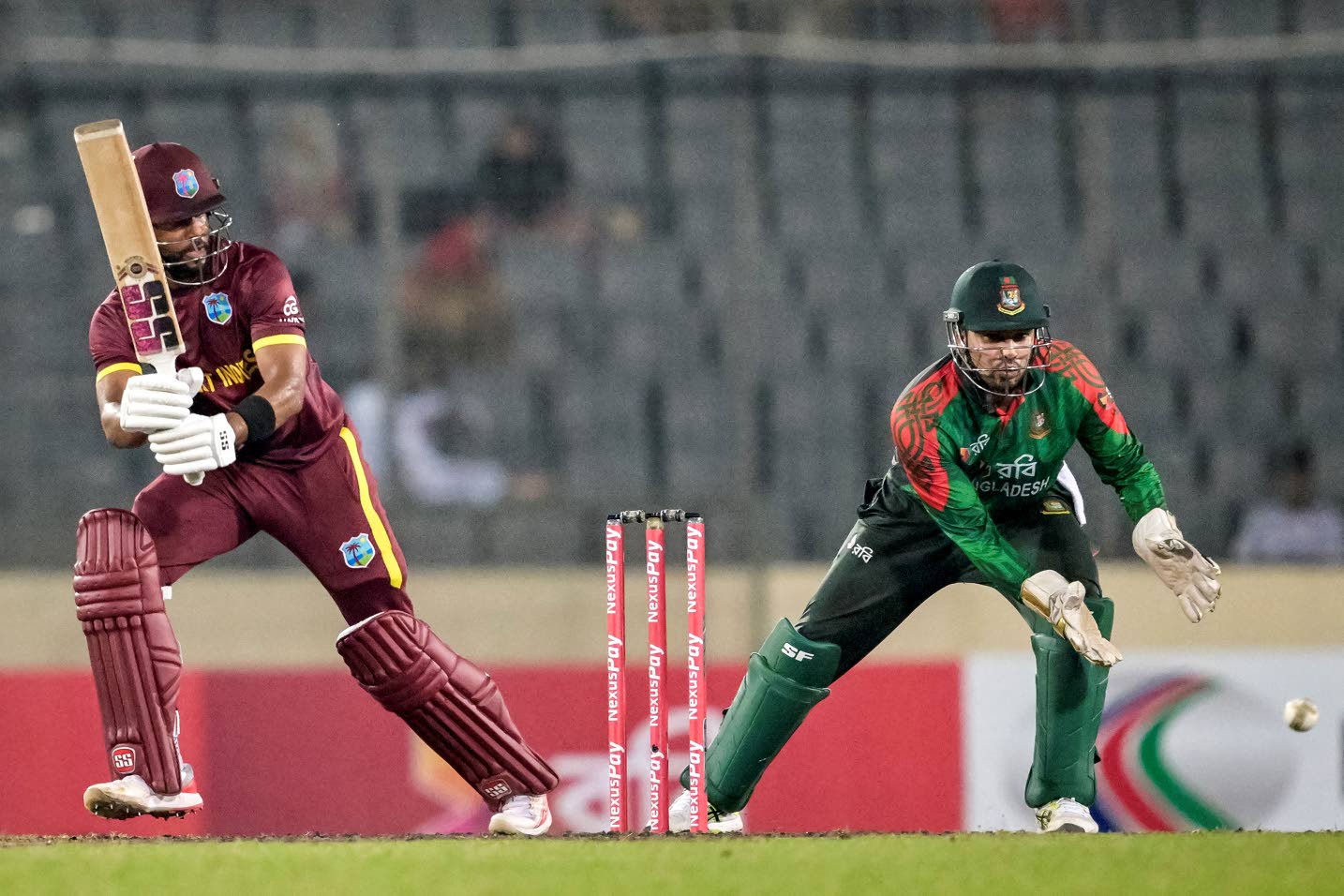
West Indies Captain Shai Hope (left) plays a shot during the first One-Day International cricket match against Bangladesh at the Sher-e-Bangla National Cricket Stadium in Dhaka, Bangladesh, on October 18. (Photo: AFP)


