



SmartHomes by CEAC brings green living to Portmore
Once known for starter homes and middle-income communities, the Sunshine City is now attracting higher-end developers and diaspora buyers in search of lifestyle and long-term returns. The latest entrant, Tessera by SmartHomes Jamaica, signals just how far that shift has come.
The real estate developer — the residential arm of CEAC Solutions — recently completed 52 homes equipped with eco-friendly and smart features at Aqueduct of Vineyards in Bushy Park, St Catherine. It has now turned its attention to Portmore, bringing to the fast-growing real estate market the city’s first fully green housing development.
Located in Bernard Lodge, Tessera will comprise 418 units across four neighbourhoods, each featuring two-bedroom, two-bathroom homes outfitted with solar panels, lithium battery storage, and EV-charging outlets. The community will also include a clubhouse, recreation spaces, multi-purpose courts and jogging trails — the kind of amenities once reserved for upper-end communities in Kingston.
But what makes Tessera stand out even more is its price tag. With units starting at $36.95 million, the development places Portmore squarely in the middle of Jamaica’s fast-rising mid- to upper-mid housing segment — a range that, until recently, was dominated by Kingston and parts of the north coast. For Portmore, where newly built two-bedroom homes typically sell between $28 million and $32 million, Tessera represents a step up in both price and enhanced features. CEAC, however, believes the price difference is justified by the inclusion of built-in energy and water systems that can dramatically reduce utility costs and make homes more resilient.
Each unit comes equipped with six solar panels, a hybrid inverter, and a lithium battery — allowing homeowners to power essential appliances even during grid outages. A solar water heater and a 400-gallon roof-mounted tank supplement daily use, while a rainwater harvesting system provides an additional 110 gallons for domestic needs.
In practical terms, the company estimates these systems can cut electricity bills by 50 to 80 per cent, depending on household consumption.
“Persons are very excited by the smart features that come standard with each smart home. And, with interest rates trending downwards, persons who were initially apprehensive are recalculating their numbers given the outlook for the next six to twelve months,” Lancedale Farquharson, operations director at SmartHomes, told the Jamaica Observer.
“Our SmartHomes are affordable because we treat smart and green as standard, not luxury,” he added.
That shift in thinking, Farquharson argues, makes sustainable living more accessible to middle-income earners rather than something only the wealthy can afford. It’s an approach the company hopes will resonate with younger professionals and the growing number of returning residents seeking to invest in modern, energy-efficient homes.
Further, for first-time buyers, SmartHomes is offering a temporary $1 million discount on applications submitted by October 31, 2025, along with a 5 per cent deposit requirement.
For decades, Portmore has been seen as Kingston’s suburban spillover — a convenient base for workers priced out of the capital. But with new highways, expanding commercial centres, and a swelling population of professionals seeking proximity without congestion, the city’s image has changed dramatically.
Developments such as Caribbean Estates, launched at around $5 million, helped set the stage. Its gated design, modern finishes and security attracted a mix of local and overseas buyers — some of whom turned their properties into Airbnb rentals catering to business travellers and short-stay visitors. That success has since made Portmore one of Jamaica’s most active residential markets, with strong resale demand and steady rental yields, two-time top-performing real estate agent Andrew Duncan, told the Business Observer in a previous interview. Modern developments like Phoenix Village, Morris Meadows and the more recent Chester Creek soon followed.
Tessera takes that momentum further, introducing a level of technology and environmental awareness not previously seen in the area.
“We’re extremely confident that the Portmore market, especially young professionals, is more than ready for a development like Tessera,” Farquharson said. “The response so far has been tremendous.”
The company considers its target buyers to be professionals between their mid-20s and 50s — often with young families or planning for one — who are willing to invest in green features that pay off over time.
While the energy savings are significant, the upfront price of each home reflects broader realities in the construction sector. Farquharson pointed to sharp increases in the cost of building materials — from cement and steel to electrical fixtures and finishing supplies — compounded by high shipping costs and exchange-rate volatility.
“The primary factor driving the cost of these homes is the high price of building materials. Over the past few years, the cost of key inputs such as cement, steel, aggregates, electrical fixtures, and finishing materials has risen significantly due to both local inflation and global supply chain pressures. Imported items are especially costly because of shipping and currency exchange rate fluctuations,” he explained.
Despite those challenges, the developer insists that the push toward smart, eco-conscious housing will become the norm rather than the exception. Each homeowner will receive a detailed owner’s manual outlining maintenance and care for the smart systems, along with warranties to guard against defects and premature failures.
Construction of Tessera’s first phase — comprising 136 units — is already under way, with completion scheduled for the first quarter of 2027. The homes are being marketed as turnkey properties, designed to offer both comfort and cost efficiency from the start.
With more developments planned in the coming years, CEAC believes the introduction of smart, sustainable housing in Portmore will raise the bar for what buyers expect from new communities.
“Within the next two to three years there will be other roll-outs…The response to our recently completed Aqueduct of Vineyards development has shown clear and growing demand for modern, well-designed homes that offer convenience, sustainability, and smart technology,” Farquharson said.
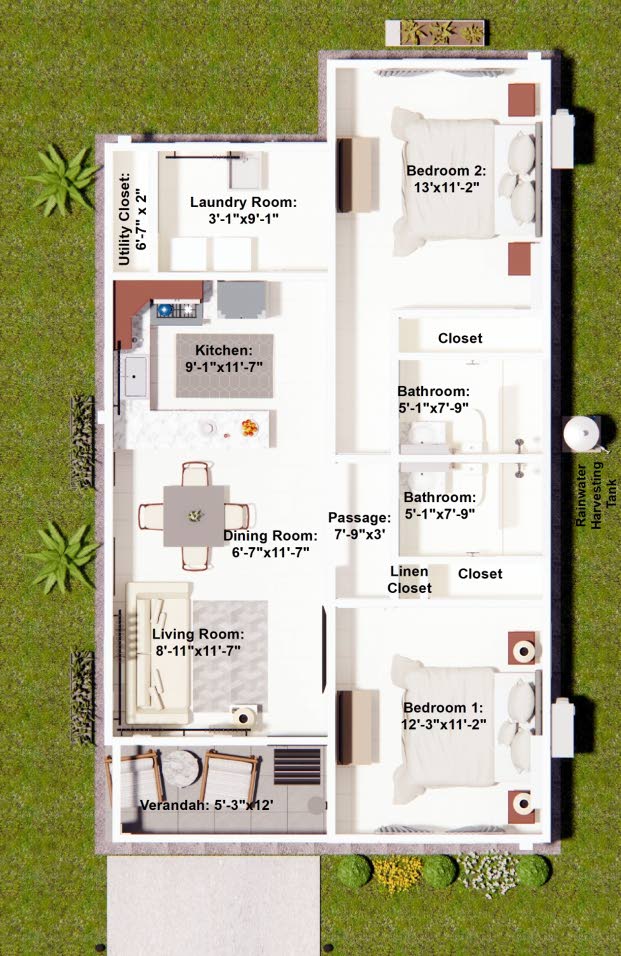
The two-bedroom, two-bathroom layout of a Tessera SmartHome. The 1,268-square-foot design includes open-plan living and dining spaces, a verandah, and energy-efficient features such as solar water heating and rooftop storage tanks.

FARQUHARSON…we treat smart and green as standard, not luxury.


