



Jamaica turns to nature to rebuild communities amid climate changes
AS rising temperatures, flooding, and rapid expansion reshape Jamaica’s communities, a new five-year programme is betting that nature itself can offer some of the most effective defences.
The initiative, called Jamaica Urban Solutions for the Environment (J-USE), is designed to weave nature-based solutions into the country’s urban development framework — an approach that harnesses natural systems like vegetation, waterways and soil restoration to reduce climate risks and improve quality of life.
Launched last week at the Jamaica Pegasus hotel, the programme marks one of the most targeted efforts yet to merge climate adaptation with city planning. It is being financed by Global Affairs Canada, which has committed CAD$4 million, and is managed by the Environmental Foundation of Jamaica (EFJ) which is contributing an additional CAD$1.2 million.
Nature-based solutions, or NbS for short, have become a key pillar of global climate policy, offering alternatives to traditional infrastructure by using ecosystems to provide resilience. In practical terms, that could mean restoring mangroves instead of building concrete sea walls, or creating green corridors that absorb stormwater and reduce heat in dense urban areas.
“Adaptation projects of this nature are important because it acknowledges that infrastructure alone will never be sufficient to support a comprehensive climate plan,” Minister of Water, Environment and Climate Change Matthew Samuda said during the programme’s launch.
Samuda noted that more than half of Jamaica’s population now live in urban centres — areas most exposed to flooding, heat stress and poor air quality. Integrating NbS into city planning, he said, could significantly lower climate vulnerability while offering new avenues for employment and community renewal.
The J-USE initiative will begin with three pilot projects — at the Abilities Foundation on Constant Spring Road, the Danny Williams School for the Deaf in Papine, and Torrington Bridge in Kingston. Each site will test different models of urban greening, such as flood mitigation through landscaping, urban gardens, and green walls.
Project Manager Joni Jackson said the pilot phase is part of a broader framework built on three pillars: a sustainable financing mechanism; policy advocacy for integrating NbS into national laws and development plans; and gender-responsive, socially inclusive climate projects in urban areas.
Later on, the projects will extend beyond Kingston into parishes such as St Catherine, Clarendon, St Thomas, St Mary, Hanover and Westmoreland, creating what Jackson described as “living examples” of how green design can be both practical and inclusive.
For Canada, J-USE forms part of its CAD$5.3-billion global climate finance commitment which focuses heavily on supporting small island developing states.
“This investment reflects our recognition that the climate crisis demands innovative and lasting responses,” Canadian High Commissioner to Jamaica Mark Berman said. “We’re not simply funding micro projects. A key pillar of this initiative is the creation of an urban environmental solutions fund — a sustainable mechanism that can leverage both public and private resources long after this direct investment ends,” he added.
If successful, that fund could help Jamaica build a replicable financing model to support other climate adaptation projects — including urban flood control, tree-planting, and water management — while reducing reliance on international grants.
The timing aligns with Jamaica’s growing use of data tools in climate planning. Samuda pointed to the launch of the Jamaica Systemic Risk Assessment Tool (J-SRAT) which allows authorities to map vulnerabilities across public and private infrastructure.
“We’ve already assessed which roads, drains, and facilities are most at risk,” he said. “The next step is to overlay those findings with where projects like J-USE can have the greatest impact.”
The Government’s National Adaptation Plan calls for investments exceeding US$5 billion, though Samuda believes that estimate may be understated given the escalating costs of resilience projects.
Jamaica’s urban growth has traditionally leaned on grey infrastructure — drains, retaining walls, and concrete embankments. But environmental planners have long argued that those systems, while necessary, are not always sufficient or sustainable.
In contrast, nature-based interventions can reduce capital costs and create co-benefits such as cooling, recreation, and biodiversity, the minister reasoned. They can also enhance the country’s tourism product and provide new opportunities for green jobs, especially in landscaping, waste management, and environmental monitoring.
The EFJ, which has supported hundreds of environmental and community projects since its creation in 1993, is positioning J-USE as a proof of concept for what community-led adaptation can look like in cities.
“Canada partnering with EFJ represents more than just choosing a capable organisation. It reflects a commitment to placing decision-making, resources and leadership in the hands of local institutions that understand their communities’ needs,” Samuda said.
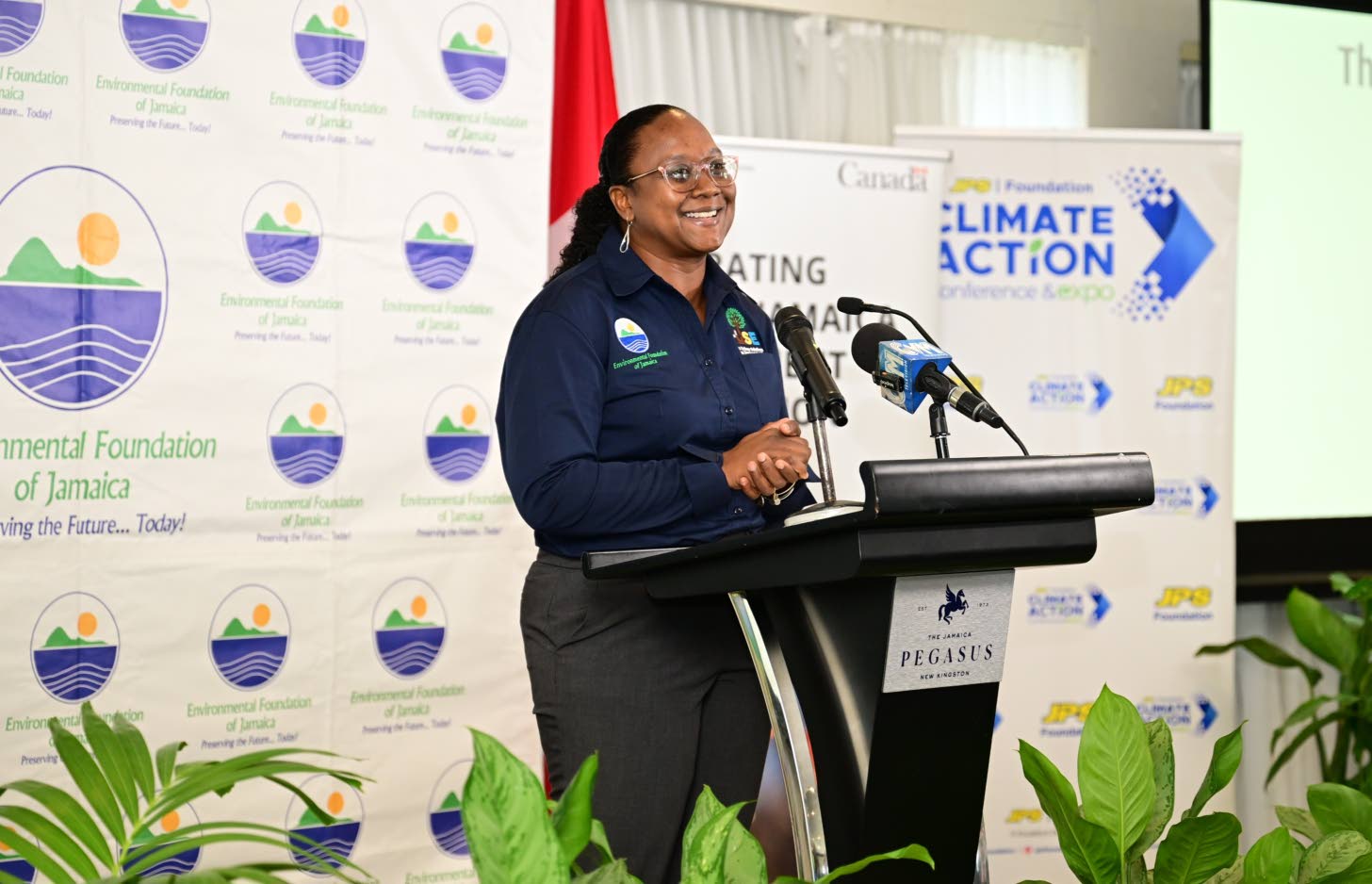
Jamaica Urban Solutions for the Environment (J-USE) Project Manager Joni Jackson addresses the initiative’s launch at the Jamaica Pegasus hotel in New Kingston.


