



Patterson urges national unity in rebuilding after Melissa
Applauds Holness for first steps in the face of hurricane’s wrath
Former Prime Minister PJ Patterson is urging Jamaicans to rebuild the nation in a spirit of unity and resolve after the widespread devastation unleashed by Hurricane Melissa.
According to Patterson, also central to that national recovery effort should be a commitment to building smarter, given Jamaica’s vulnerability to the forces of nature.
“National unity is always beneficial for any country, but there are times when national unity is an absolute imperative, and that time is now,” Patterson, who served as Jamaica’s chief executive from 1992 to 2006, told the Jamaica Observer on Thursday.
“The hurricane didn’t separate people according to their denomination; it didn’t discriminate between people because of their political support of one side or another, [so] what is going to be required is a total unity of effort and total unity of purpose,” he added.
During his tenure as prime minister, Patterson introduced the concept of a national body responsible for rebuilding the country after the damage inflicted by Hurricane Ivan on September 10, 2004.
That body, the Office of National Reconstruction (ONR), was led by Danville Walker, who was seconded from his job as director of elections, a post in which he gained wide respect for reforming the country’s electoral system, reducing corruption, and bringing more integrity to the voting process.
“We had to get somebody who was non-partisan that could get along with representatives at the national and local government levels and elected representatives, no matter what their political affiliation,” Patterson said of Walker’s appointment at the time.
“We need to get somebody who can work with the private sector, the non-governmental groups, the churches and civil society, who knows about Jamaica, every nook and cranny,” he added.
On September 17, 2004, Patterson announced that the ONR’s terms of reference had been expanded “to facilitate the ongoing programme of disaster management and the equitable distribution of relief benefits and supplies, mindful of the importance of these linkages in effecting a smooth and speedy reconstruction”.
Additionally, an ONR board chaired by Walker was constituted “to receive contributions for the Jamaica Hurricane Relief Fund and to disburse money from this fund to the relevant State, NGO or other bodies undertaking various relief efforts and to ensure that the monies are spent in an efficient, accountable and transparent manner”.
Reflecting on that initiative on Thursday, Patterson suggested that it could be adopted, tweaked, and improved.
“Of course, it will have to have working committees, but there must be an overall supervisory body, most suitably under the direct accountability of the Office of the Prime Minister, which already is responsible for infrastructural works,” he said.
“There has to be, of course, one of the technical committees dealing with accountability, because both the international donors and the diaspora — who respond generously, as they usually have — will want to be satisfied that expenditure is being handled in the most productive and meaningful ways,” Patterson said.
He commended Prime Minister Dr Andrew Holness, members of the Cabinet, officials of the Office of Disaster Preparedness and Emergency Management, the security forces, and everyone involved in the work done so far in managing the response to Melissa which slammed into the south-western coast on Tuesday at Category 5 strength, leaving a trail of death and destruction in its march to the northern coast where it exited the island.
“I think, based on the experience we have accumulated over the years, and applied improved techniques, the country was well prepared for the disaster that was to happen. And so far, in the preliminary stages of the response our systems are holding up,” Patterson said.
“We now have to concentrate on restoring shelter, getting all the utilities working and repairing the road network,” he said, adding that “the damage has been truly, truly devastating”.
He pointed to Holness’s comment on Wednesday regarding the rebuilding of Black River in St Elizabeth which took the brunt of Melissa’s fury.
Holness, during a visit to the historic town, said while it was destroyed, “we can envision a future of it rising stronger and better because the truth is that many of the buildings were not located properly in the first place. They were in vulnerable areas [and] we will now take the opportunity to properly reorganise the town and to build back even stronger”.
Patterson agreed, saying that the rebuilding effort should not be focused on simply reconstruction.
“We have to look at building smarter and differently. We have to gather all the expertise available in our country to look at some factors as to the planning and the development for the way forward,” Patterson said.
“Yes, we have to do some temporary things to provide immediate shelter, so zinc and plywood will be used as we are accustomed to, but in terms of the housing construction that we’re going to have to undergo now and in the future, we have to revisit what kind of material, what are the designs, what is the substance that goes into construction. And this leads me to the point that yes, the Government has a lead responsibility, but it has to involve the entire country.
“Certainly in terms of legislative action and remedial action, both parties can’t afford to be bickering, for example, about the distribution of material that comes in for assistance. And we have to know what is going to be done short term and what is going to be done long term. It’s also going to involve a great deal of community work, because our people have certain habits, they have certain customs, and we’re not going to change them easily,” he argued.
“So the planning has to take that into account,” Patterson said, pointing to Jamaica’s susceptibility to hurricanes and earthquakes.
“The prime minister, in his utterances, has already said things which indicate an acceptance and appreciation that we have to do some things differently.
“What I’m really proposing, and hope that we’ll be taking into account, is that we are subject now to more frequent, erratic, devastating hurricanes. In fact, not only in Jamaica, but in the entire Caribbean. And we can hardly complete recovery from one before the next one comes,”added Patterson.
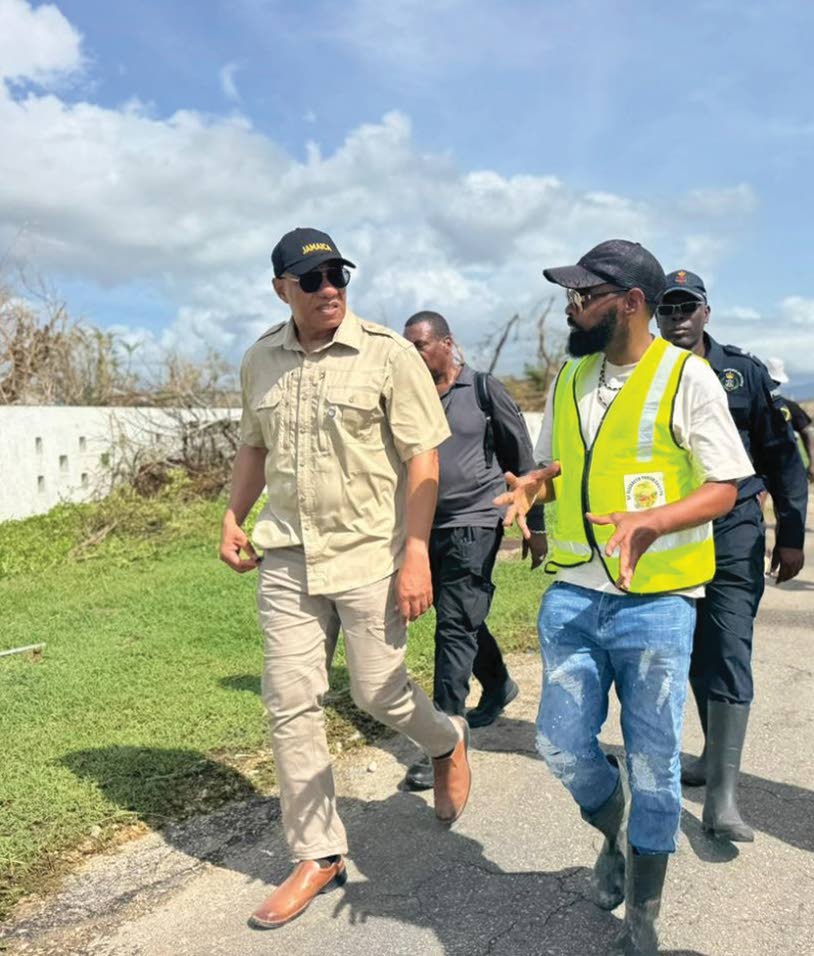
Prime Minister Dr Andrew Holness (left) gets an update on conditions in Black River during his visit to the historic town in St Elizabeth on Wednesday.


