



‘Build forward better’
Holness announces sweeping post-Melissa recovery plan
Prime Minister Dr Andrew Holness has pledged that Jamaica’s recovery from Hurricane Melissa will not simply restore what was lost, but will “build forward better”, unveiling several plans to rebuild homes, restore key infrastructure, and strengthen climate resilience across the island.
Addressing Parliament on Tuesday, Holness said, “Hurricane Melissa was not only a national tragedy — it was a warning.”
He noted that the recovery effort would unfold across four overlapping phases — immediate relief, emergency relief, stabilisation and recovery, and long-term reconstruction — each aimed at rebuilding lives, restoring livelihoods, and strengthening Jamaica’s climate resilience.
“Our goal is not just to repair what was damaged. Every repaired bridge, re-roofed home, and rebuilt road must be designed for the storms of tomorrow, not the storms of yesterday,” he said.
Holness detailed a wide range of new measures designed to accelerate national recovery. He announced that the Office of Disaster Preparedness and Emergency Management (ODPEM) would be reassigned to the Office of the Prime Minister, a structural change intended to streamline logistics and strengthen coordination with the Jamaica Defence Force in reaching marooned communities.
“This realignment establishes virtually a single point for emergency logistics and further tightens coordination with relief partners. This is about speed. The new arrangement will accelerate the distribution of relief supplies in the aftermath of Hurricane Melissa, better serve the most affected communities, and restore normalcy as quickly as possible,” he explained.
The Government has also launched a National Clean-Up Week, a countrywide effort to clear debris and restore civic pride. The initiative will be led by the National Solid Waste Management Authority, supported by community groups, schools, faith-based organisations, and private sector volunteers. Holness called on every Jamaican to “roll up our sleeves, clean up our surroundings, and help restore beauty, order, and hope to our communities”.
Furthermore, with thousands of families left homeless, the prime minister announced a constituency-level housing support programme allocating $10 million to constituencies in the most severely affected parishes — St Elizabeth, Westmoreland, Hanover, St James, Manchester, and Trelawny. Those in moderately affected parishes such as St Ann, Manchester, and Clarendon will each receive $5 million, while all other parishes will get $3 million per constituency.
He also outlined a major National Housing Trust (NHT) relief package, which includes a six-month mortgage moratorium for over 20,000 homeowners in the hardest-hit parishes, low-interest repair loans of up to $3.5 million, and grants of up to $500,000 for contributors who need to repair or rebuild their homes.
“I wish to remind the public that all NHT mortgagors are insured under the Trust’s House Owners’ Comprehensive Policy, which covers damage from hurricanes, storms, floods, fire, and other perils. The NHT has already mobilised its branches islandwide to help mortgagors prepare and process their insurance claims quickly and efficiently,” he assured.
To further ease the burden, he also announced that the Government would extend Customs duty and general consumption tax exemptions on relief goods until the end of December 2025, allowing the importation of items such as solar panels and Starlink equipment duty-free to support power restoration in rural areas.
Holness also announced additional allocations to support Members of Parliament in responding to local needs. In addition to the $1.5 million previously granted to all constituencies before the hurricane, each will receive another $1.5 million once earlier funds are exhausted. However, recognising the scale of devastation across western Jamaica, constituencies in St Elizabeth, Westmoreland, Hanover, St James and Trelawny will receive an additional $5 million each, while those in Manchester, St Ann and Clarendon will receive $2.5 million.
He further revealed that all MPs will receive targeted funding for the trucking of water to drought and flood-affected areas — with the most impacted constituencies in western Jamaica to receive $2 million each, and others between $1 million and $1.5 million depending on need. He said that between 4,000 and 5,000 water tanks will also be distributed to affected communities, with special attention to schools, families with young children, and the elderly.
In a bid to maintain national stability while financing recovery, Holness said the Government would activate provisions under the Financial Administration and Audit Act to temporarily relax fiscal rules. This, he explained, would allow the Government to spend more freely in the short term to rebuild the country while maintaining accountability.
“We anticipate a rise in the debt-to-GDP ratio in the short to medium term as resources are channelled into rebuilding for resilience. Yet Jamaica’s record of disciplined fiscal management provides the credibility and space to respond decisively. Our focus remains clear — to restore livelihoods, protect the vulnerable, and ensure that Jamaica emerges from this crisis stronger, more resilient, and more competitive than before,” he said.
Holness also paid tribute to the security forces and first responders, praising the JDF and Jamaica Constabulary Force for their “heroic” service during and after the hurricane. “Their efforts have been extraordinary,” he said, acknowledging that many officers and soldiers had suffered personal losses while continuing to serve on the front line of rescue and relief operations.
He revealed that the JDF had already established 22 humanitarian assistance and disaster relief outposts across the hardest-hit areas of western Jamaica, using what he described as a “hub-and-spoke” model to reach isolated communities.
In St Elizabeth, the bases have been set up in New Market and Springfield. Over in Westmoreland, operations are active in Burnt Savannah, Savanna-la-Mar, Darliston, Lennox Bigwoods, Bluefields, Bethel Town, Amity, Beeston Spring/Thatch Valley, Frome, Roaring River, Glenbrook, and Reno. Meanwhile, in neighbouring St James and Trelawny, outposts have been established in Catadupa, Cambridge, Adelphi, Maroon Town, Wire Fence, Jackson Town, Falmouth, and Perth.
“These will serve as humanitarian bases in a ‘hub-and-spoke’ model from which to reach other surrounding communities. This operation represents the highest standard of joint civil-military coordination and underscores the discipline and capacity of our armed forces,” Holness told the Parliament.
Turning to the education sector, Holness said hundreds of schools, particularly in the western parishes, had been severely damaged or destroyed, disrupting learning for more than 150,000 students. He said the Government’s focus would be on “safe reopening where facilities permit; continuity of learning through blended, remote, and alternative sites; and accelerated reconstruction to return students to permanent classrooms as soon as possible”.
In the health sector, he confirmed that field hospitals would be established in the hardest-hit parishes to provide temporary emergency and outpatient care while damaged hospitals such as Black River, Falmouth, and Cornwall Regional undergo repairs.
“Recovery will not be measured in bricks and mortar, but in the confidence and emotional well-being of our people as well,” he added, announcing expanded mental health and psychosocial support for affected families.
Opposition Leader Mark Golding welcomed the prime minister’s announcements but urged greater transparency, inclusiveness, and clarity in the management of the national recovery.
“One of the concerns I have currently is the command structure is not well understood. We need to have clear lines of communication into the chain of command… it cannot be totally informal, it must be transparent,” Golding said.
He also stressed that relief and assistance must be distributed based on need, not political affiliation.

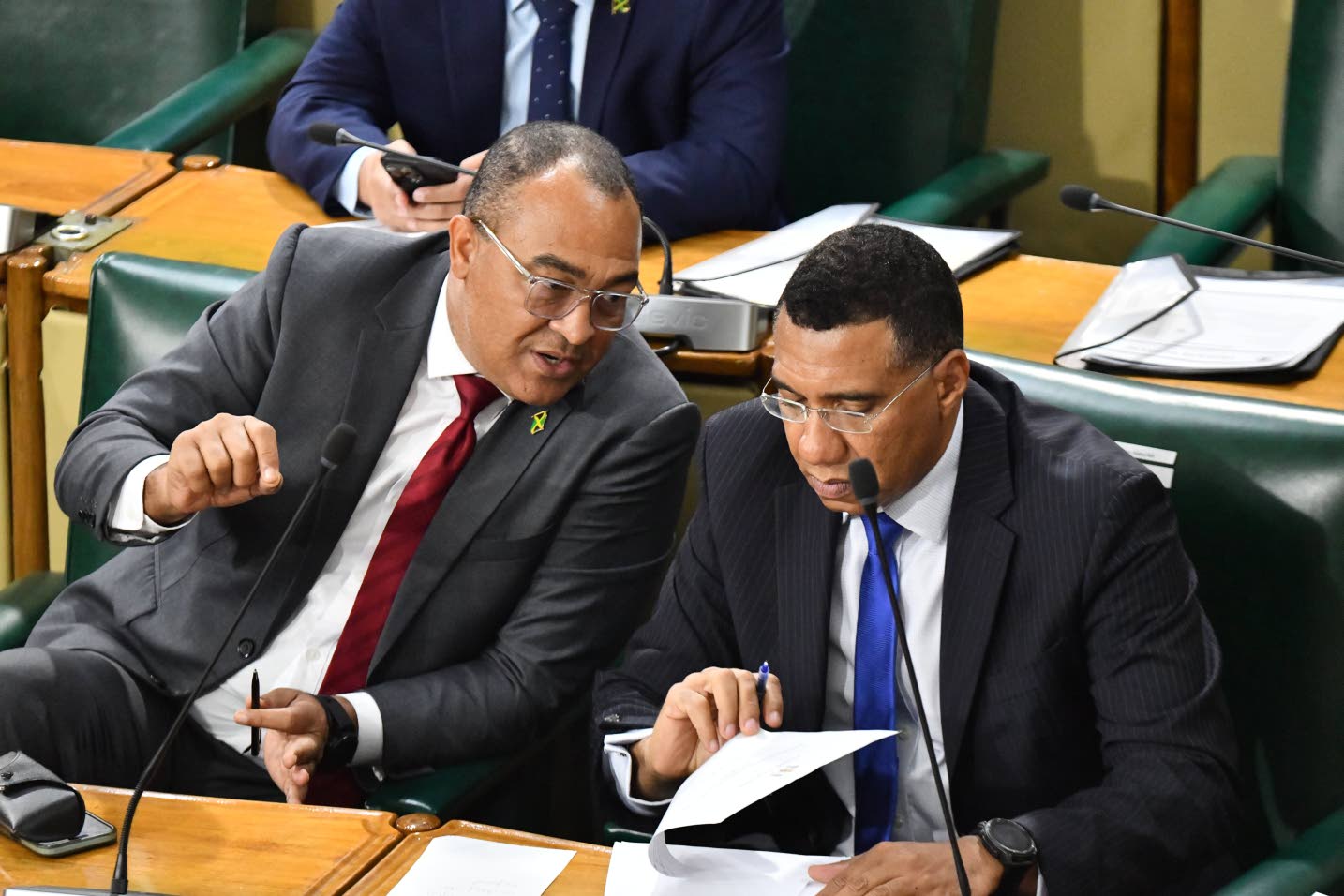
Health and Wellness Minister Dr Christopher Tufton (left) has a word with Prime Minister Dr Andrew Holness in Parliament on Tuesday. (Photo: Naphtali Junior)


