



Health sector workers hailed as loyal, heroic, committed
Public health staff who turned up for duty despite suffering personal losses because of Hurricane Melissa were on Tuesday hailed as “loyal, heroic, and committed”. However, officials in the sector are on edge as a reported 10 to 20 per cent of staff have not been accounted for since Melissa’s assault on October 28.
“They have been diligent and heroic. The workers of health care are also victims of the storm, they have been loyal and committed, they still show up for work unless they are marooned in, but they are also traumatised from the experience — they have lost their roof, their possessions, and so on — and so the rest of us are helping to coordinate interventions to give them support while trying to mount a response to the infrastructure and services that are offered by them,” Health and Wellness Minister Dr Christopher Tufton said at a health cluster Hurricane Melissa response meeting with donor agencies and non-governmental organisations at The Courtleigh hotel in St Andrew.
Tufton pointed out that there are nearly 23,000 public health workers in the system, from porters to doctors and nurses, across the island.
Nicole Dawkins Wright, director of emergency disaster management and special services in the ministry, said while the majority of public health workers are at their posts there is concern about those who have not surfaced since the storm.
“If I were to group the main challenges we have at this time, the main headings they would fall into would be: the infrastructure, our workforce — based on reports so far, we still have some accounting to do for some of our health-care workers and for those we have accounted for we still have about 10 to 20 per cent that we haven’t completed accounting for,” she stated.
Hurricane Melissa, which now holds the record as the most intense storm ever to make landfall on Jamaica, packing winds of 185 miles per hour, hit the south-western section of the island on Tuesday, October 28 near New Hope, Westmoreland.
The powerful cyclone caused catastrophic flooding across the southern and western belt. It mauled St Elizabeth, Westmoreland, Hanover, Montego Bay, and Trelawny leaving untold damage on infrastructure, vegetation, and lives. The official death toll from the ferocious system has climbed to just over 30 so far.
Dawkins Wright, who said up to Tuesday 60 per cent of reconnaissance to scope the damage done had been carried out, told the meeting that a “significant amount of health records have been lost”.
“That has its own implications, which we need a solution for. We are still in that evaluation mode, so what the solution will be will be informed by that,” she said, adding that “some of the morgue capacity within the parishes are also compromised”.
“And so what will happen going forward needs to be addressed as well,” Dawkins Wright said.
Dr Jacquiline Bisasor-McKenzie, chief medical officer of health for Jamaica, said psychosocial issues are a huge problem for not just health workers “who themselves are challenged in terms of having to cope with their loss and provide care” but ordinary survivors of the storm.
During a slide presentation Bisasor-McKenzie showed images she said she captured while driving through hurricane-ravaged areas.
“That lady sitting down with her head on her hands, we saw a lot of that, people just sitting on the rubble, what do to, everything is lost. So that’s a very real situation, a lot of people with no houses just on the road,” the chief medical officer said.
Noting that “traversing along the area that was previously very rich and lush with vegetation [is] now depressing” Bisasor-McKenzie said, “We have a lot of psychosocial issues that we have to manage.”
“I know that we have a PAHO (Pan American Health Organization) team that is coming to help us set up psychosocial centres within each of our parishes, and I don’t think we can get enough help in terms of psychologists and social workers and those types of paramedical personnel because we are going to need to staff centres right across the country with these persons who are able just to listen to persons, offer solutions where there are solutions, and just to provide help,” she told the meeting.
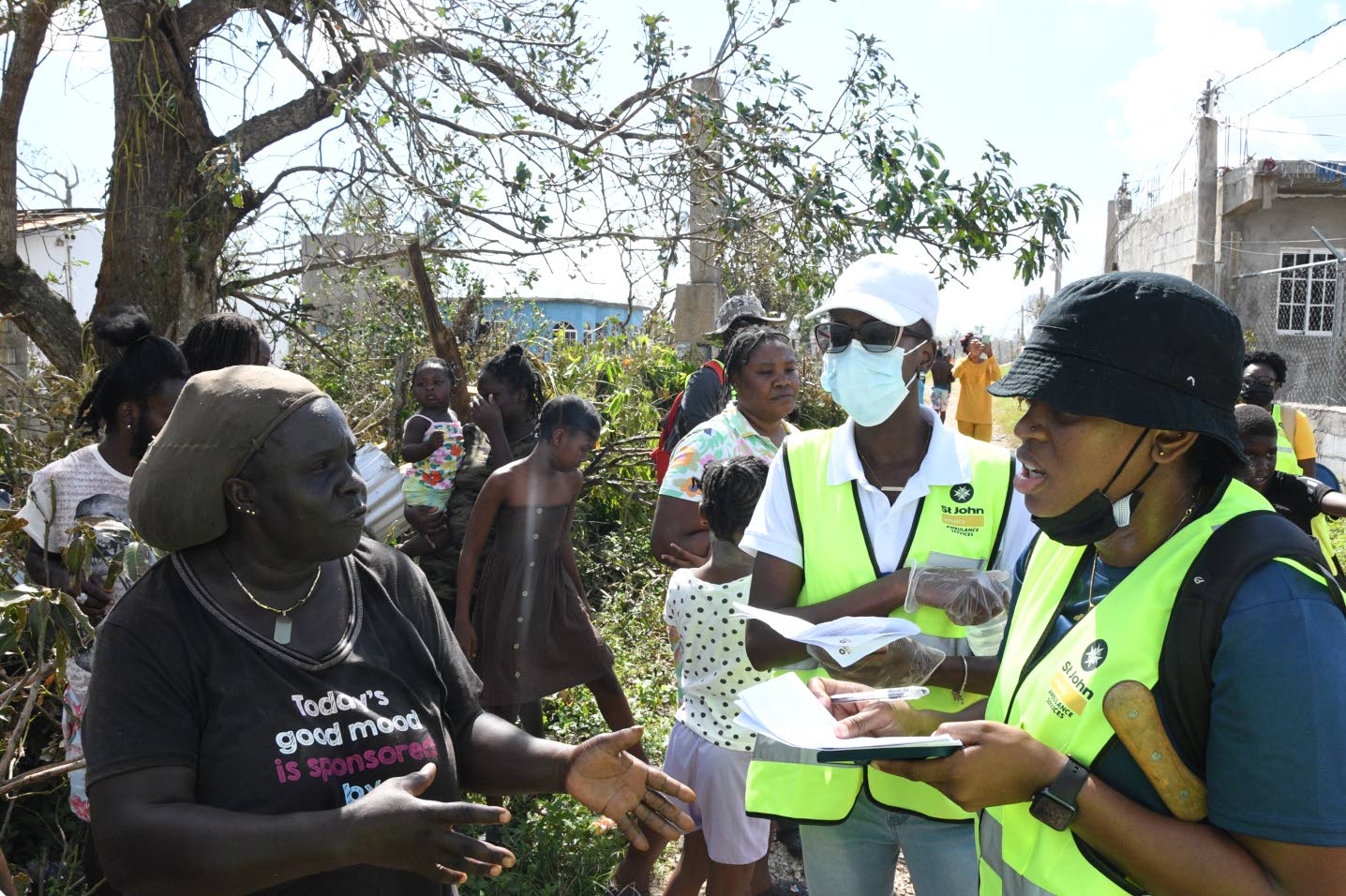
A member of the St John Ambulance Jamaica medical team checks the vitals of a resident of Whitehouse, Westmoreland, on November 1. More than 250 volunteers galvanised by St John’s Ambulance Jamaica and the JN Foundation brought first aid care last weekend to nearly 800 residents of the areas in St Elizabeth and Westmoreland worst-affected by Hurricane Melissa.


