No hiding from Melissa
St Elizabeth farmer reports heavy livestock losses, but already rebuilding
WHEN he built his farm, Ackeeno Cole thought he had found the perfect hiding place — deep within the morass near Luana in St Elizabeth, far from prowling thieves and wild animals that once threatened his livestock and crops — but there was no hiding from the fury of Hurricane Melissa.
The catastrophic Category 5 weather system roared across the west of the country and tore through his sanctuary with unrelenting force. However, Cole has refused to roll over and die, saying he has already started rebuilding his business.
“We nah give up… Me nah go sit down, so me have to just continue,” Cole told the Jamaica Observer last Wednesday.
He said 80 of his goats were swept away, along with a few cows. His business partner also lost 40 goats. Only two goats survived, Cole said.
His freshly planted sorrel, pak choi, and other crops were buried beneath mud and ruin, and bags of animal feed were gone. Still, Cole refuses to admit defeat.
The Sunday Observer spotted him on the quiet waters of Black River last Wednesday in a small, worn, 15-year-old fibreglass boat, travelling towards what was left of his farm. It was his third visit to the disaster-struck area since Hurricane Melissa made landfall two Tuesdays ago.
However, his journey from his home in Middle Quarters — approximately two miles from the farm — was not one of submission, but defiance and resilience. He recalled the moment he realised he’d lost it all.
“Me know say it did a go [get] damaged, so me did a go with high hopes to say some would survive — or majority — because them did dike the Black River, so [it’s not] really the flood, so me did a go with a high hope, but just two [goats] left back. Everything dead, dead, dead,” said Cole.
“It’s a big setback. We spent thousands of dollars to complete the structure down there, with like zinc and board, just to facilitate them down there in the morass because we a hide from thief, animal, and dog, and all them stuff there. So we go way inside the morass with the goat business and lose same way,” he said, chuckling at the irony of his misfortune.
While he could not quantify the loss, he shared that he had invested heavily and was waiting patiently for the profit to roll in before the hurricane hit on October 28.
“We [bought] some hybrid goats for all $80,000; the rammy and mother goat for all $40,000, and we did try to cross them with the common goat,” he told the Sunday Observer.
However, he won’t see the end result of that process as he’s lost his investment. He shared that some of the crops he recently planted were also destroyed.
“Me did have about three big patches of some that me did set off already with pak choi. I [had] about six to seven pounds of sorrel seed that I set off, and everything [was] damaged down there. No sorrel for Christmas, practically no crop in St Elizabeth for Christmas, so that’s why I want [to] start back as early as possible,” he told the Sunday Observer.
Cole shared that he was on his way last Wednesday to see how far his business partner had got with preparing the field for cash crops such as lettuce and pak choi, and was already plotting how he could get some seeds for other produce. He’s hoping for some assistance from the Rural Agricultural Development Authority (RADA), but until then he will do what he can with what he has.
A father of two — a six-year-old and a three-year-old — Cole said he has both his young family to care for and his father, a retired farmer who taught him everything he knows.
As he tried to stay afloat in the worn boat he and his father built 15 years ago, Cole admitted that he had often thought about upgrading his vessel but simply could not afford to.
“[Because] you have family and you try to do things, sometimes money comes and it nuh come as how you would want it. Sometimes it’s there to do the boat, but other means and necessaries [come up], that’s why we can’t really afford one at this time,” he explained.
Cole, who also raises other livestock, said his farm can be accessed by foot, but it is easier to let the ripples of the Black River carry him — even though the route comes with its set of challenges. On several occasions he’s encountered crocodiles, but he has learnt to remain calm, knowing that if he doesn’t provoke them they are unlikely to attack. He shared that, sometimes, he even travels by night.
“We used to it, and we do it for years, so sometimes we do night fishing. Me nuh really afraid because me know say the crocodile nah go attack. The only thing we are afraid of is the crocodile, and them nuh attack we like that. [As] soon as they realise say somebody is [coming], they position themselves and go in the water,” he told the Sunday Observer.
Cole said on some trips he carries goats and produce from his farm in the boat and has to be careful of his movements to protect the livestock.
“When we look for sale, we tie them up and put them in it — all five or six of them. We tie them and pack them like how you pack a bag…We carry agricultural stuff [in the] same way. Sometimes you plant pumpkin, anything we farm in here, we bring it. It’s kind of difficult to walk with [them] from so far, but in here [the boat] we stuff everything.
“Sometimes, like this, when the water tall, and sometimes like when a piece of log comes and we make a bad move, [the boat] takes in water; all me jump out same way [and have to] swim and hold back the boat, because the boat overturn. As you see, [it’s] a short boat. You have to be very skilled like this to stand up and paddle it. It has a whole heap of obstacles, but true we used to it and can swim, it won’t be a problem,” he added.
While using the worn boat to get to and from his farm has become second nature, Cole said he would not shy away from assistance to get a better boat to travel the waters as he seeks to rebuild.
“The goat business coming like it go down the drain, but we nah give up…Me nah go sit down so me have to just continue. I raise all cows same way and couple herd of them over there so same way, couple of them dead same way. Everybody got impacted — the whole district, the whole community with livestock got an impact. [It’s not] just me alone, but we have to keep going,” he charged.
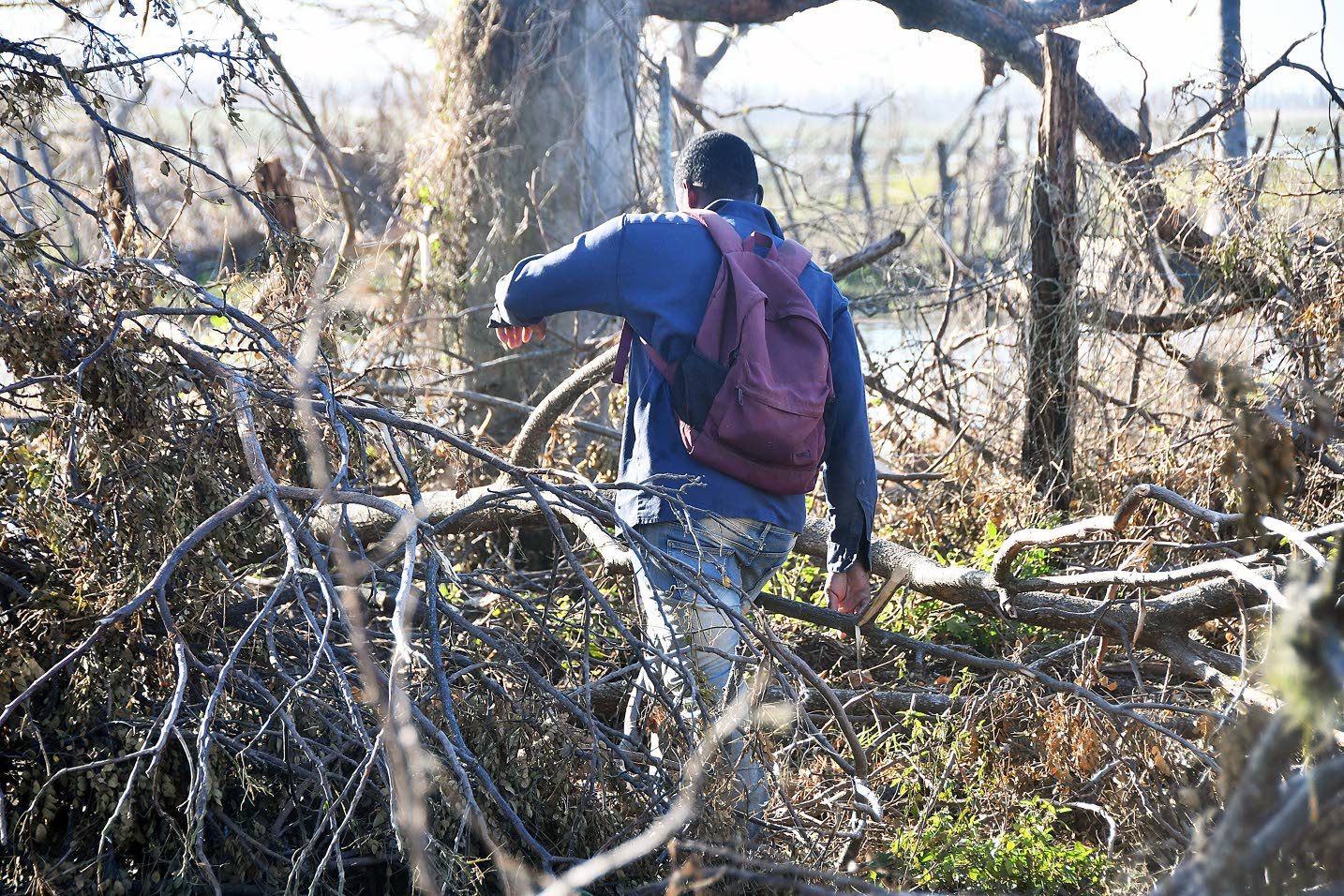
Ackeeno Cole makes his way through downed trees after speaking to the Jamaica Observer last Wednesday in St Elizabeth while on his way to his Hurricane Melissa-ravaged farm. (Photos: Garfield Robinson)
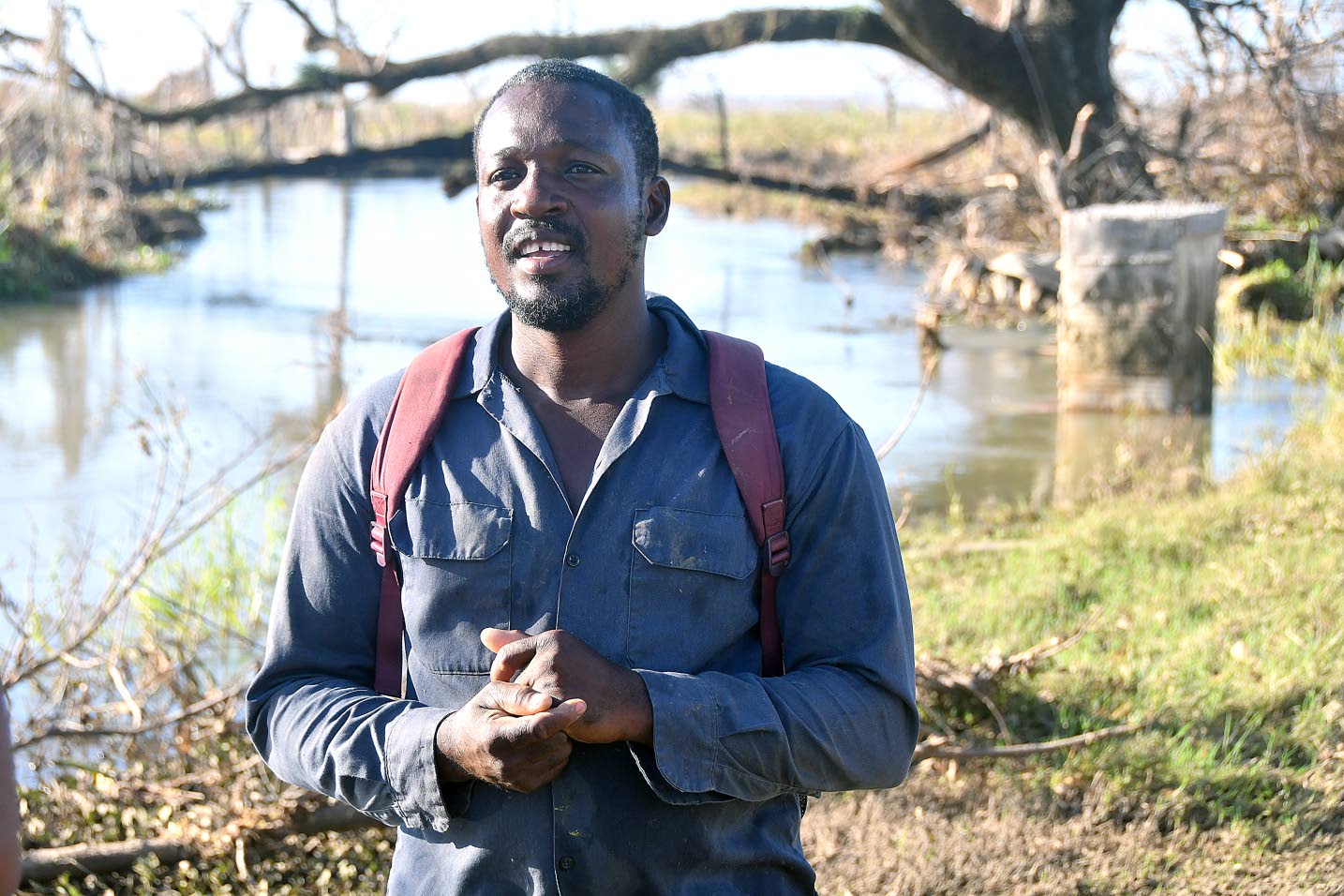
COLE…we go way inside the morass with the goat business and lose same way