



Hotels take different paths on staff security after Melissa
With thousands of tourism workers facing months of uncertainty after Hurricane Melissa, the Jamaica Hotel and Tourist Association (JHTA) says more hoteliers are working through ways to protect their staff.
The update follows a disclosure from Sandals Executive Chairman Adam Stewart, who announced that the company will keep 100 per cent of its team members on payroll throughout the recovery.
JHTA president Chris Jarrett told the Jamaica Observer that the weeks since Melissa have revealed a widening range of responses across the sector. He said many properties have revived the same protective measures used during COVID-19 to keep workers attached to the industry, even as revenue tightens and several resorts remain closed.
“As were observed under the situation with the COVID pandemic, where some hotels had made arrangements to protect employees by rotating them,” he said. “Some hotels would have made arrangements… with employees to take a reduced salary and then rotate them… so that everybody remains employed but at a lesser salary… just so that we would preserve the livelihoods of our employees because that’s our most valuable resource.”
Jarrett emphasised that while the public may be focused on roof damage, washed-out beaches and repair costs, hotel leaders are simultaneously managing a deeper internal crisis — stabilising their workforce so properties do not lose skilled staff before the recovery.
He described a growing set of “quiet interventions” underway across the industry.
“There are several properties. Some want to remain nameless, but some are doing soup kitchens for both employees and the public. Some are fixing the houses of their employees. Some are giving care packages. Some are providing tarpaulins… And some are allowing employees to remain on property… because their houses sustained some damage,” he said.
He noted that the efforts reflect the sector’s recognition that staff are the backbone of its recovery. “Each of them are doing their own thing, so to speak, in ensuring that employees’ livelihoods [and] opportunities” are protected, he added.
Still, Jarrett acknowledged that not all hotels are able to hold staff on payroll.
Bahia Principe — one of St Ann’s largest employers — has begun a redundancy exercise affecting workers across its two Runaway Bay hotels. The company has advised staff that both properties will remain out of service for an extended period due to the scale of reconstruction required.
The 850-room Bahia Principe Grand Jamaica will not reopen until December 2026, a full year beyond previous estimates. Its sister property, Bahia Principe Luxury Runaway Bay, is now scheduled to reopen in early 2026.
In communication to employees, the chain noted that “the closure of the hotels will occasion a redundancy exercise across both hotels”, and said it is working with the Bustamante Industrial Trade Union, counsellors and service providers to support staff through the transition.
Jarrett described Bahia’s position as an outlier rather than the start of a broader trend.
“That’s not the majority of the properties,” he said. “Most of them expect to be up early next year… and quite a majority of them are pushing to be ready for the winter season which starts December 15th.”
Jarrett’s deeper concern is the risk that prolonged closures — whether from Melissa or large-scale renovation schedules — could push workers out of tourism entirely, as happened during the pandemic.
“As we know, as with COVID, some people chose other industries to enter after they were displaced… and we suspect that some of that may happen,” he warned.
But he noted that new hotel projects coming on stream could help reabsorb displaced workers, preventing a full-scale labour drain.
“There are other properties that will be opening,” he said. “So we think that there might be some balance maintained between those displaced and those that will be taking up new positions.”
Meanwhile, Sandals’ commitment to retain its full workforce, with all benefits intact, has set a strong benchmark for the industry.
Stewart told a global audience that “100 per cent of our team remain on payroll — whether they’re at an open or closed resort. All benefits will also remain in place — pension, medical, dental, everything”.
The company has so far committed more than US$3 million to staff support, offering financial assistance, temporary accommodation and emotional-wellness services, even as several of its properties remain closed until next year.
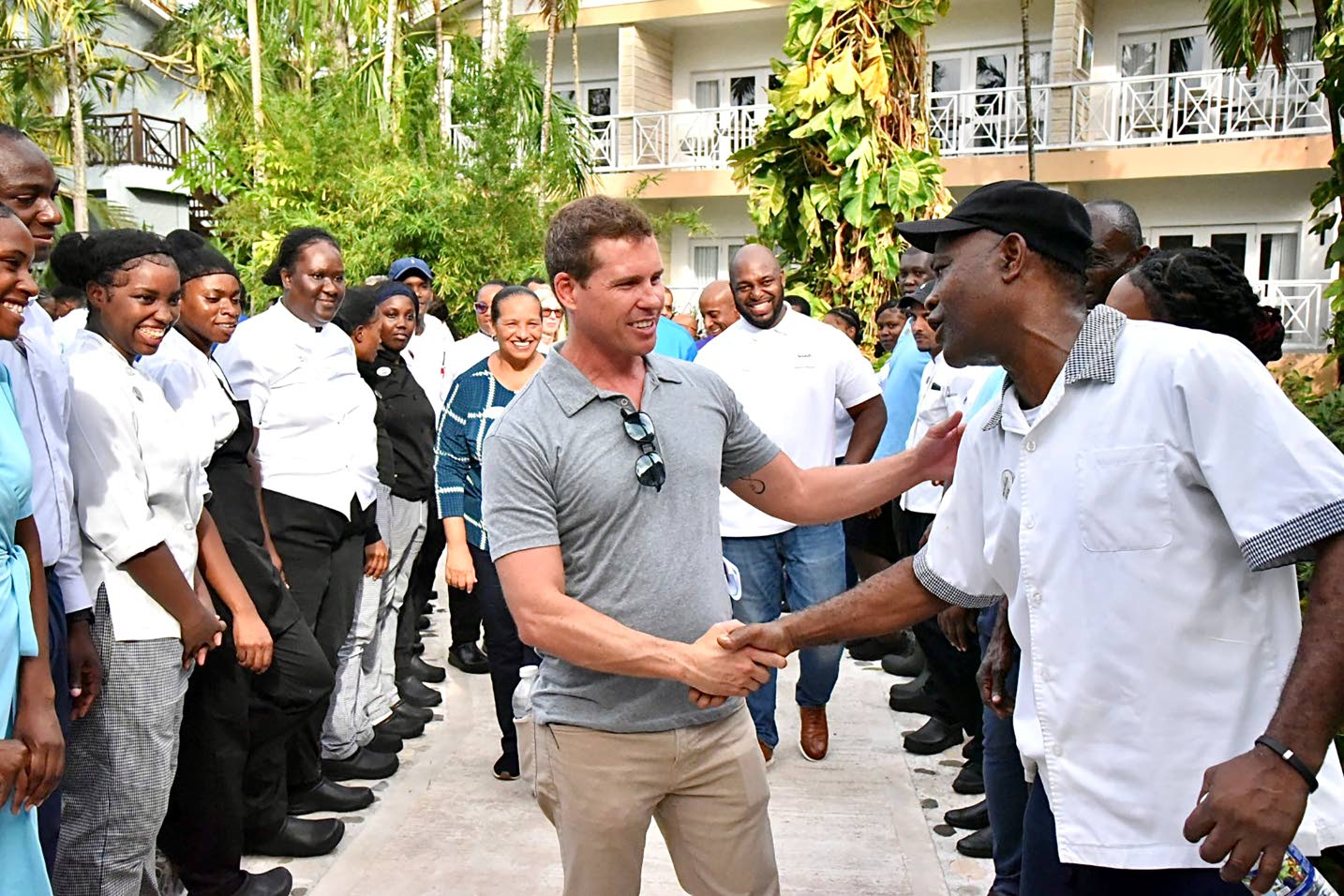
Executive chairman of Sandals Resorts Adam Stewart interacts with team members during his visit to the resorts following the passage of Hurricane Melissa.
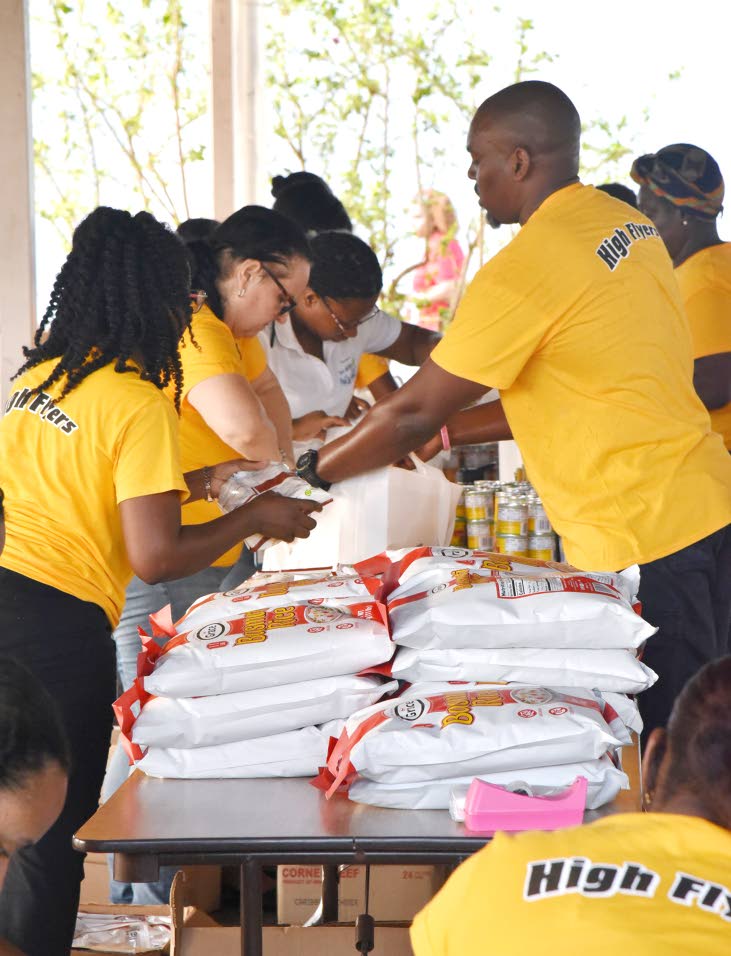
Volunteers at Sandals Resorts’ corporate office pack hundreds of relief food packages for team members.


