



Working for the ‘Greater Good’ American charity planning long-term support for Jamaica’s post-Melissa recovery
UNITED States-based Greater Good Charities has ramped up its disaster response efforts across several Jamaican parishes following Hurricane Melissa, focusing on immediate humanitarian needs while laying groundwork for long-term recovery, especially in the agricultural sector.
Executive vice-president of environmental programmes at Greater Good Charities Bryna Donnelly told the Jamaica Observer that the non-profit organisation, founded in 2007, has been deploying teams across Jamaica to support affected communities, animal organisations and various agricultural projects.
“Our mission is to help people, animals and the environment. We do that by leveraging our expertise, our financial aid, and deploying volunteers in the field for both disaster response and our normal programmatic work,” said Donnelly.
Since arriving in the island days after Melissa hit Jamaica on October 28, Greater Good Charities has dispatched humanitarian supplies to St Ann, Trelawny, St James, Hanover, and Westmoreland. The organisation plans to extend operations along the southern corridor, including Manchester and St Elizabeth.
The charity’s ‘Good Packs’ — which Donnelly says provide 72 hours’ worth of hygiene and comfort items — have been distributed, along with loose supplies such as soaps, shampoos, lotions, insect wipes, and sunscreen.
Distribution has been carried out in partnership with the Salvation Army, which Donnelly praised for its reach across more than 50 communities.
“The urgent needs were food, water, electricity and communication,” said Donnelly. She told the Observer that by one week after Melissa the Government and non-profit organisations did an amazing job meeting many of the needs of the people hardest hit by the hurricane.
“Now it’s about fine-tuning and reaching harder-to-reach areas.”
According to Donnelly, Greater Good Charities is also providing significant support to animal organisations, particularly Hope Zoo, the Jamaican Society for the Prevention of Cruelty to Animals (JSPCA), Montego Bay Animal Haven, and the Negril Spay and Neuter Clinic.
“Our biggest animal partners are the Hope Zoo and the Jamaican SPCA. They are donating their staff and vehicles to help move supplies. We could not do this without them,” Donnelly added.
She said pet-care items are already in distribution through the JSPCA network, with another shipment expected in the coming days.
Donnelly said the Hope Zoo has been assisted through cash grants to cover operational costs, including vehicle maintenance, as teams navigate debris-covered roads.
With major agricultural regions severely impacted, Donnelly emphasised that long-term recovery depends heavily on restoring bee populations.
“Your breadbasket was wiped out. Replanting isn’t an option yet because the land is still saturated. But even when it dries, if bees aren’t alive to pollinate, there won’t be any fruit of that labour,” said Donnelly.
Greater Good Charities is working with the Ministry of Agriculture, the Rural Agricultural Development Authority (RADA) and local beekeeping associations, including groups in St Ann, Trelawny, St James, Hanover, Westmoreland, St Elizabeth, and Manchester, to distribute temporary hive boxes, pollen and other resources to keep colonies alive.
Donnelly encouraged Jamaicans to help by feeding displaced bees at home.
“Bees can survive a long time on simple sugar water,” she said. “A one-to-one mix of sugar and water, placed in a blue bowl, bees love blue, can keep them alive until they find their way back home. It keeps them from swarming and helps the entire agricultural recovery,” Donnelly added.
She argued that road conditions remain one of the greatest obstacles to recovery, particularly in mountainous communities where access is still limited.
Vehicle wear and tear, especially punctured tyres from storm debris, has slowed distribution efforts but not stopped them.
Donnelly said all humanitarian aid which arrived in Jamaica earlier has already been distributed with more animal supplies en route to the island and teams will resume assessment and delivery missions as soon as shipments are cleared.
“It’s a slow and tedious process, but it’s all about making sure supplies reach the people who really need them,” said Donnelly as she urged Jamaicans to stay hopeful.
“After a disaster, it’s easy to lose hope when you look at your home or community. But there are people who care, there are people helping. It all gets done, it just takes time,” underscored Donnelly.

Executive vice-president of environmental programmes for Greater Good Charities Bryna Donnelly is joined by two team members from Montego Bay Animal Haven distributing animal care packages in St James.
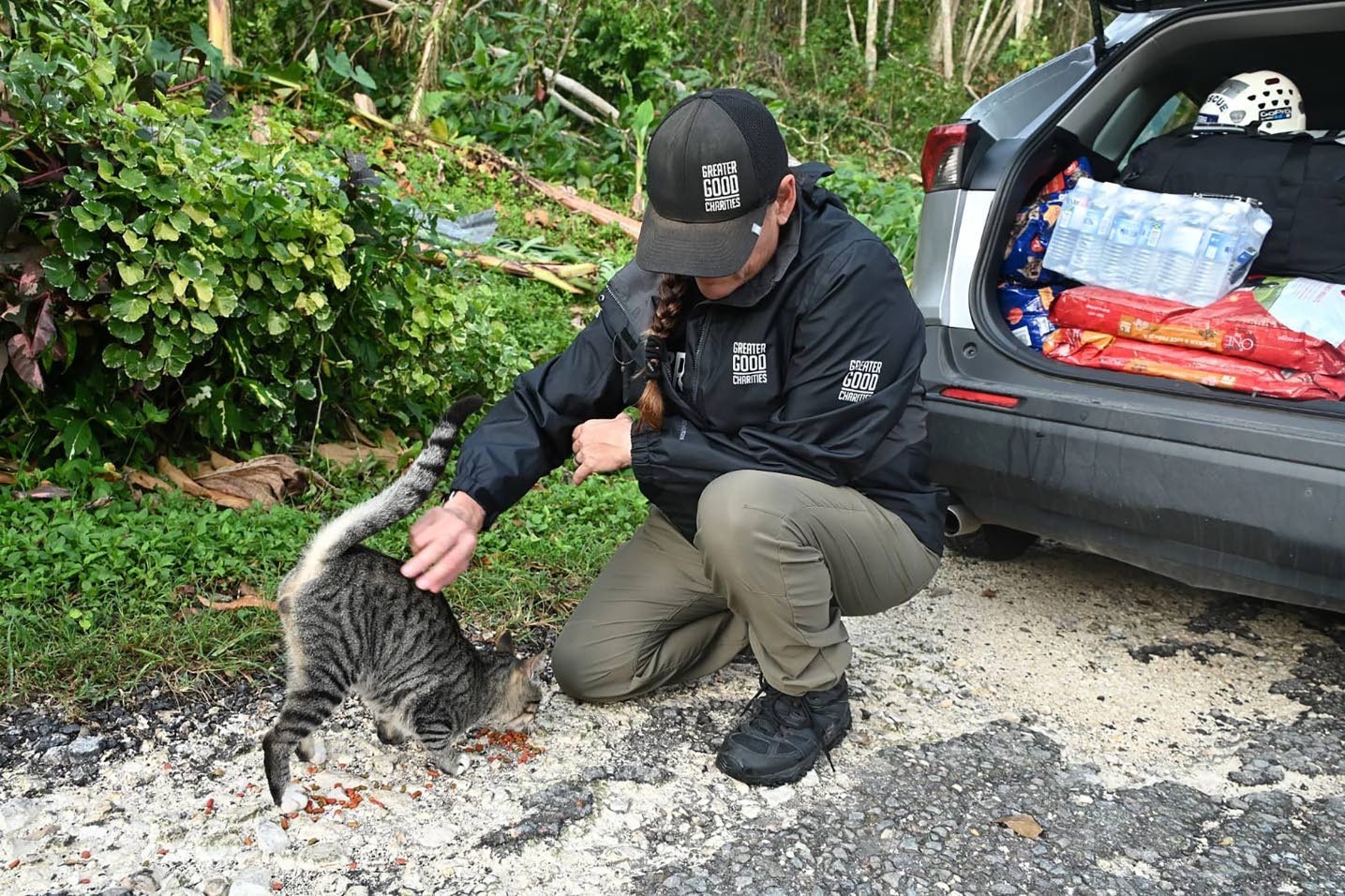
Laura Littlebear has a moment with a cat during a visit to one of the hard hit communities in St James.


