



The foreign v home-grown debate
Dear Editor,
Another missed opportunity for the Reggae Boyz and yet another call to refocus the national programme on home-grown players.
As the search for scapegoats dominates the post-mortem of how we fumbled such an easy World Cup qualification campaign, the foreign-based players are called to the front of the line for their lashings and questions are asked about their loyalty to the black, green, and gold. The prevailing fallacy: Your birth paper being signed at Registrar General’s Department makes you more loyal and valuable to the Jamaican football programme. It’s a convenient scapegoat that has been left to graze the fields of public opinion for years, but, ultimately, it’s a fallacy that holds the programme back.
The idea that local-born players are inherently more committed, more passionate, or more capable of bringing success is not only untrue, but dismissive of the realities of modern football. National teams don’t succeed because their players are born within certain borders; they succeed because their talent pools are maximised. Jamaica needs its Diaspora in order to be competitive on the global stage. In our final World Cup qualifier on November 18, 2025, Curacao, who are now celebrating their World Cup berth, fielded a starting 11 made entirely of players who were born in the Netherlands. I am by no means suggesting we adopt such an extreme, but highlighting how other countries recognise the importance of diaspora talent.
Football talent is global, and not bound by geography. Players who grow up in a successful footballing nation like England benefit from world-class academies, nutrition, sports psychology, strength programmes, tactical education, and rigorous competition from the time they are eight years old. That doesn’t make them better Jamaicans, it makes them better prepared athletes. To pretend that a player trained in a system that struggles for resources, facilities, and structured youth development will automatically outperform a player raised in the top football ecosystem on Earth is disingenuous. Jamaica’s domestic potential is rich, but the pathway to elite performance is still developing.
The local v foreign debate often presents an emotional argument that is not rooted in fact: Local players care more, have more passion, and will fight harder. However, the evidence — historic and recent — shows otherwise. If you make a quick check of Sofascore’s player ratings from Tuesday’s draw v Curacao, you will see that the lowest-rated Jamaican on the night was locally born, while the highest rated was born in England. Commitment is not in a postcode; it’s in a mindset. There are local-born players who underperform and foreign-born players who give everything, and the reverse is equally true. The shirt doesn’t care where your navel string is buried.
Jamaica’s greatest football success, the 1998 World Cup qualification, was built on a fusion of local talent and foreign-born players. Renée Simões understood the importance of blending physicality with professionalism and harnessing overseas experience to raise the standard of the entire squad. That equilibrium is what carried Jamaica to the world stage. We didn’t succeed because we were local; we succeeded because we were united, balanced, and strategically assembled. Let me whisper when I say this: Many local-born players lack the professionalism that competitive football requires.
International football is about the best available, not the most local. Countries with far stronger football traditions than Jamaica embrace the diaspora model. Morocco, Algeria, Senegal, Nigeria, and Ghana — teams performing well in world football — actively recruit their diaspora talent. France, two-time world champions, are effectively a multicultural mosaic of global roots. Many of their foreign-born players hold strong ties to their home countries, but commit to representing France despite the racism they face there. Good programmes cancel ‘birth papers’.
The truth is simple: If you want to consistently qualify for the World Cup, you must use every available resource. Jamaica’s population is just under three million. Why would a small nation voluntarily cut off its largest pool of footballing potential?
There’s a romantic idea that relying solely on local-born players will strengthen the domestic game, but football doesn’t work that way. Sharing the Jamaican struggle does not guarantee sporting prowess. The highest-performing local players become even better when surrounded by teammates who challenge them, raise their standard, and introduce new professional habits. Competition is the engine of improvement. The presence of foreign-born Jamaicans has historically elevated local players, not suppressed them.
If Jamaica wants to produce more elite local players, the solution is not to exclude foreign-based ones; it is to fix the foundation. No butler will do that for us; we have to do the dirty work collectively, together. To our leaders, great defender, grant true wisdom from above that they may implement:
• Proper youth development systems
• Modernised coaching education
• Investment in facilities
• Long-term technical planning
• Consistent leadership and less politics in football
Blaming foreign-born players is a distraction from the structural problems that truly hold back Jamaica’s football.
The Reggae Boyz don’t need a local-based project. They need the best Jamaicans, wherever they were born. Football is a global game, and Jamaica is a global nation. The Diaspora is not a threat to local football identity; it is one of our strongest competitive advantages. The fallacy isn’t that we should use foreign-based players. The true fallacy is believing we can succeed without them.
Kalvin Brown
kalvin.ac.brown@gmail.com
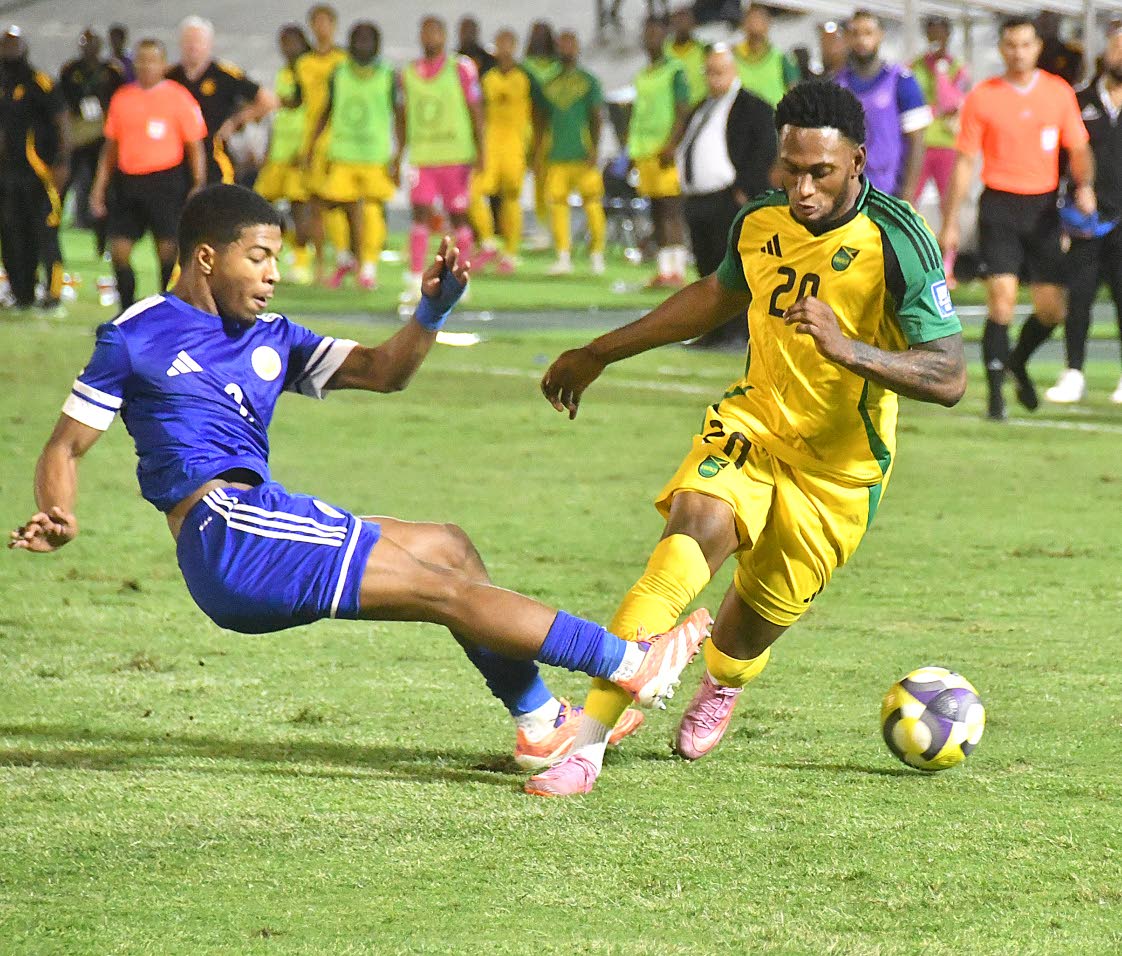
Curacao defender Shurandy Sambo (left) challenges Reggae Boyz winger Renaldo Cephas at the National Stadium recently. (Photo: Garfield Robinson)


