Gov’t weighs new school models to prevent learning loss
The Government is looking at implementing several operational models to stave off the risk of “significant learning loss” to children in sections of the island where many schools were obliterated by Hurricane Melissa. Among them is what is termed a ‘Host School Model’.
“This is a temporary arrangement where a student from a non-operational school continues learning in another institution for a defined period of time. Students nevertheless remain anchored to their home institutions so we are not doing a transfer,” Education Minister Senator Dr Dana Morris Dixon announced in the Senate on Friday.
She said the ministry is aware of the pains that can come with transition as different schools have different cultures. As such, students and their host schools will be supported by strong regional coordination, psychosocial services, clear accountability measures, accommodation, and transportation.
Morris Dixon reported that as of Wednesday this week, 78 per cent or 791 schools have reopened. She said some schools, depending on the level of impact the hurricane had on infrastructure, will have full school, others will operate on a rotational or extended day model (shift), while others will utilise temporary or alternative sites or have students reassigned to other schools that have agreed to host them.
She said a preliminary request for the phased repair and reconstruction of 600-plus affected schools has been submitted to Cabinet for consideration. At the same time, damage assessments are still underway, as 21 public tertiary institutions and 679 schools islandwide were affected by the Category 5 hurricane which made landfall on the island’s south-western coast on October 28.
Those schools, based on the nature of the damage, have been placed in three categories: Priority One, which were severely damaged; Priority Two, those which were moderately damaged; and Priority Three, schools which suffered minor damage.
Within these categories Morris Dixon said 239 were deemed as Priority One; 339, Priority Two; and 101, Priority Three.
She said the majority of the Priority One schools are in the affected parishes of St Ann, Trelawny, St James, Hanover, Westmoreland, St Elizabeth, and Manchester.
“That’s where we had the greatest damage from the hurricane overall. It must, however, be noted that every educational region experienced damage. There was damage in St Andrew, there was damage in Portland, there was damage across the entire country,” Morris Dixon told the Upper House.
“Some of these schools, when you go there you don’t see a school, the hurricane has completely destroyed it. We have one that when you go there you don’t see it, you [only] see the wall to the school and no evidence of the school, you just see some foundation and that’s what tells you there was a school there at one point,” the education minister shared.
In the meantime, she said there was strong take-up for the Host School Model.
“I find it encouraging that many schools, both public and private, have already volunteered to host displaced students. Many principals have reached out to the ministry, indicating their interest. This is demonstrating the very best of our national spirit and our shared commitment to Jamaica’s children,” she said, adding that parents who want to benefit from this initiative should reach out to their regional education office for assistance.
“Go to the nearest regional office that you have and you will be able to sign up for one of these spots that we have,” Morris Dixon advised.
She said schools involved so far include Kingston Technical High School, St Andrew Technical High School, Campion College, and Ardenne High School.
“So there are a range of schools in Kingston and also in St Catherine that have said they are willing to take students and some of our schools in Manchester are also renovating their boarding facilities to take students from the West,” she said.
The education minister said the model will be complemented by several remote strategies to extend learning, including synchronous online learning, asynchronous digital resources, offline printed kits, and broadcast lessons via radio and television. She said the modality chosen will depend on the levels of connectivity and supporting infrastructure available to teachers and students.
Additionally, Morris Dixon said since the doors of many schools cannot reopen immediately, the Government is considering temporary consolidation of some schools in St Ann, Trelawny, St James, Hanover, Westmoreland, St Elizabeth, and Manchester.
Under that proposal, students from severely affected schools will be bussed to other schools near them. “These students, where needed, can be facilitated under the rural bus transportation system or other forms of transportation support,” the minister said.
She further told the Upper House that the ministry is also actively exploring the immediate deployment of temporary solutions to resume face-to-face instruction.
“Already, we have received some solutions from the international donor community, and those will be deployed in short order. UNICEF has been a significant partner in our education response. Already, they have come to the table with essential supplies to facilitate the resumption of teaching and learning. They have given us some specialised tents that will be deployed — we have started with 10 and they have over 60 more on their way to Jamaica, so we will be making use of those across the education system,” she said.
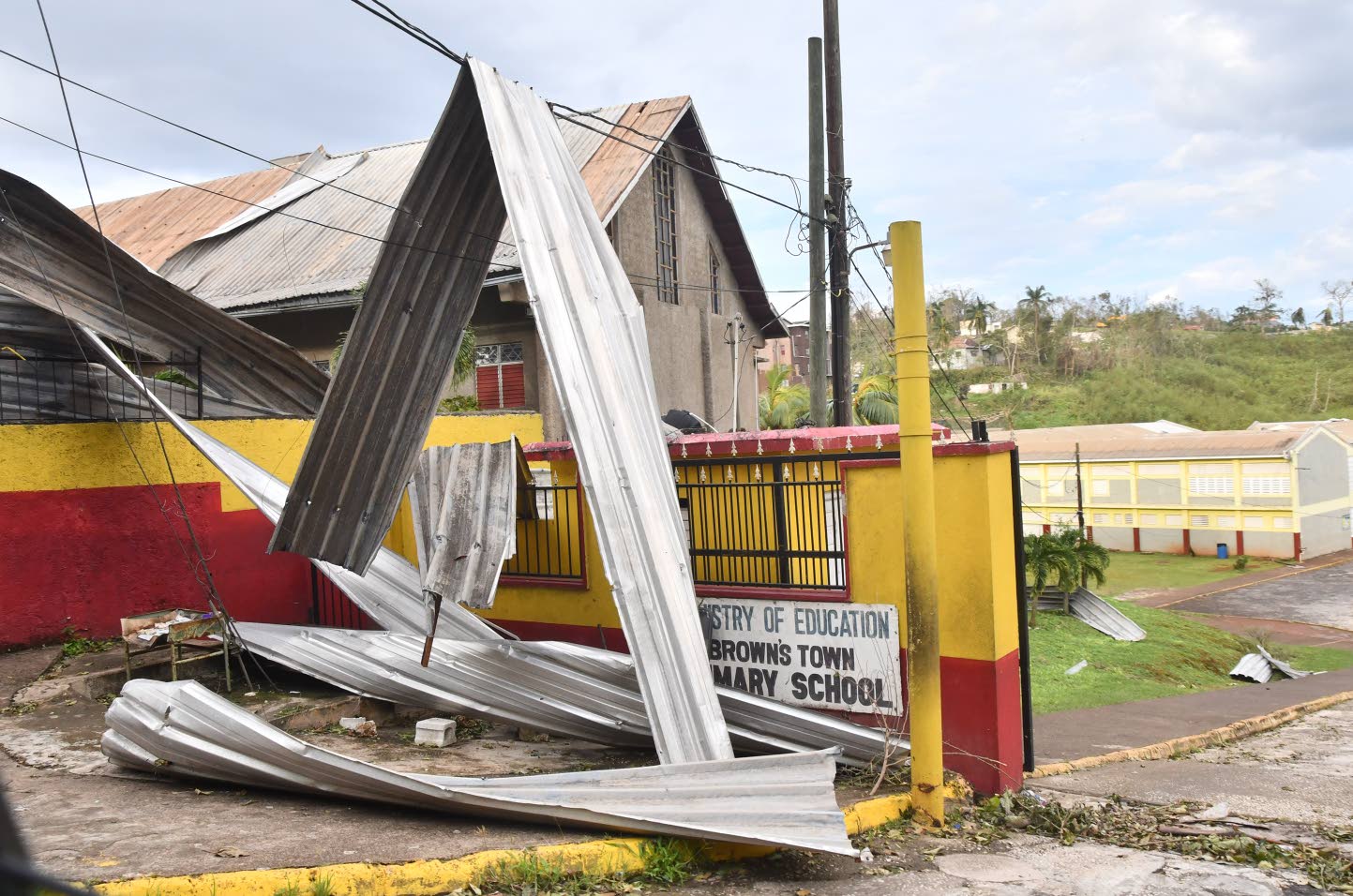
Sheets of zinc are seen at the entrance of Brown’s Town Primary School in St.Ann after a section of the roof was removed by Hurricane Mellisa. (Photo: Naphtali Junior)