Brace for a recession
PIOJ issues grim outlook as Hurricane Melissa set to uproot economic growth
Technocrats at the Planning Institute of Jamaica (PIOJ) yesterday signalled that the catastrophic fallout from Hurricane Melissa is likely to erode recent economic gains, increase unemployment, reduce gross domestic product (GDP) and potentially push the country into a recession in the coming quarters.
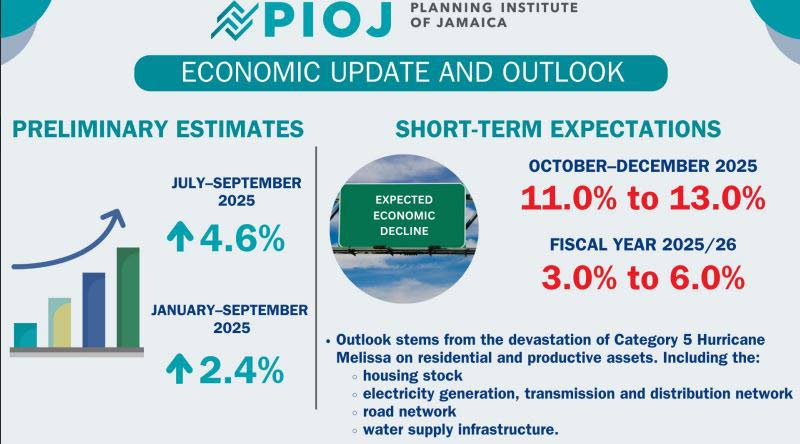
Given the widespread devastation caused by the Category 5 storm, which battered the island late last month, PIOJ Director General Dr Wayne Henry told the institute’s quarterly press briefing on Tuesday that the short- to medium-term economic outlook is now “generally negative”. He reported that the economy is projected to contract by 11-13 per cent in the current October-December quarter, with an overall decline of 3-6 per cent expected for fiscal year 2025/26.
“As we look at the impacts of Hurricane Melissa, it’s quite unlike anything we have ever seen before and as such, based on the projections outlined, the country should brace for a recession,” he said. A recession is generally defined as a sustained decline in economic activity, typically measured by two or more consecutive quarters of falling GDP. It is often accompanied by rising unemployment, reduced business investment, and lower consumer spending.
Late last year, following Hurricane Beryl’s onslaught, public discussion around a recession had surfaced. At the time, the PIOJ dismissed the concerns, noting that despite the economy contracting for two consecutive quarters (the July-Sept and Oct-Nov 2024 quarters), the broader indicators of recession — such as rising unemployment and macroeconomic instability — were not present. However, in the wake of Melissa’s severe destruction, the institute now accepts that a recession is a real possibility.
James Stewart, senior director in the Economic Planning and Research Division, supported the latest forecast by noting that the bleak outlook reflects expectations that economic growth will not return until about a year from now — assuming that ongoing rebuilding efforts begin to generate higher levels of output.
“For the next three to four quarters there is therefore an expectation for a downturn to take place, and as such the next growth quarter may not be until the October-December quarter of 2026…so at least three to four quarters of downturn is anticipated at this stage,” Stewart said.
Henry added that the projected contraction for the current quarter — expected to be the worst since the April-June 2020 period when the economic impacts of COVID-19 first took hold — will end some three consecutive quarters of growth following Hurricane Beryl, which struck as a Category 4 storm in early July 2024.
The devastation from Hurricane Melissa — historic in scale, with extreme winds and torrential rainfall — has severely damaged both residential and productive assets across the country.
The powerful storm left behind widespread destruction, particularly across western parishes, and billions in reconstruction costs, wiping out an estimated 41 per cent — nearly half — of the country’s GDP.
“The extent of the damage from Hurricane Melissa is unprecedented and far-reaching, affecting all industries. This is expected to result in increased unemployment, weakened demand and output,” he said while noting Agriculture, Tourism, Information and Communication and Construction among others being the industries to be most affected.
Agriculture is expected to suffer the harshest effects, as the seven most devastated parishes (Westmoreland, St Elizabeth, Hanover, St James, Trelawny, St Ann, and Manchester) account for roughly 74 per cent of the hectares used for domestic crop production, in addition to major livestock operations.
Similarly, the Accommodation and Food Service (tourism) industry, responsible for approximately 90 per cent of the island’s total hotel room stock, has been hit by temporary closures, reduced capacity and the continuation of a US Level 3 Travel Advisory issued in November 2025 — all of which are expected to significantly dampen visitor arrivals. Preliminary data for October already reflects an 18 per cent drop in total visitor arrivals.
Significant damage to electricity generation, distribution and transmission infrastructure as well as a halt in the spend on capital projects and a curtailing of land, maritime and airport services, are further expected to taper positive gains.
Henry cautioned that while the current projections are debilitating, they remain fluid and may change as new information becomes available. He likewise stressed that the depth and duration of the economic shock will depend heavily on how quickly major humanitarian and economic recovery initiatives are implemented.
“Recovery to pre-Hurricane Melissa output levels is conservatively projected to be within 3-5 years,” He said. “There was significant loss of productive assets which implies that an extended time is required to rebuild. Given that recovery from COVID took two years with productive assets in place, we anticipate that at least twice the time would be required for full recovery from Hurricane Melissa.”
He noted that the PIOJ, with support from international partners, expects to complete its full damage and loss assessment, currently underway, by mid-December.
The grim forecast comes despite a strong July-September quarter, during which heightened election-related spending, tourism activity and major sports events boosted national earnings and produced economic growth of 4.6 per cent.
The agriculture sector, rebounding from previous hydrological shocks including Hurricane Beryl, delivered an exceptional 23.9 per cent growth driven by higher crop yields, robust traditional crop exports and a resurgence in animal farming.
For the first nine months of 2025 (Jan-Sept), real GDP is estimated to have grown by 2.4 per cent, supported by increases of 5 per cent in the Goods Producing Industry and 1.6 per cent in the Services Industry.
“The most significant drivers of this performance were Agriculture, Forestry & Fishing, up 11.3 per cent; Accommodation & Food Service Activities, up 2.9 per cent and Construction, up 2.6 per cent,” Henry noted.