



NWA head blames single-occupant cars for Kingston’s traffic gridlock
CHIEF executive officer of the National Works Agency (NWA) EG Hunter has blamed Jamaica’s heavy reliance on single-occupant motor cars as one of the major drivers of Kingston’s chronic traffic congestion.
Speaking during Tuesday’s sitting of the Infrastructure and Physical Development Committee, Hunter argued that Kingston’s gridlock stems largely from a transport system built around private vehicles rather than mass transit.
He argued that no modern city moves its population around based on individual transport.
“There has to be some kind of mass transport — and that is as simple as that. We have a lot of cars in Jamaica carrying single persons. We are not a part of the Ministry of Transport so policy prescription, understandably, will come from that ministry but as someone who has interest in the sector, I think the whole issue of mass transit will have to be addressed,” Hunter said as he responded to a question from Member of Parliament (MP) for St Andrew East Central Dennis Gordon.
The first-term MP also questioned whether poor coordination among planning authorities was contributing to the worsening traffic situation.
“We are in a planning deficit, and as we seek to rebuild stronger and better the NWA should assume some responsibility for our traffic gridlock because you continue to sanction these multi-family homes without any attention to the road network. And so, as we go forward, is there any collaboration with the NWA, NEPA (National Environment and Planning Agency) and the municipalities as to how we redesign, plan and rebuild?” said Gordon.
But Hunter rejected the suggestion that the agency was culpable as he told the committee that, “Notwithstanding any recommendation made by the NWA, the local planning authority is reposed in the municipalities.”
He said the NWA supports efforts to improve coordination but pointed out that final approval powers do not rest with the agency.
Hunter also pushed back against the assumption that multi-family dwellings automatically translate into higher traffic volumes, describing the claim as an oversimplification.
“It is not unusual in urban centres worldwide for there to be multi-family dwellings, and so on. I mean, that’s a normal concept, that’s how cities grow and regenerate and so on. The issue is that concepts such as live and work…and a whole set of permutations that can be examined to accommodate the population and manage the transportation,” added Hunter.
The NWA head pointed to several major road projects now under way in what he said is an attempt to expand corridors that routinely choke during peak hours.
“We do have plans to expand a number of corridors under what we call the CAPEX (Capital Expenditure)Programme. We recently did Grange Lane in Portmore (St Catherine) and we’re now expanding the Hellshire and Braeton roadway (also in St Catherine), dualising that from two lanes to four lanes, and that is now under construction,” Hunter said.
“The next corridor that is slated for similar expansion is after we drive down to Tom Redcam all the way down to South Camp Road; that construction will start in the next financial year. And we also have the corridor from Barbican Road, East King’s [House] Road, Lady Musgrave Road to Trafalgar Road…and we’re also going to expand the bridge on Washington Boulevard — the one above the Sandy Gully — from two lanes, which is a constriction, to three lanes,” Hunter added.
However, he acknowledged that several planned upgrades intended to ease congestion at key entrances to Kingston have been delayed due to funding shifts earlier this year.
Hunter said that the agency had begun preliminary engineering works on projects for the Washington Boulevard corridor, the approach from Norman Manley International Airport into Kingston, and the Papine corridor, but he noted that “those sums were subsequently reallocated”.“If you examine our budget for this financial year, if you go back to the start of the financial year, you would have seen a provision that was originally made in the budget for some gully work as well as the expansion and beautification of a number of the entrances into the city.
He returned to the theme of excessive car dependency, pointing to the sharp drop in congestion during school holidays as evidence of how school-related trips overwhelm the road network.
”And, as I said before, I don’t know of any urban centre worldwide that has grown based on individual ownership of cars, driving to work, picking up kids. If you notice the reduction in traffic when schools are on holiday, you go up to a certain high school on Constant Spring Road for girls. I mean, there are 1,500 students and there are 1,500 cars so, I mean, there are some things that we have to face,” said Hunter.
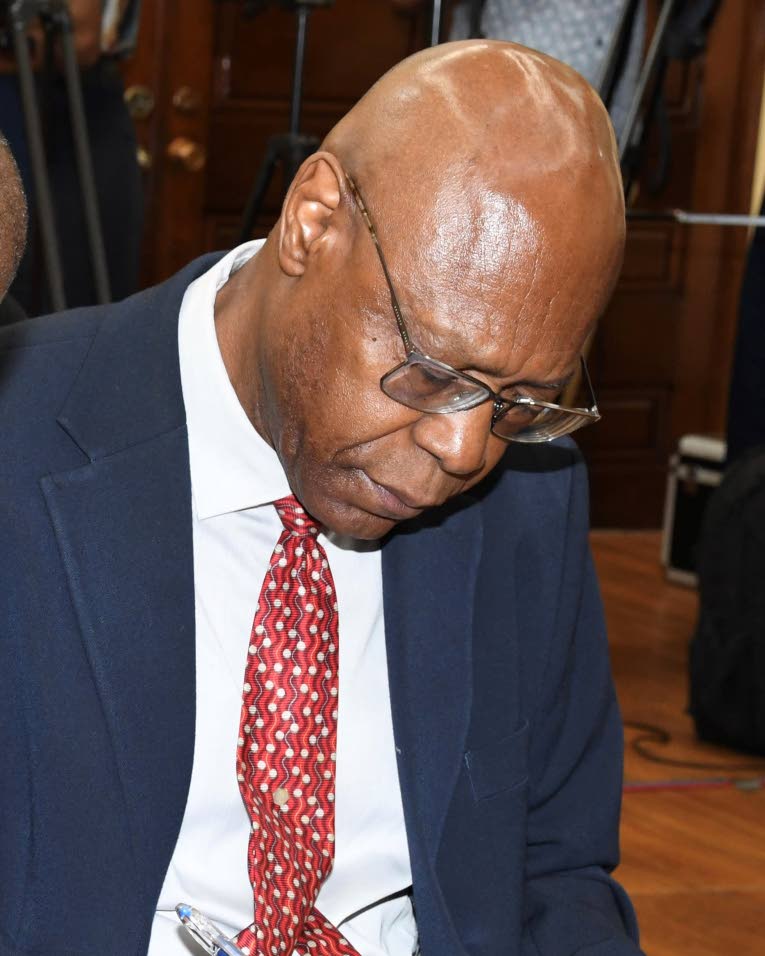
HUNTER…no modern city moves its population around based on individual transport.


