Edwin Allen High sets example with post-hurricane recovery effort
FRANKFIELD, Clarendon — True to its motto, Transeamus in Exemplum, which translates from Latin to ‘We shall be an example’, Edwin Allen High School in Clarendon has started its recovery from the effects of Hurricane Melissa with the intention of full resumption of classes early January.
“…[The] hope is in the Ministry of Education, not in Jesus this time. [The ministry did its] assessment, the engineers did come and are doing their design, so we are hoping that during the Christmas break they could get some work done [so] we can bring out all our students come January 5,” Principal Jermaine Harris told the Jamaica Observer on Monday.
The school has started repairing sections of its canteen and has covered damaged areas with tarpaulin. Additionally, a schedule to facilitate as many students each week has been implemented.
“The entire roof of the canteen and the storage area got damaged, but because we had to get the canteen back in operation we had to replace the roof with zinc and a part of it is tarpaulin as well,” Harris said during a tour of the school.
He said the school has been supported by its alumni which donated a Starlink satellite Internet unit for the benefit of students, primarily those sitting external exams.
A major computer lab used by those students was severely affected during the storm.
“All the computers were damaged; the smartboard and all the contents within the room, [including] the AC unit, got damaged. [We] have relocated this lab temporarily to the library because those students will be sitting CSEC (Caribbean Secondary Education Certificate) information technology,” said Harris.
“In order to give them the opportunity to do their [school-based assessments and internal assessments] we have to now relocate them to another space. We have to be using Starlink… thanks to past students who purchased the package for us, and we will be paying the subscription fee monthly — so that is one of the good things that came out of this experience,” the principal added.
He said the school’s infrastructure was weakened even before the Category 5 hurricane, due to another major hazard in the form of termite infestation.
“The timber lost its strength… We have recommended to the ministry to use the metal raft instead of the lumber,” he said in reference to rebuilding.
Although optimistic that the ministry will pull through in time for January, he supports the rebuilding in a sustainable way.
“So rather than using timber and zinc they are seeing where some of these spaces can be slabbed, use concrete roof, or they use metal raft and then screw the zinc onto the mental frame,” he said.
“As a school we can’t do anything as it relates to the structure [but] what we can do is temporary roof — as in the tarpaulin — or replace some of the zinc, and then we have classes,” he added.
In total, nine classrooms and offices were damaged during the passing of the storm
“So dealing with the aftermath of Hurricane Melissa has been a very difficult time for us as a school, however, as part of crisis leadership I have to rally the troops. And we have been doing fairly well in terms of having some makeshift roofs, and we were able to get all our students [in] our face-to-face [classes], albeit on a rational basis,” said Harris.
With a register of approximately 2,000 students, accommodating everyone is a difficult task.
“This is the largest high school in Clarendon and one of the largest in Jamaica, so managing the numbers has not been easy but, again, we are being creative and we are getting support from the ministry and past students as well as the community members. Because of the partnership that we have we were able to get back students [in classes] for [the] past three weeks,” said Harris.
“…Monday to Wednesday we have grades 7, 8, 11, 12 and 13 and then Thursday, Friday we bring in grade 9, and then we ask grades 7 to 8 to stay home. The constant grades are grades 10, 11, and 13 — those are our external exams and senior students, so we have them for five days,” he added.
The school has also provided continuous psychosocial support for its students, particularly those whose families were severely affected by the storm in western Jamaica.
“We have been doing that on a daily basis for those kids. Most of them belong to [the] track and field programme, and they live in a dorm at school, so when we heard about the impending hurricane we had to send them home, based on our protocol. We sent them home not knowing that landfall would have been made in the west,” said Harris.
“When we heard about their displacement we decided right away to bus them back to school so we got a standby generator, we got Starlink, and we were able now to get them back and resume training shortly after. So those [students] from the west, they are all back when we continue to provide the psychosocial support,” he said.
The remaining students who live in surrounding areas are not being left out.
“The other children who were affected who live close to school — some in Clarendon, some in Manchester — when they resume face-to-face classes we [will] have psychosocial sessions from the ministry [and our] internal guidance counsel [ling] team,” said Harris.
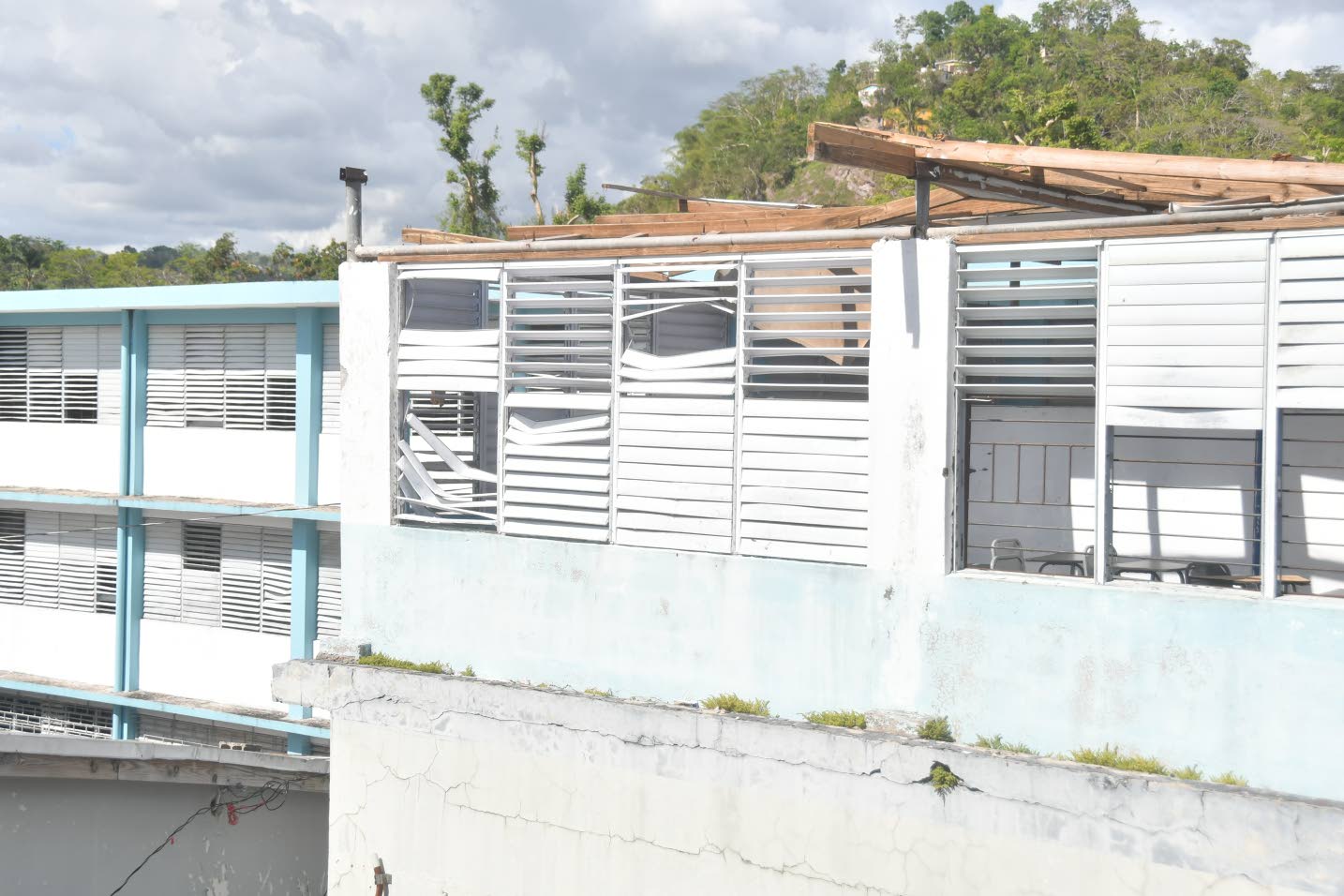
Damaged classrooms at Edwin Allen High School in Clarendon
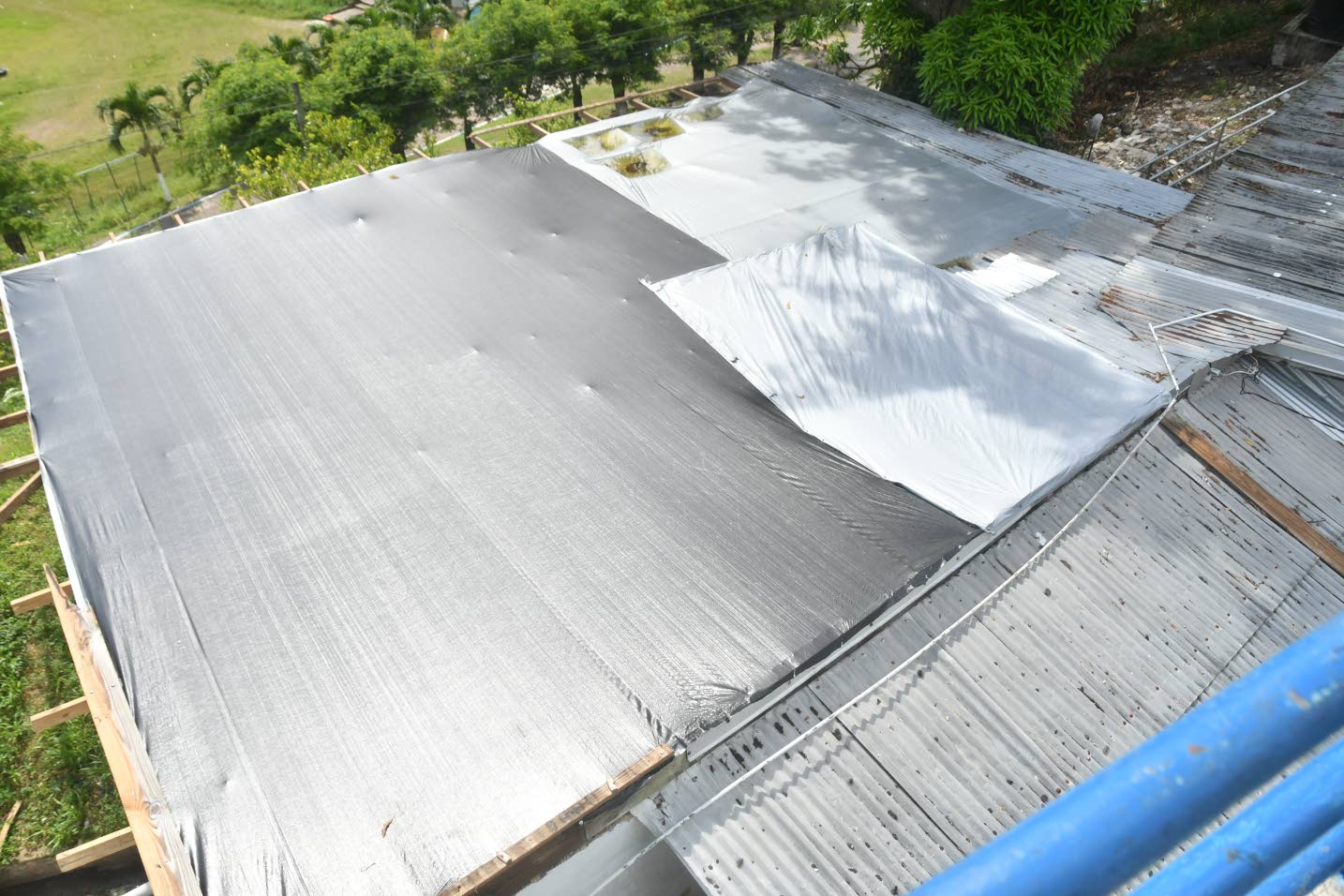
A section of the canteen and guidance counselling offices covered by zinc and tarpaulin at Edwin Allen High School in Clarendon on Monday