



‘We don’t have the capacity’
OUR admits it lacks manpower to verify utility companies’ recovery claims
THE Office of Utilities Regulation (OUR) has admitted that it lacks the manpower to independently verify utility companies’ post-Melissa restoration claims, raising fresh concerns about the accuracy of self-reported data.
At Wednesday’s sitting of the Public Administration and Appropriations Committee, members pressed the regulatory body on why Parliament continues to rely almost entirely on restoration figures submitted by Flow, Digicel, National Water Commission (NWC), and the Jamaica Public Service (JPS), despite mounting complaints from several communities still without service.
Member of Parliament (MP) for St James Southern Nekeisha Burchell questioned how the OUR could effectively assess national recovery efforts by the utility providers if it is unable to verify what companies report.
She asked bluntly whether the regulator was doing more than accepting the utilities’ numbers at face value.
“Data coming from self-reporting is helpful and, as you know, can sound as good as you want them to sound if you’re self-reporting, but for you as the regulatory authority, what are you doing, whether with ODPEM’s (Office of Disaster Preparedness and Emergency Management) assistance or JDF’s (Jamaica Defence Force) assistance to ensure that the data coming to us really matches the reality on the ground? And I’m not talking about radar and satellite data because that doesn’t help really in rural constituencies. How are you getting in there to ensure that these are true figures?” she asked.
In response, OUR Director General Ansord Hewitt admitted that the regulator simply does not have the staffing required to conduct thorough checks.
Hewitt explained that while the OUR conducts occasional spot checks and posts the companies’ reported information online for public scrutiny, these methods are limited.
“We don’t have the capacity to actually do, you know, a universal check on this and this information but, what we do as well is that we also check the information that comes to us and indeed, we have had occasions where we have had to question, well, is this really correct? You need to take another look at these figures because they don’t, it does not match up with, for example, what you reported last week. So we’re going through that kind of quality check as well,” he said.
However, Burchell argued that such quality checks fall far short of the independent verification needed during a national disaster response.
She pressed further, asking whether the OUR had sought any assistance from the Office of the Prime Minister or ODPEM to secure additional staff or technological resources capable of validating companies’ reports.
Hewitt conceded that the suggestion had not been raised with the authorities but said the regulatory body would consider it.
Manchester North Western MP Mikael Phillips, meanwhile, questioned how the regulator could have declared recovery efforts credible after Hurricane Beryl last year when it now admits it cannot conduct real-time audits, while challenging the regulator’s confidence in the data being submitted.
“…So your answer was that you didn’t have the capacity to do your own audit, right? But after Beryl, how is it then that you were able to then say that what they were telling you is so, and that everything was in place…? How did you know that what they were giving was so?…And the reason why I ask about the audit is because how is it then that you said that you get accurate information, but how do you know that it is accurate information if you yourself don’t have information yourself independent of what they are giving to verify that what they are saying is so?” Phillips queried.
In reply, Hewitt clarified that while the OUR can appoint auditors after the fact, it lacks the manpower to conduct live, on-the-ground assessments during a disaster response.
“We do in fact have the ability to appoint auditors and to conduct audits ourselves, but those are like post-restoration activities which is something that we considered after Beryl for example, so we looked to see whether or not we really needed to do that kind of audit… So we do have the capacity to do post-event audits, it’s the question of doing it in real time that I was seeking to address,” he said.
St Andrew East Rural MP Juliet Holness also raised concerns about the lack of clear, community-level information during restoration efforts. She recalled that even the only detailed schedule she received after Beryl turned out to be a fabricated document.
She urged the OUR to adopt a more co-ordinated, long-term approach that involves community representatives, parish councils and political leaders — many of whom are on the ground and have more direct knowledge of affected areas.
“We would really need OUR to take a look at some sort of long-term approach to when we have emergency situations in the way that JPS has a community group that they have set up with themselves and the parish council that it goes a little deeper, and we have representatives from almost every community who would be able to see what is happening and it could act as a mechanism in your own audit of the information you’re getting re: Flow, re: JPS, re: Water Commission, from various communities across different constituencies,” she told the regulatory body.
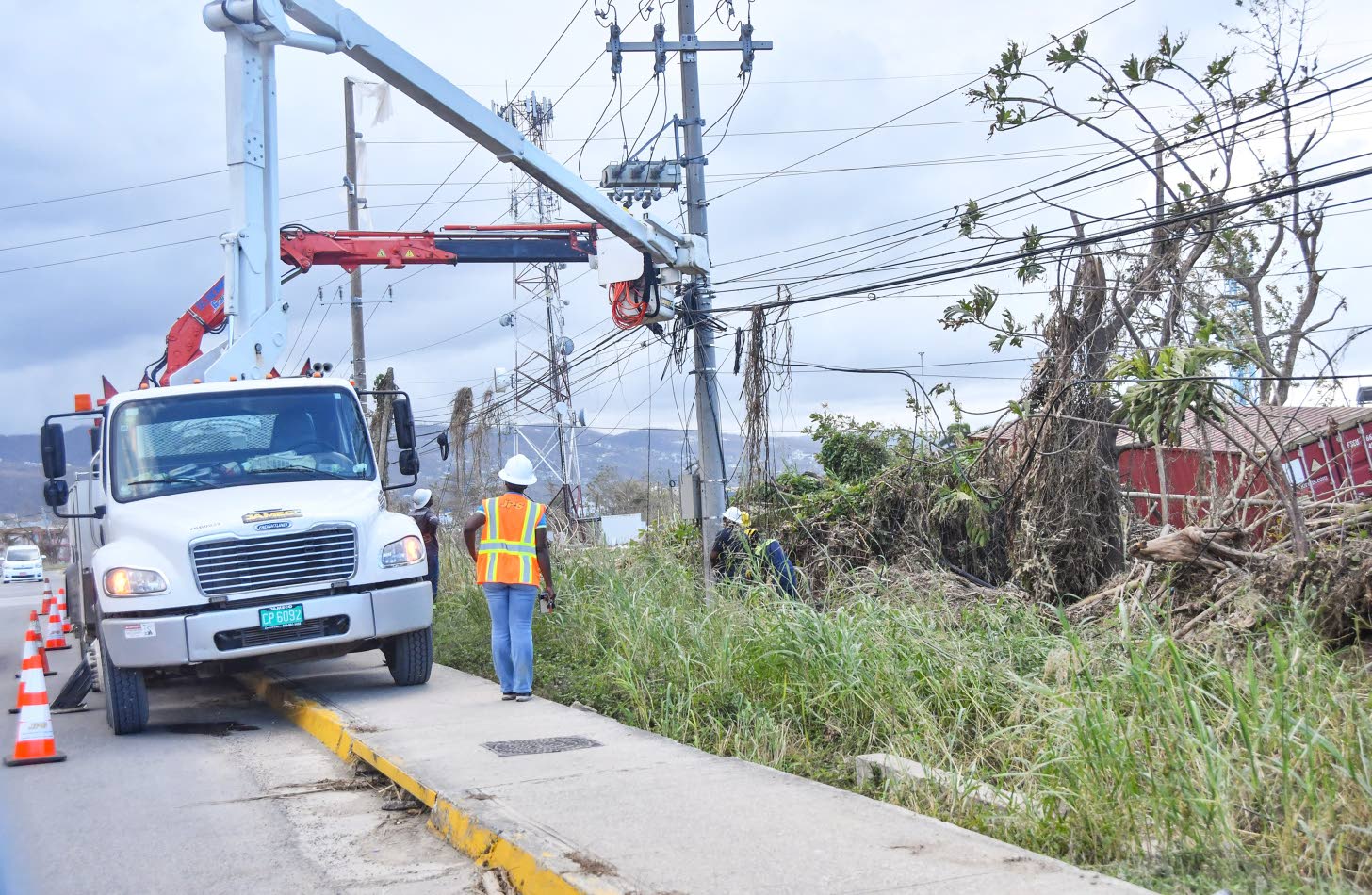
JPS workers doing restoration work in Montego Bay, after the passage of Hurricane Melissa (Photo: Naphtali Junior)


